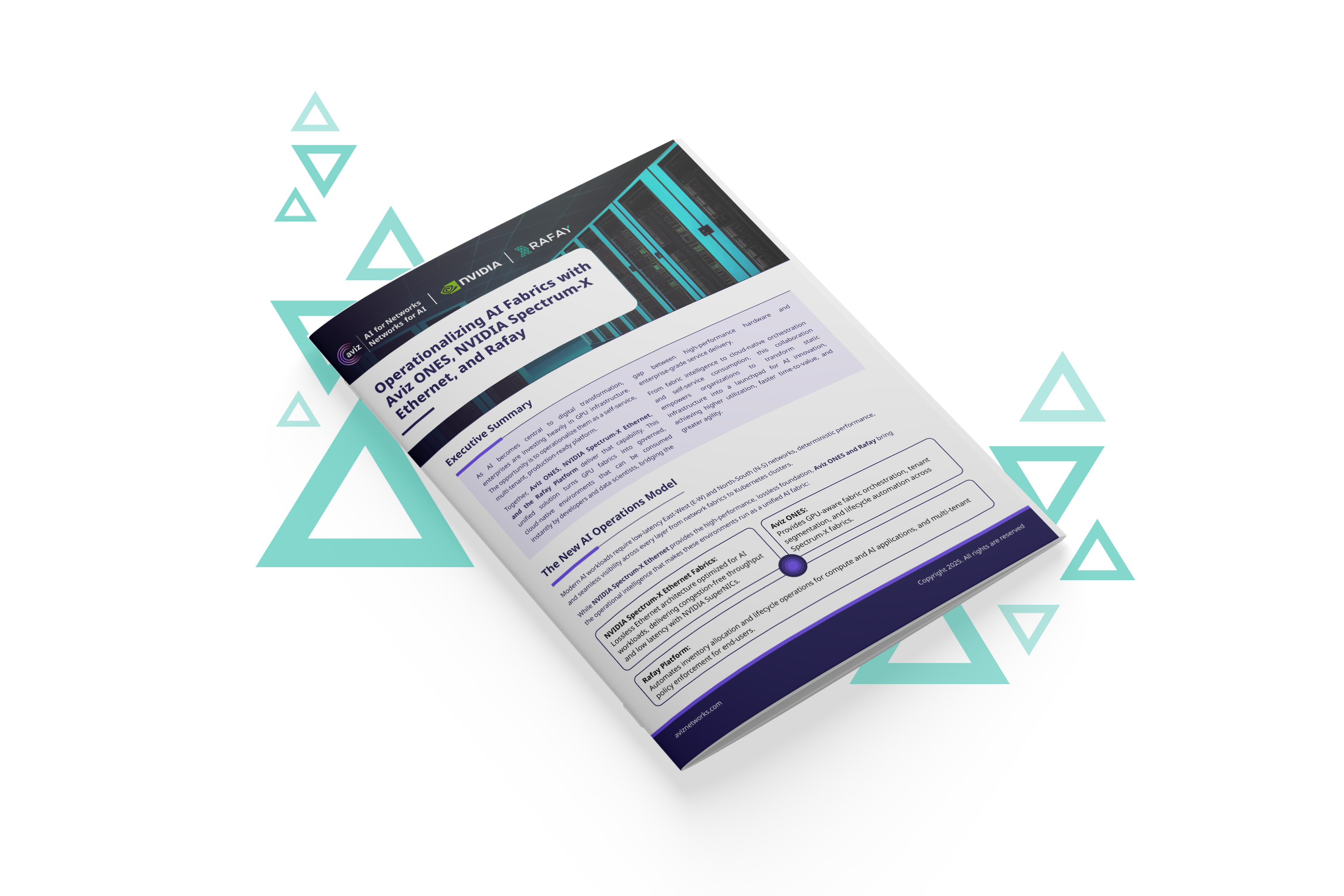
Operationalizing AI Fabrics with Aviz ONES, NVIDIA Spectrum-X, and Rafay
Discover the new AI operations model available to enterprises that enables self-service consumption and cloud-native orchestration for developers.

Rafay-powered SLURM as a Service delivers fully managed, multi-tenant SLURM environments for high-performance computing workloads as a cloud-like, on-demand service. Through automated, BCM-based bring-up of the underlying Kubernetes cluster, with secure per-tenant separation and governance built in, tenants request a Slurm cluster, and Rafay provisions, schedules, and governs it as an isolated namespace on that shared infrastructure.

Slurm as a Service delivers the Slurm workload manager through a fully managed, on-demand platform. Instead of manually deploying and maintaining HPC clusters, organizations can provision per-tenant Slurm clusters, submit jobs to managed queues, and allocate compute resources through self-service, while the platform automates both the underlying Kubernetes cluster's provisioning and the Slurm environment's scheduling, governance, and lifecycle management.
Rafay automates bring-up of the underlying Kubernetes cluster and layers Slurm on top via the open-source Slinky Slurm Operator, enabling providers and enterprises to deliver HPC resources as scalable, self-service Slurm clusters.
Familiar HPC scheduling, delivered as a governed, on-demand service.

Automated BCM-based bring-up removes manual management of the underlying Kubernetes cluster.

Once a tenant's Slurm cluster is running on its namespace, login access lets users submit jobs immediately via familiar sbatch/srun commands.

Multiple tenants or teams with full isolation and operational control.

Provisioning, scaling, and teardown are handled automatically.
Rafay simplifies the deployment and operation of Slurm clusters through self-service provisioning, multi-tenant governance, automated lifecycle management, and built-in usage metering. Organizations can deliver secure, production-ready HPC environments, support both HPC and AI workloads, and transform shared infrastructure into scalable, self-service services with less operational overhead.
With Rafay, you can:
Why not build it yourself? Deploying and managing Slurm at scale involves much more than installing a scheduler. Teams must provision clusters, manage users, enforce governance, monitor resource utilization, automate lifecycle operations, and maintain secure multi-tenant environments. Rafay brings these capabilities together in a single platform, enabling organizations to deliver Slurm as a self-service while reducing operational complexity.


.svg)

Provision fully managed Slurm clusters on demand through a self-service portal or API.
Automate cluster provisioning, scaling, lifecycle management, and governance to eliminate manual administration.
Run HPC and AI workloads on shared CPU and GPU infrastructure to improve resource efficiency.
Deliver isolated, multi-tenant Slurm environments with centralized governance and policy controls.
Turn HPC infrastructure into a managed, consumption-based service with built-in usage metering and chargeback.
Deliver production-ready HPC environments that support research, engineering, and AI workloads from a single platform.
Whether you're delivering HPC services to customers or supporting internal research and engineering teams, Rafay helps simplify HPC operations while maximizing infrastructure utilization.
Find answers to common questions about our SLURM as a service offering below.
Slurm (Simple Linux Utility for Resource Management) is an open-source workload manager used to schedule and manage compute-intensive workloads across high-performance computing (HPC) clusters. It allows users to submit jobs, request compute resources, join queues, and run workloads across CPUs, GPUs, and other infrastructure.
Originally designed for HPC environments, Slurm is widely used in research, engineering, scientific computing, and AI/ML workloads where teams need efficient resource allocation, scheduling, and cluster management.
Slurm as a Service enables cloud providers, neoclouds, research organizations, and enterprises to offer managed HPC and GPU compute environments without building and operating the entire platform themselves.
Common users include:
Managing Slurm independently requires significant expertise to deploy, configure, secure, scale, and maintain HPC clusters. Rafay automates bring-up of the underlying Kubernetes cluster and simplifies delivery of per-tenant Slurm clusters on top of it, enabling self-service access and enterprise-grade governance.
Yes. Multiple tenants share the same underlying Kubernetes cluster, with each tenant's Slurm cluster isolated in its own namespace — giving Rafay the isolation, governance, and access controls needed to securely serve multiple teams, customers, or business units.
Yes. Through the open-source Slinky Slurm Operator, Slurm's scheduler runs on top of the same Kubernetes cluster that Rafay provisions, so Slurm-based HPC jobs and native Kubernetes workloads share the same underlying infrastructure rather than running as separate stacks.
Slurm is commonly used for batch-oriented HPC workloads, including large-scale simulations, scientific computing, and AI training jobs. Kubernetes is often used for containerized applications, AI inference, and cloud-native services.
Using both enables organizations to support a broader range of workloads while maximizing GPU utilization across their infrastructure.
Yes. Rafay supports GPU workloads by helping organizations orchestrate, manage, and deliver GPU infrastructure for AI, machine learning, and HPC use cases.
Yes. Slurm can be deployed in sovereign, private cloud, and air-gapped environments where organizations need greater control over infrastructure, data, and security. Rafay supports deployment across a range of environments, including private data centers, sovereign cloud environments, and air-gapped networks. This helps organizations deliver HPC and AI compute while meeting strict security, compliance, and data residency requirements.
Rafay enables usage tracking and resource metering to support billing and chargeback models for Slurm-based compute services. Organizations can track resource consumption such as GPU and CPU usage, compute time, and user or tenant consumption. Cloud providers can use this data to create customer billing models, while enterprises can allocate infrastructure costs across teams, projects, or departments.
Talk with Rafay experts to assess your infrastructure, explore your use cases, and see how teams like yours operationalize AI/ML and cloud-native initiatives with self-service and governance built in.









.png)