From GPUs to Revenue: A Practical Guide to AI Factory Builds
This white paper breaks down what it actually takes to turn GPU investments into measurable business outcomes.

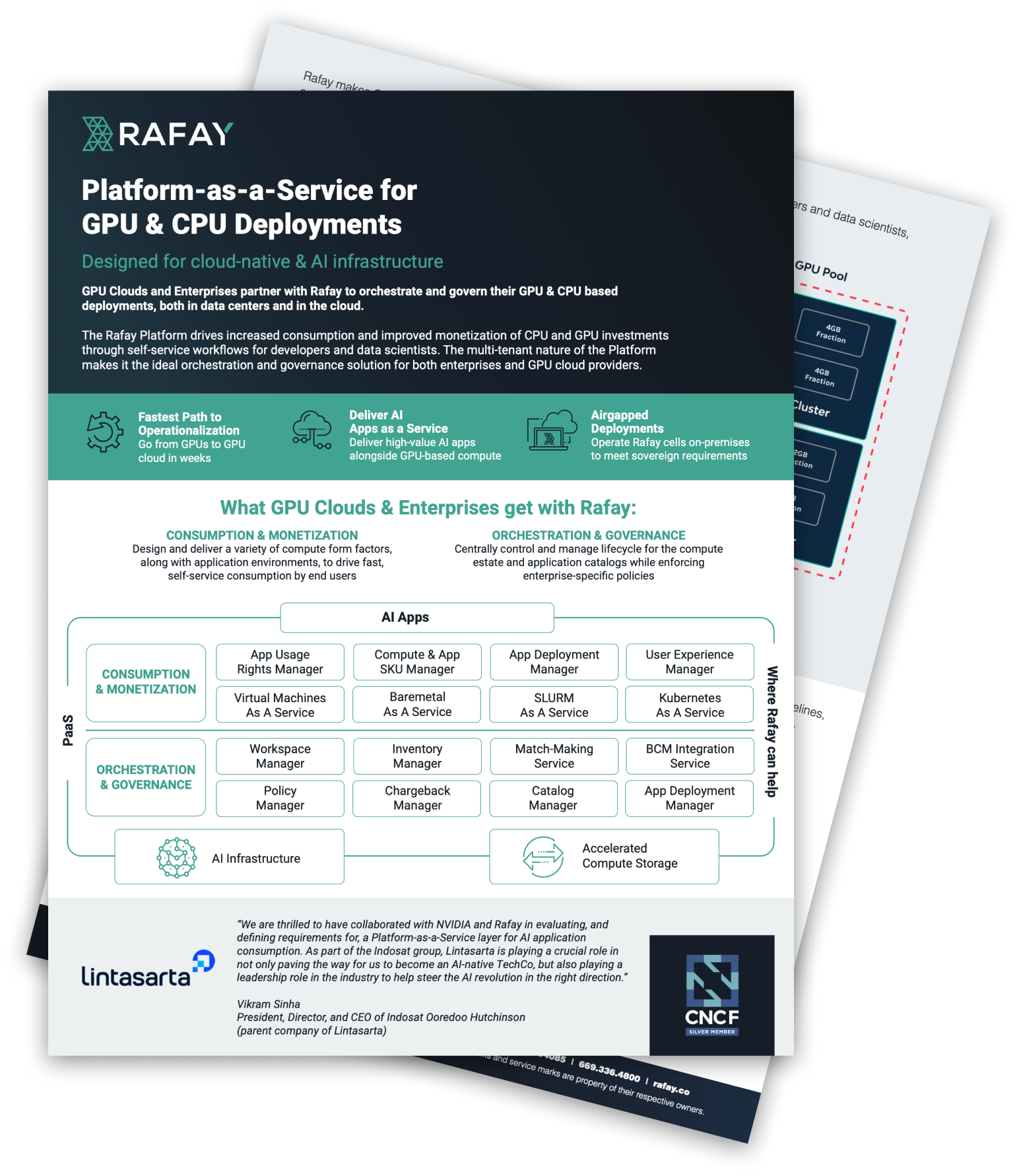
GPU infrastructure is a major investment, and without the right orchestration and workflow automation in place, those resources remain underutilized or are delivered to the market at low price points. The sure-fire way to drive higher margins is to deliver self-service consumption experiences to developers while enforcing enterprise-grade controls and strong multi-tenancy.
The Rafay Platform empowers neoclouds, Sovereign AI Clouds, Telcos, and cloud service providers (CSPs) to offer premium services that meet the highest enterprise expectations for governance and control, while delivering self-service consumption to their enterprise users. With Rafay, CSPs achieve higher revenues, higher margins, and higher infrastructure utilization.

GPU-as-a-Service (GPUaaS) is a cloud delivery model that allows organizations to consume GPU resources on demand rather than purchasing and managing dedicated hardware. Instead of manually provisioning GPU infrastructure, organizations can provide GPU-powered environments through self-service with automation, governance, and usage controls.
AI service providers use GPUaaS to deliver scalable GPU capacity, AI development environments, inference services, and managed AI platforms through self-service portals that simplify resource access while maintaining operational control.
Rafay helps cloud providers, telcos, neoclouds, and sovereign AI clouds transform GPU infrastructure into consumable services. The platform enables self-service GPUaaS delivery with built-in governance, multi-tenancy, automation, and usage visibility, helping providers improve infrastructure utilization and accelerate time to revenue.
Building an enterprise GPU-as-a-Service offering requires more than GPU hardware. Providers need capabilities that enable secure, self-service GPU consumption at scale, including the following.
Together, these capabilities enable providers to deliver GPU resources as secure, scalable, and self-service services that are ready for enterprise AI workloads.
Securely isolate customers, business units, or teams while enabling shared use of GPU infrastructure.
Apply policies for provisioning, lifecycle management, and compliance to ensure resources are used consistently and responsibly.
Track GPU consumption to support customer billing, internal chargeback, or showback reporting.
Provide a catalog where users can provision approved GPU-powered environments and AI services on demand.
Integrate with enterprise identity providers to enable role-based access control and centralized authentication.
Protect workloads with tenant isolation, policy enforcement, and secure access to GPU resources.
Prevent resource contention by controlling GPU allocation, capacity limits, and consumption across tenants.
Ensure workloads remain independent to improve security, performance, and reliability in shared environments.
GPU-as-a-Service provides the foundation for a broader portfolio of AI and compute services. By packaging infrastructure into self-service offerings, providers can increase GPU utilization while creating new revenue opportunities.With the Rafay Platform, cloud providers, neoclouds, telcos, and sovereign AI clouds can package GPU infrastructure into ready-to-consume services, including:


.png)








The Rafay Platform gives enterprises the capabilities needed to launch, operate, and grow enterprise GPU-as-a-Service offerings, enabling them to:

Launch revenue-ready AI/ML environments with built-in SKU management, billing, and consumption metering so every GPU hour turns into billable services faster.
Offer a fully integrated, white-labeled portfolio of AI/ML and GenAI tools (Jupyter, Ray, Kubeflow, Slurm) that attracts developers and retains enterprise customers.
Deliver secure, sovereign-ready deployments that meet compliance requirements for regulated industries, expanding your addressable market.
Go beyond GPU capacity by offering AI models, developer workspaces, NVIDIA Blueprints, and packaged AI applications through a self-service marketplace.
Reduce engineering overhead with multi-tenant automation and operational efficiency, freeing your teams to focus on growth while cutting costs.
Find answers to common questions about our GPUaaS services below.
GPU-as-a-Service delivers GPU resources through a self-service platform, allowing users to provision GPU-powered environments on demand. Providers manage provisioning, governance, security, and usage, while users consume GPU resources without managing the underlying infrastructure.
GPU-as-a-Service is used by cloud providers, neoclouds, enterprises, AI platform teams, and research organizations that need scalable, on-demand GPU resources for AI development, training, inference, and high-performance computing.
GPU-as-a-Service helps organizations improve GPU utilization, scale resources on demand, reduce infrastructure costs, and accelerate AI development by providing fast, self-service access to GPU capacity.
Yes. The Rafay Platform supports three GPU sharing modes that operators can offer to tenants in self-service: full passthrough (one physical GPU per workload, optimal for large training runs), NVIDIA MIG (Multi-Instance GPU) partitioning (up to seven isolated MIG instances per A100 or H100, each with dedicated memory and compute), and time-slicing (multiple workloads sharing a GPU in time-multiplexed fashion, suited for lower-intensity inference or development workloads). Operators configure which sharing modes are available per SKU through PaaS Studio; tenants select the appropriate GPU size from the catalog without needing to understand the underlying partitioning mechanism. Security and compute isolation between MIG instances is enforced at the NVIDIA hardware level; chargeback data is collected per MIG instance or per time-slice allocation for granular cost attribution across tenants and business units.
Yes. The Rafay Platform has always supported CPU-based workloads and can easily deliver a PaaS experience that offers CPU+GPU instances to end users.
Rafay offers a comprehensive solution for chargebacks and billing. The platform collects granular chargeback information on resource usage, which can be easily exported to customers’ existing billing systems for further processing and distribution. Rafay allows for customizable chargeback group definitions to align with organizational structures or projects. Both group definition and data collection can be carried out programmatically, enabling efficient and accurate billing processes.
Yes. GPUaaS can be deployed in sovereign, private, and fully air-gapped environments to meet data residency, security, and regulatory requirements while providing controlled access to GPU resources.
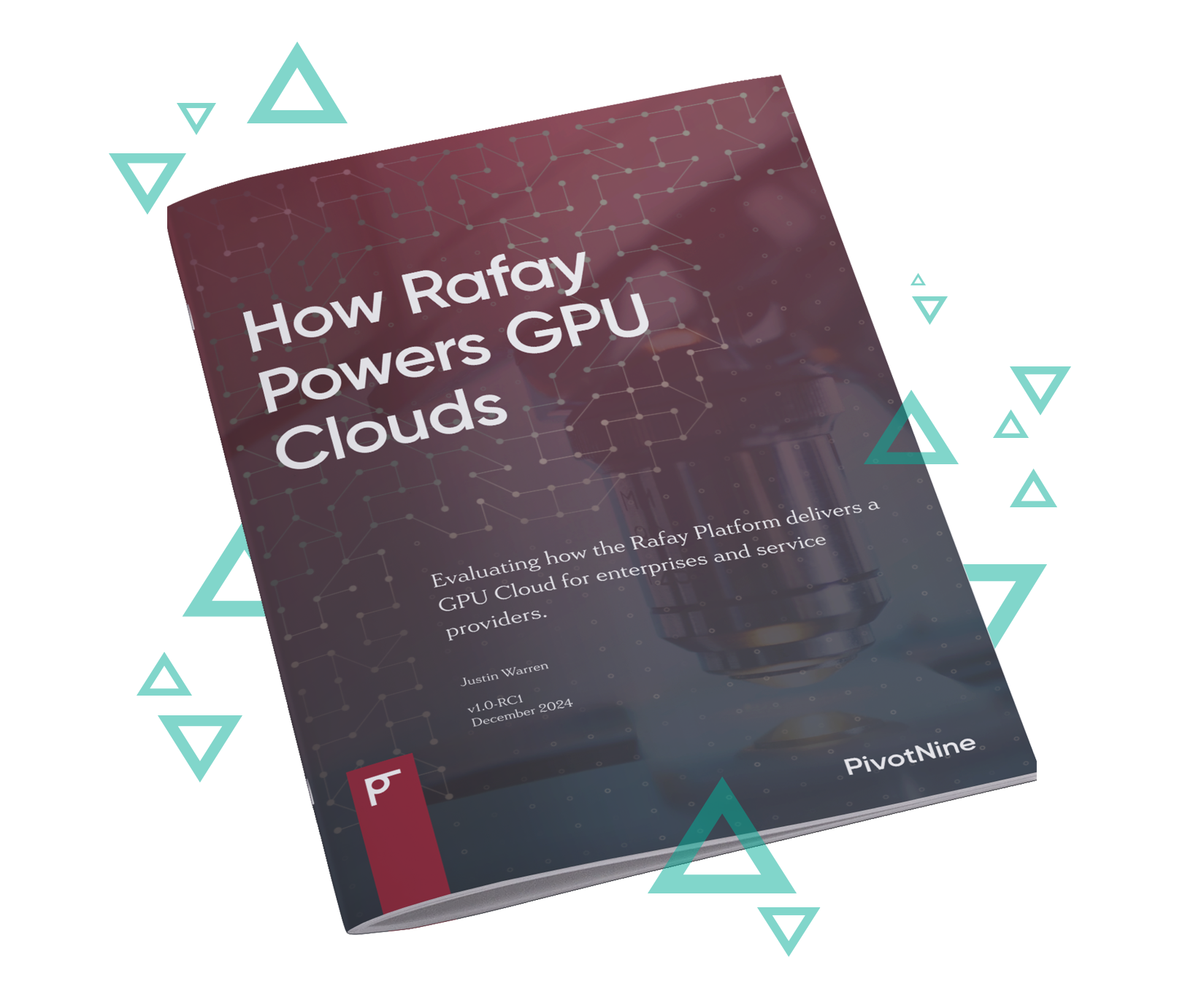
Evaluating how the Rafay Platform delivers a GPU cloud for enterprises and cloud service providers by PivotNine.










.png)