GPU Cloud Services for AI Infrastructure
A GPU cloud platform enables organizations to transform GPU infrastructure into self-service, multi-tenant services that developers, data scientists, and AI teams can consume on demand. Instead of manually provisioning GPU clusters, platform teams expose GPU resources through governed service catalogs with built-in policies, quotas, usage tracking, and chargeback.
The Rafay Platform transforms GPU infrastructure into a secure, multi-tenant, revenue-ready cloud. Cloud providers, neoclouds, and Sovereign AI clouds that partner with Rafay are delivering CSP-grade use cases to their user communities. Learn how Rafay helps power the most innovative GPU providers in the world.
What is a GPU Cloud Platform?
A Graphics Processing Unit cloud platform is software that enables organizations to turn GPU infrastructure into self-service, governed cloud services. Rather than manually provisioning GPU clusters for every workload, platform teams can package GPUs, AI applications, and development environments into standardized services that developers and data scientists consume on demand. Built-in governance, multi-tenancy, usage tracking, and policy controls help organizations improve GPU utilization while maintaining operational control.
Why Organizations Build GPU Clouds
More organizations are building GPU clouds to make expensive AI infrastructure easier to consume, govern, and scale. With GPU demand outpacing supply, manual provisioning often leaves costly hardware underutilized and developers waiting for access.
GPU cloud service providers offer automated provisioning, self-service access, and centralized governance to make GPU utilization seamless and cost-effective. It simplifies governance with policy enforcement, multi-tenant isolation, quotas, and usage tracking, enabling platform teams to scale AI infrastructure without sacrificing control.
For enterprises, this means faster AI development with greater operational control. For cloud providers, neoclouds, and sovereign AI clouds, it also creates opportunities to package GPU resources, AI applications, and model APIs into monetizable GPU-as-a-Service and AI service offerings.
.svg)
Key Capabilities of a GPU Cloud Platform
- Self-service provisioning Self-service provisioning: Give developers and data scientists on-demand access to GPU-powered environments through portals or APIs.
- Multi-tenant governance Multi-tenant governance: Isolate teams and customers with RBAC, quotas, policy enforcement, and audit controls.
- Flexible GPU allocation: Support dedicated, shared, and fractional GPU allocation to maximize utilization.
- Service catalogs and SKUs: Package GPU infrastructure, AI applications, and development environments into standardized services.
- Usage metering Usage metering and chargeback: Track resource consumption for cost visibility, internal chargeback, or customer billing.
- Policy-driven automation: Standardize provisioning, security, and lifecycle management across every deployment.
- Hybrid and multi-cloud deployment: Deliver a consistent operating model across private data centers, public clouds, and sovereign AI environments.
Common Use Cases of GPUs
Organizations use GPU cloud platforms to support a wide range of AI and high-performance computing workloads, including:
AI Model Training
Provision GPU clusters for training foundation models, fine-tuning LLMs, and distributed machine learning.
Inference and AI services
Deliver inference APIs, Retrieval-Augmented Generation (RAG) applications, and Model-as-a-Service offerings through governed self-service environments.
Developer workspaces
Provide AI engineers and data scientists with on-demand notebooks, Kubernetes clusters, and GPU-enabled development environments.
High-performance computing (HPC)
Support simulation, financial modeling, life sciences, and scientific research with scalable GPU infrastructure.
Media and Visualization
Accelerate rendering, video transcoding, and graphics-intensive workloads.
GPU Cloud Platform vs DIY GPU Infrastructure
As AI infrastructure grows, manually managing GPU resources with scripts and ticket-based workflows becomes increasingly difficult. Whereas a GPU cloud platform provides a standardized operating model that improves scalability, governance, and developer productivity. Here's a closer look at how they compare:
Manual provisioning through tickets and scripts
Self-service provisioning through portals and APIs
Inconsistent governance across teams and environments
Centralized governance with policies, RBAC, and quotas
Underutilized GPU resources
Optimized GPU allocation and higher utilization
One-off environment configurations
Standardized service catalogs and reusable SKUs
Limited visibility into GPU consumption
Built-in usage metering, reporting, and chargeback
Difficult to support multiple tenants securely
Multi-tenant isolation for teams and customers
Significant operational overhead for platform teams
Automated provisioning and lifecycle management
Primarily delivers raw GPU access
Delivers GPU-as-a-Service and AI services
Deliver a full-service GPU cloud in days

Assemble Inventory
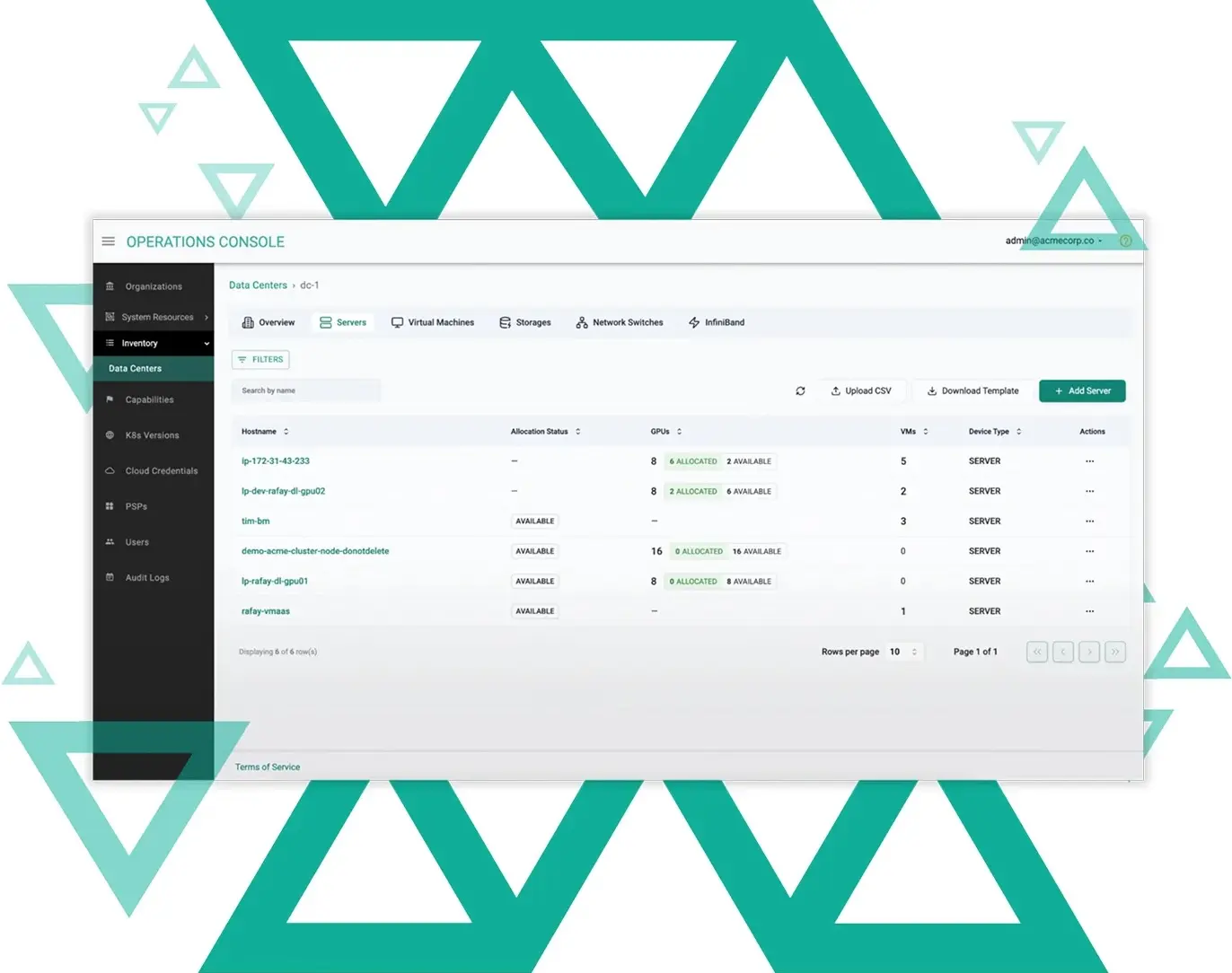
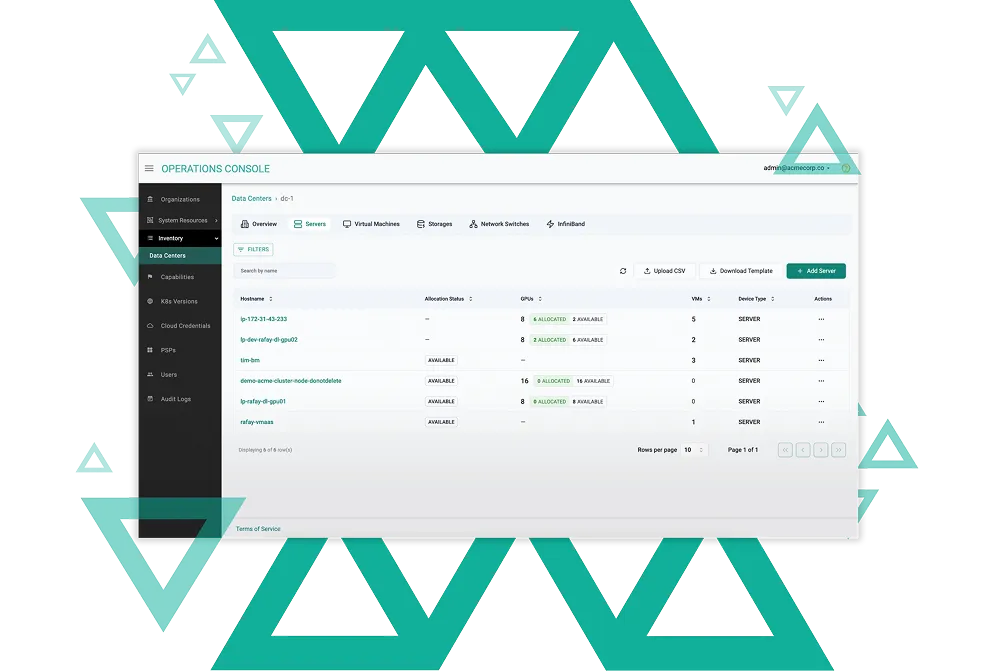
Onboard GPU and CPU resources from data centers, public clouds, or colocation into a single control plane. Standardize and unify infrastructure for easier governance.
Select Service Offerings
Create standardized compute and application packages such as training, inference, or RAG workloads, complete with networking, storage, and policy enforcement.
Choose Allocation Models
Maximize GPU utilization with dedicated, shared, or fractional GPU allocation. Rafay ensures the right workload lands on the right compute at the right time.

Deliver Self-Service Experiences
Expose services through APIs or branded portals. Enable developers and data scientists to instantly access GPU-backed environments while maintaining governance and control.
Assemble Inventory
Centralize and standardize GPU resources across clouds and on-prem—including AWS, GCP, private data centers, or colocation. Rafay provides a single control plane to onboard and register hardware and virtualized infrastructure into a unified inventory.
Select Service Offerings
Define the GPU-backed services your developers and data scientists will consume. Offer standardized configurations for training, inference, or hybrid workloads—complete with networking, storage, and security baked in.
Select Allocation Strategy
Choose from a range of allocation models—dedicated, shared, or burstable—to maximize GPU utilization and cost efficiency. Rafay's policy engine ensures the right workloads get the right compute, when and where it's needed.
Deliver Experiences
Publish ready-to-consume services to internal users via APIs or self-service portals. Empower developers to instantly spin up GPU workspaces while maintaining platform control, governance, and visibility.
Turn GPU Infrastructure into a Revenue-Ready AI Cloud
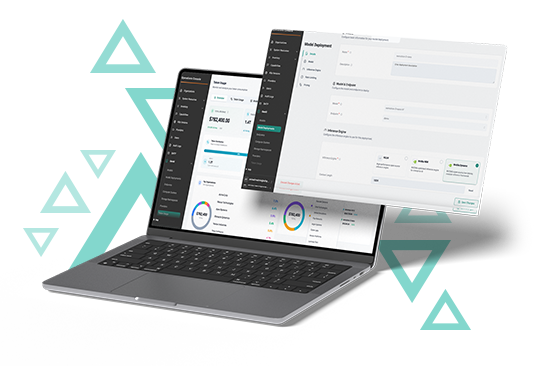
The Rafay Platform provides the orchestration and workflow automation required for GPU clouds to turn static compute into enterprise-grade, centrally governed, self-service environments so costly hardware is turned into a means for generating business value and higher revenues.
Scale Self-service Compute Consumption
Give developers and data scientists cloud-like access to GPU resources via catalogs, no IT tickets required.
AI Apps Delivered "as-a-Service"
Package and deliver inference APIs, LLMs, and vertical AI apps using NVIDIA NIM, Run:AI, or custom frameworks.
Multi-Tenancy & Governance
Enable secure isolation, fine-grained access controls, quota enforcement, and chargeback across customers, teams, and workloads.
Deliver Experiences
Empower developers and data scientists to consume GPU resources in a store-front experience, on-demand.
AI Apps delivered as-a- Service
Templatize and package AI/ML apps on the Rafay Platform for as-a-Service delivery.
Cost Efficiency
Maximize your infrastructure efficiency with real-time monitoring and optimized GPU utilization.
Deliver Experiences
Maximize your infrastructure efficiency with real-time monitoring and optimized GPU utilization.
One Platform – Multiple Deployment Options
The Rafay Platform is designed to address the most complex requirements from the most demanding cloud customers. Rafay's customers have multiple deployment options available to them including:
- Platform-as-a-Service experience
- Air-gapped model for customers using Sovereign AI clouds and/or in highly regulated industries
- Across data center and CSP environments
FAQs About GPU Cloud Platforms
Find answers to common questions about our GPU Cloud Platform services below.
A GPU cloud platform transforms raw GPU infrastructure into governed, self-service services. Platform teams onboard GPU resources, define standardized services, enforce policies and quotas, and expose resources through self-service portals or APIs. Developers and data scientists can then provision GPU-backed environments on demand, while operators maintain centralized governance, usage visibility, and cost control.
GPU-as-a-Service (GPUaaS) is a cloud delivery model that provides on-demand access to GPU resources without requiring organizations to purchase and manage dedicated hardware. Using a GPU cloud platform, providers can package GPU infrastructure into standardized, self-service services with built-in governance, usage metering, and billing or chargeback capabilities.
Self-service AI infrastructure allows developers, data scientists, and AI teams to provision approved GPU environments, AI workspaces, and application stacks without relying on manual IT requests. Platform teams define standardized services and governance policies in advance, enabling faster access to AI infrastructure while maintaining security, compliance, and operational control.
Multi-tenant GPU infrastructure enables multiple teams, departments, or customers to securely share the same GPU environment while remaining isolated from one another. A GPU cloud platform enforces tenant isolation through role-based access control (RBAC), quotas, policies, and resource allocation, allowing organizations to maximize GPU utilization without compromising security or governance.
Rafay includes Kubernetes management as part of a broader platform for delivering self-service AI infrastructure. Beyond cluster lifecycle management, Rafay helps organizations package GPUs, AI applications, and development environments into governed services with multi-tenancy, usage metering, chargeback, and self-service provisioning. The result is an operating model that enables organizations to deliver GPU-as-a-Service and scalable AI platforms rather than simply managing Kubernetes clusters.
Yes. Rafay helps cloud providers, neoclouds, telcos, and enterprises package GPU infrastructure, AI applications, and model APIs into standardized services that can be consumed through self-service portals or APIs. Built-in SKU management, usage metering, and billing or chargeback integration enable organizations to track consumption, recover costs, and support revenue-generating GPU-as-a-Service and AI service offerings.
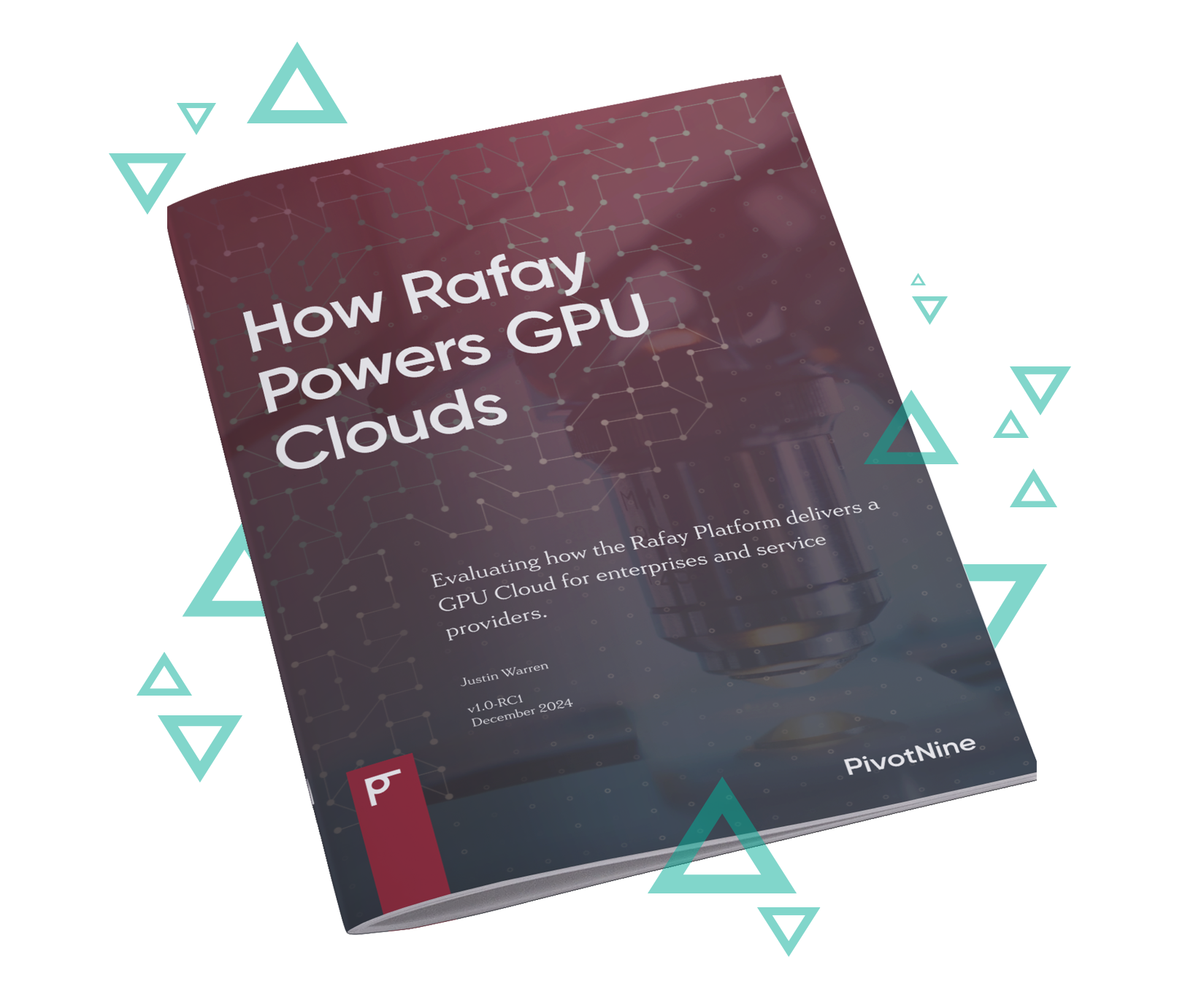
GPU cloud evaluation report
Evaluating how the Rafay Platform delivers a GPU cloud for enterprises and cloud service providers by PivotNine.