Elevate Your AI Factory. Run It on Rafay.
Rafay transforms GPU infrastructure into self-service, governed AI platforms that deliver applications and services at scale. With built-in usage tracking and monetization capabilities, organizations move from deploying GPUs to operating AI platforms.
Organizations have already invested billions in accelerated compute. But GPUs alone don’t create outcomes. Without a scalable operating model, infrastructure remains fragmented, underutilized, and difficult to consume.
The world’s largest AI factories succeed by turning infrastructure into a platform—where developers, data scientists, and customers can access AI environments on demand, with governance, visibility, and cost control built in from day one.
Rafay provides that operating layer.

What Is an AI Factory?
An AI Factory is an operating model that transforms GPU infrastructure into a self-service, multi-tenant platform for building, deploying, and delivering AI applications and services.
Can One Platform Support the Full AI Infrastructure Stack?
Rafay gives AI Factory operators one platform for bare metal, virtual machines, Kubernetes, SLURM, GPU resources, and AI services. This creates a consistent operating model across infrastructure, compute, and AI service delivery.
Trusted by leading enterprises, neoclouds and service providers


.png)








Why AI Factories Are Needed
AI infrastructure is widely deployed, but difficult to operationalize and scale across teams.
Most organizations face the same challenges:
- GPUs are available, but access is manual and slow
- Environments are inconsistent across teams
- Infrastructure is siloed and underutilized
- Usage is difficult to track, govern, or attribute to cost
This creates a gap between infrastructure investment and usable AI outcomes.
AI Factories close this gap by introducing a platform model for how infrastructure is consumed, governed, and delivered as services.
What Defines an AI Factory?
AI Factories extend beyond infrastructure. They introduce a consumption and operating layer with five core capabilities:
Self-Service AI Consumption
Developers provision compute, environments, and AI services on demand without tickets or manual setup.
Multi-Tenant Governance
Infrastructure is securely shared across teams, customers, or business units with isolation, access controls, and policy enforcement.
Standardized SKUs and Environments
Compute, AI workspaces, and applications are packaged into repeatable offerings that are deployed consistently across environments.
Integrated Usage Tracking and Cost Control
All usage is measured and attributed, enabling chargeback, cost visibility, and operational accountability.
AI Application and Model Delivery
AI Factories deliver not just infrastructure, but models, APIs, and applications that are consumed directly by developers and end users.

What Leading AI Factories Achieve
Organizations using Rafay to power AI factories unlock measurable outcomes:

Faster time from infrastructure to production AI services

Higher GPU utilization through shared, multi-tenant consumption models

Reduced operational overhead with automated lifecycle management

New revenue streams through AI services and marketplaces
By turning infrastructure into a platform, AI factories become engines for innovation and growth—not cost centers.
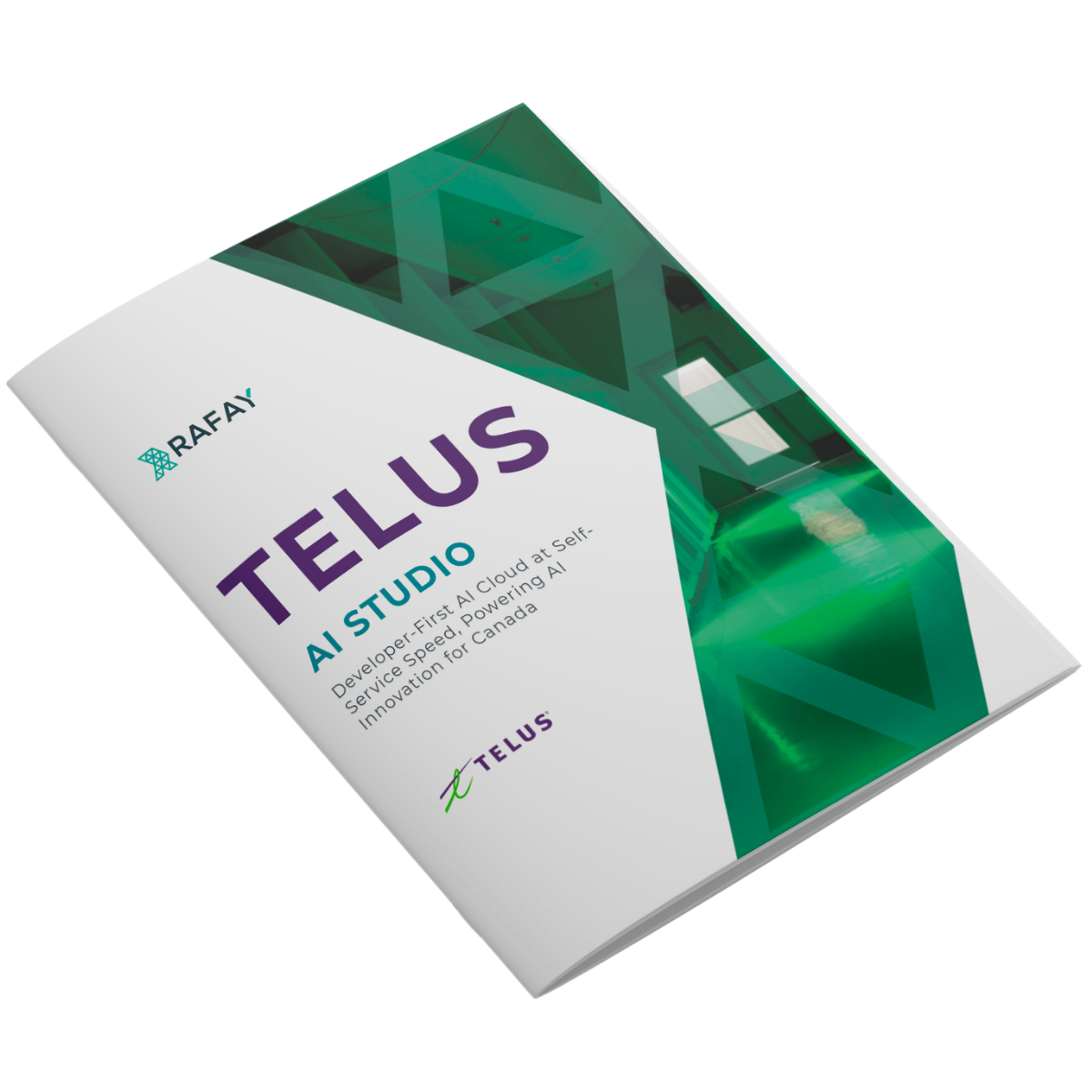
TELUS Launches a Sovereign, Developer-Ready AI Studio

Rafay powers real-world AI factories across telecom, cloud providers, and enterprises. For example, TELUS built a sovereign AI factory that enables developers to provision GPU-powered environments on demand, access curated model catalogs, and deploy production-ready AI services—all within a governed, multi-tenant platform.
This model is becoming the standard for AI infrastructure globally.
The Rafay Advantage
AI Factories require more than infrastructure orchestration. They require a complete operating model for how infrastructure is consumed, governed, and monetized.Rafay delivers this through four core layers:

The Orchestration Layer
Operationalizes GPU infrastructure
Automates provisioning and lifecycle management of Kubernetes clusters, GPU resources, and environments across data centers and public clouds.

The Consumption Layer
Enables self-service AI access
Provides developer-ready portals and APIs where users can:
- Provision compute resources effortlessly
- Launch environments instantly
- Deploy AI workloads without manual intervention

The Governance Layer
Applies control and compliance at scale
Enforces:
- Multi-tenant isolation
- Role-based access control
- Quotas and policy guardrails

The Monetization Layer
Tracks, attributes, and monetizes usage
Captures usage across infrastructure, environments, and AI services to enable:
- Enables internal chargeback and external billing models for AI services
- Cost visibility and control
- External billing and revenue generation
This is what turns AI infrastructure from a cost center into a revenue-generating platform.

Together, these layers transform GPU infrastructure into a fully operational AI Factory—ready to deliver AI applications and services at scale.
AI Factory vs Traditional AI Infrastructure
Turn Your Infrastructure into an AI Factory
Move beyond GPUs and clusters. Build a platform that delivers AI at scale.