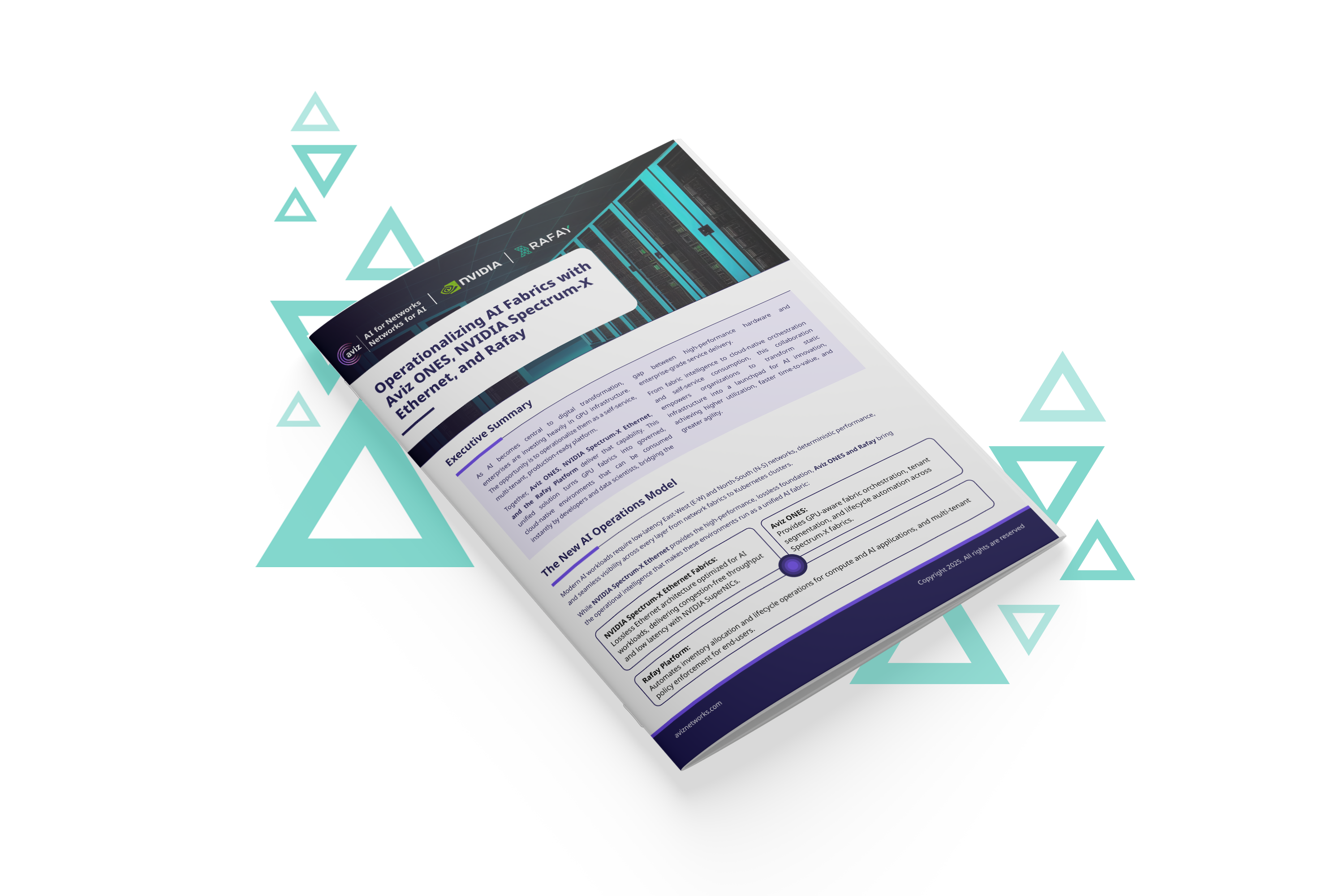
Operationalizing AI Fabrics with Aviz ONES, NVIDIA Spectrum-X, and Rafay
Discover the new AI operations model available to enterprises that enables self-service consumption and cloud-native orchestration for developers.

Rafay-powered Bare Metal as a Service (BMaaS) gives customers direct access to the host operating system on dedicated GPU servers. It is designed for teams running large distributed training jobs or highly opinionated software stacks that need a level of control that a virtualized environment cannot offer.
The platform delivers each server with secure access, connectivity to the customer's other rented servers, and the required storage already mounted. With no virtualization overhead, customers get maximum performance for AI training, inference, and High Performance Computing (HPC) workloads.

Check out the end-user experience in this quick click-through demonstration.
Rafay automates how GPU servers are deployed, managed, and scaled across multiple tenants and environments.

Match servers from inventory, reserve IPs, boot and discover, install the OS, and configure drivers and services in one workflow

Per-tenant VRFs, north-south tenant access, and optional firewall rules, programmed automatically as tenants onboard

InfiniBand and Ethernet with RDMA for low-latency distributed training and HPC

NVIDIA H100, A100, L40S and more, up to 8 GPUs per server with NVLink and NVSwitch
Owning GPU infrastructure is only part of delivering Bare Metal as a Service. Infrastructure providers also need an operating model that allows customers to consume dedicated compute on demand without creating unsustainable operational overhead for the provider as the service grows. Rafay provides the platform layer for turning physical GPU infrastructure into governed, self-service cloud services that can be operated and monetized at scale.
Provisioning a dedicated GPU server can involve inventory selection, server discovery, OS installation, networking, storage, drivers, and access configuration. Handling these processes manually for every customer makes it difficult to scale a bare metal service efficiently. Rafay automates provisioning and lifecycle workflows, allowing providers to support growing demand without adding equivalent operational complexity.
Bare metal performance does not have to come with traditional infrastructure provisioning processes. Rafay allows providers to package dedicated compute into approved services that customers can provision on demand through a self-service portal or API. Customers get faster access to the resources they need, while providers retain control over quotas, access, and governance.
Serving more customers increases the need to maintain isolation, governance, and visibility across the infrastructure. Rafay combines multi-tenancy with network isolation, RBAC, quotas, and policy controls, allowing providers to expand their customer base while managing GPU resources through a unified platform.
Not every customer wants to consume compute in the same way. High-performance AI training may require dedicated bare metal, while other workloads may be better suited to virtual machines (VMs), Kubernetes, or SLURM. Rafay allows providers to offer multiple compute models through the same platform, expanding the services available to customers without building a separate management stack for each one.
GPU infrastructure generates more business value when capacity is used efficiently. Rafay combines rapid resource allocation with usage metering and billing integration, allowing providers to offer on-demand consumption models. Greater visibility into consumption also helps providers understand how infrastructure is being used and reallocate capacity as customer requirements change.
“We are able to deliver new, innovative products and services to the global market faster and manage them cost-effectively with Rafay.”



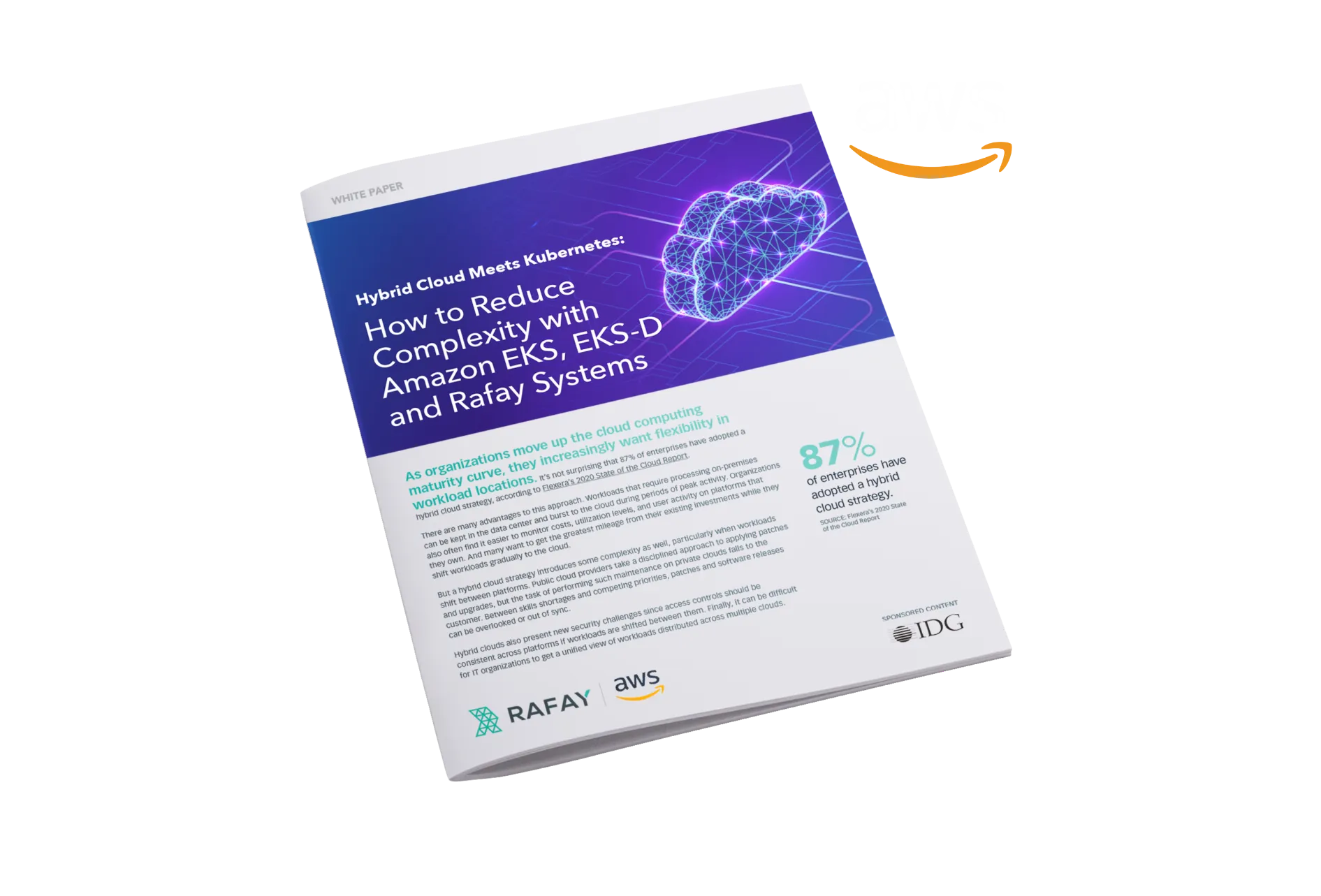
Learn how to Streamline Kubernetes Ops in Hybrid Clouds with AWS & Rafay
Bare Metal as a Service (BMaaS) provides dedicated physical servers on demand. Unlike virtualized compute, customers get access to the physical hardware without a hypervisor separating the operating system from the server. This provides the predictability and control that workloads with demanding performance or configuration requirements need.
A bare metal cloud combines these characteristics with a cloud-like operating model. Customers can provision infrastructure as needed, rather than purchasing, installing, and maintaining their own physical infrastructure in a data center.
A physical server provides its hardware resources directly to the operating system, whereas VMs use a hypervisor to divide a host into separate virtual environments. A bare metal environment therefore avoids the virtualization layer and dedicates the underlying CPU, memory, GPU, and other resources to the customer.
This can make BMaaS suitable for workloads that need high performance, hardware-level control, or consistent resource availability. VMs may be preferable when the agility of virtualized infrastructure matters more than direct access to dedicated hardware.
Bare metal GPUs suit workloads that benefit from dedicated compute, low latency, and improved performance without virtualization overhead. These can include large AI training jobs, inference, HPC, big data processing, and other mission-critical applications with demanding compute requirements.
Bare metal can also accommodate specific needs around the OS, drivers, and software stack. Because the customer isn't sharing the server with other tenants, a single-tenant environment can provide greater control over how the available resources are configured and used.
Yes. BMaaS can make bare metal infrastructure available on demand rather than requiring customers to acquire and operate servers themselves. Rafay enables a cloud provider to package approved server configurations into a self-service catalog that customers can access through a portal or API.
Automation handles the underlying deployment and provisioning workflow, while the provider retains governance over the service. This creates a more cloud-like consumption experience while still giving the customer dedicated access to the underlying physical hardware.
Yes. A BMaaS platform can serve multiple users or organizations while assigning dedicated resources to individual tenants. Each tenant can be assigned dedicated server resources even though the provider manages many customers through the same service platform.
Rafay supports this model with tenant isolation, RBAC, quotas, and automated networking. Per-tenant VRFs and other controls can create a private network for tenant resources while helping providers maintain separation across the wider service.
Bare metal can form part of a broader cloud infrastructure strategy alongside VMs, Kubernetes, and other compute models. Depending on the organization's architecture, dedicated infrastructure may also sit alongside public cloud, private cloud, or on-premises resources rather than replacing them.
This gives organizations the flexibility to select a cloud environment based on workload requirements. Rafay provides the orchestration and service-delivery layer across these compute models, while the underlying infrastructure remains with the infrastructure or cloud provider.
GPU hardware is expensive, so unused capacity can significantly affect the economics of an infrastructure service. Automated allocation, reclamation, usage visibility, and lifecycle management can help providers optimize how that capacity is consumed and returned to the available resource pool.
For Rafay-powered BMaaS, servers can be reallocated between tenants rather than remaining stranded after a customer finishes using them. Usage metering and billing provide the commercial layer around that consumption, supporting more cost-effective operation and ongoing resource optimization.
Yes, as long as the underlying infrastructure provides the storage the workload needs. Bare metal servers can be connected to storage services rather than being limited to storage physically installed in the server itself. Rafay's BMaaS workflow supports mounting per-tenant storage when provisioning a server.
Requirements vary by application. AI and data-intensive workloads may need different combinations of local storage, network-attached storage, or object storage. The appropriate architecture therefore depends on the infrastructure provider and workload, not on BMaaS prescribing a particular storage model.
Not exactly. BMaaS is commonly positioned as a form of Infrastructure as a Service (IaaS), but it differs from the virtualized infrastructure often associated with traditional IaaS. Instead of dividing host capacity among virtual machines, BMaaS provides dedicated server resources without a virtualization layer.
The distinction matters because the two models address different requirements. Traditional IaaS can provide highly flexible virtualized cloud resources, while BMaaS prioritizes dedicated hardware access, performance, and control. Infrastructure providers can offer both models rather than treating them as mutually exclusive.
A BMaaS platform should support more than initial server provisioning. Providers should consider automation, inventory management, networking, storage, tenant isolation, governance, scalability, usage visibility, billing, and how easily the service integrates with existing operational processes.
Commercial requirements matter as well. Providers may need to define different service configurations, consumption models, or SLAs based on customer requirements. A scalable platform should allow the service to grow without requiring the operational team to manually manage each server or build a standalone management stack for every new service.
Talk with Rafay experts to assess your infrastructure, explore your use cases, and see how teams like yours operationalize AI/ML and cloud-native initiatives with self-service and governance built in.