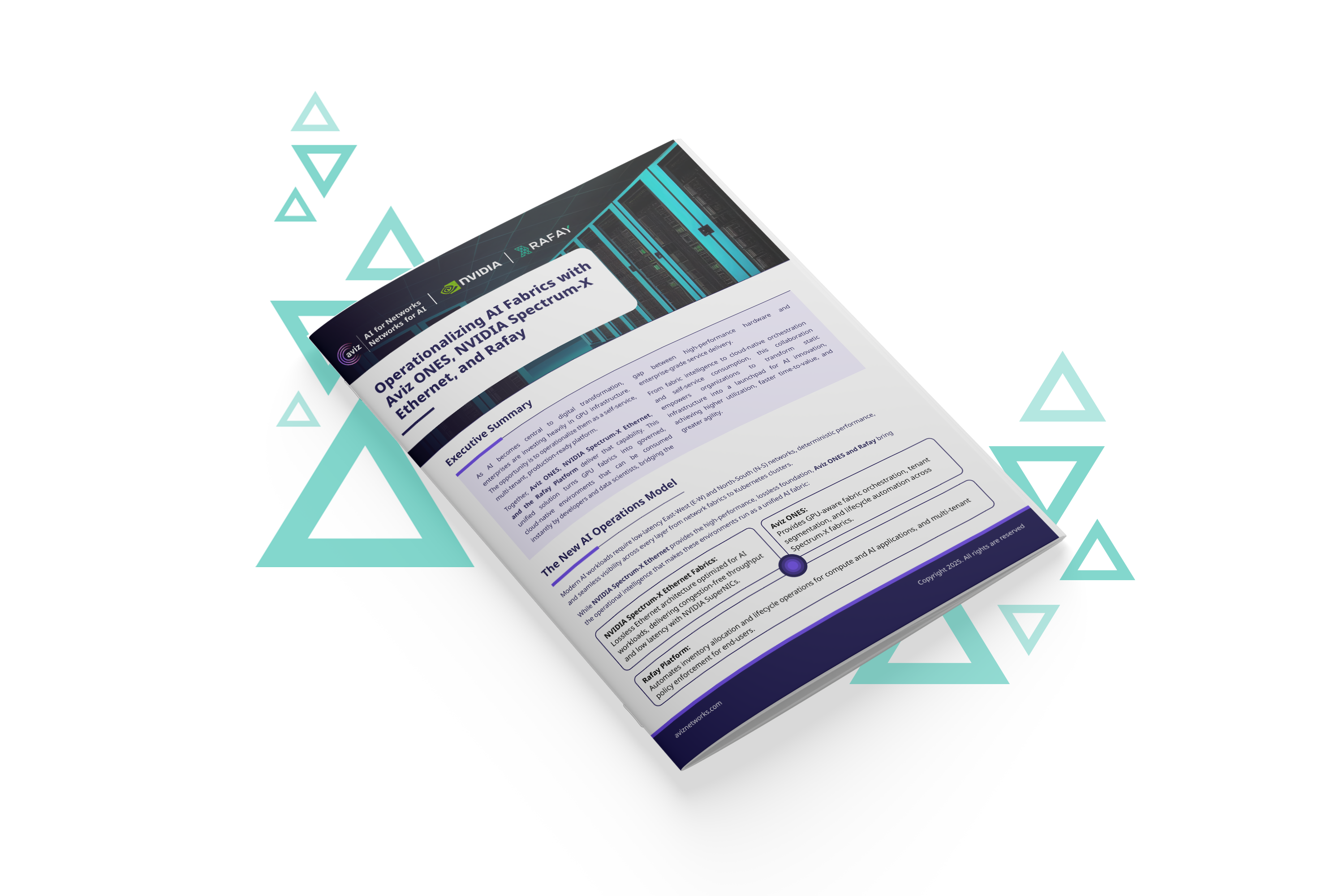
Operationalizing AI Fabrics with Aviz ONES, NVIDIA Spectrum-X, and Rafay
Discover the new AI operations model available to enterprises that enables self-service consumption and cloud-native orchestration for developers.

Rafay's Managed Kubernetes as a Service (MKS) delivers fully managed, GPU-ready Kubernetes clusters as a governed, self-service offering. The service is built on Rafay MKS, an upstream Kubernetes distribution for bare metal and virtual machines. It streamlines every stage of your operations, including provisioning, securing, and managing the full cluster lifecycle across public, private, air-gapped, and sovereign environments.

One control plane provisions, governs, and scales clusters across every environment

On-demand provisioning, upgrades, scaling, and Day-2 operations fleet-wide, with multi-version support

Integrated GPU operator and GPU scheduling for training and inference out of the box

Cilium, Calico, Flannel, or your own CNI, plus load balancer and ingress integration

Per-tenant isolation, RBAC, and zero-trust kubectl access on every tenant


Kubernetes as a Service is a managed model for providing Kubernetes clusters and the supporting capabilities required to operate them. Normally, organizations must build and maintain the entire Kubernetes infrastructure themselves. A managed service, on the other hand, allows them to provision clusters, apply governance, and handle ongoing operational tasks.
The exact division of responsibility depends on the service. A comprehensive managed Kubernetes solution can cover areas such as cluster lifecycle management, security policies, upgrades, monitoring, and access controls. This reduces the operational burden of installing, configuring, and maintaining Kubernetes. At the same time, it gives end users a more consistent way to access the resources they need.
The primary difference is who is responsible for operating the Kubernetes environment. With self-managed Kubernetes, internal teams typically configure, upgrade, secure, monitor, and troubleshoot the clusters themselves. Managed Kubernetes shifts some or all of those responsibilities to a platform or service provider.
This can be particularly valuable as the number and size of Kubernetes environments grow. Instead of maintaining separate operational processes for individual clusters, organizations can standardize how they deploy and manage workloads and establish centralized visibility across their Kubernetes estate.
Yes. Kubernetes can run across public cloud, private cloud, virtualized, bare-metal, and other infrastructure. However, the environments supported depend on the Kubernetes service or platform being used.
A consistent management layer can help organizations operate clusters across multiple cloud providers and infrastructure types without creating an entirely separate operational workflow for each environment. This is particularly useful when applications need to remain in particular locations for performance, security, sovereignty, or regulatory reasons.
Kubernetes as a Service gives development teams a standardized environment for deploying and running containerized applications without requiring them to manage the underlying clusters themselves. Developers can concentrate on application development, while platform teams establish the infrastructure, policies, and operational controls that applications run within.
Standardized environments can also make it easier to move modern applications through development, testing, and production. Teams can use familiar Kubernetes tooling, including APIs and Helm, while the service handles much of the underlying container orchestration and cluster administration.
Yes. Kubernetes can run both stateless and stateful workloads, including applications that depend on persistent storage and database services. However, these workloads have different requirements from applications that can simply be restarted elsewhere without retaining local state.
Organizations therefore need to consider persistent storage, backup and recovery, availability, and how workloads are rescheduled when a node becomes unavailable. The Kubernetes platform only provides the orchestration layer. It's the underlying storage and infrastructure architecture that determine many of the resilience and performance characteristics of the application.
Kubernetes provides mechanisms for maintaining application availability and responding to changes in workload demand. It can reschedule workloads when infrastructure fails and increase or decrease application capacity according to configured requirements.
However, high availability and scalability depend on more than Kubernetes itself. Organizations also need appropriately designed compute, networking, storage, load balancing, monitoring, and recovery processes. A managed service helps bring these operational components together so teams can build more resilient environments without individually managing every part of the Kubernetes stack.
A managed Kubernetes service should provide controls for managing who can access clusters, what actions they can perform, and how workloads communicate. Depending on the environment, these can include role-based access controls, identity integration, network policies, secrets management, audit capabilities, and policy enforcement.
Security also needs to extend beyond individual clusters. Organizations operating distributed environments need a consistent way to apply controls and understand activity across the fleet. Observability and centralized governance can help teams identify issues and operate Kubernetes securely as the number of clusters, workloads, and users increases.
Organizations should look for a platform that can support the complete operational lifecycle rather than focusing only on cluster provisioning. Important considerations include lifecycle automation, governance, security, deployment flexibility, multi-tenancy, observability, developer access, and support for the infrastructure and workloads the organization intends to run.
The platform should also fit existing operational processes and tooling. Support for Kubernetes APIs, automation, policy controls, and established deployment tools can reduce the need to create bespoke processes as the environment grows. For service providers in particular, it is also important to consider how easily the platform can provide governed services to multiple customers or business units.
“We are able to deliver new, innovative products and services to the global market faster and manage them cost-effectively with Rafay.”


Talk with Rafay experts to assess your infrastructure, explore your use cases, and see how teams like yours operationalize AI/ML and cloud-native initiatives with self-service and governance built in.