AI infrastructure is moving from the server to the rack. NVIDIA GB200 NVL72 connects 72 NVIDIA Blackwell GPUs and 36 NVIDIA Grace™ CPUs in a single NVIDIA NVLink™ domain, so the whole rack behaves like one very large accelerator, which raises the bar for the software that runs it. The control plane now has to understand the rack: verify hardware before handoff, carve fabrics into isolated tenant slices, place workloads with topology in mind, and return every node to a clean state between tenants.
That's the bar Rafay is now testing against at rack scale. Rafay is recognized as an NVIDIA AI Cloud-Ready validation partner and implements NVIDIA Infra Controller (NICo) on a GB200 NVL72 rack in the NVIDIA validation lab, extending its validation work from single systems to full racks.
Where NVIDIA Grace Blackwell racks are landing
NVIDIA positions GB200 NVL72 for real-time inference and training of trillion-parameter and mixture-of-experts models, and GB300 NVL72 for AI reasoning. Three groups of operators are deploying these systems:
Neoclouds selling rack-scale capacity to AI labs and model builders.
Sovereign AI clouds, such as Australia's Sharon AI, which agreed with NVIDIA in June 2026 to deploy up to 40,000 GB300 GPUs.
Enterprises, telcos, and research institutions building private AI factories.
NVIDIA AI Cloud-Ready does for AI cloud software what the NVIDIA Cloud Partner reference design does for hardware. Stacks are assessed against the NCP Software Reference Guide, and results are reviewed jointly with NVIDIA.
In May 2026, Rafay announced that the Rafay Platform, integrated with NICo, achieved AI Cloud-Ready validation, and Rafay is listed among the initiative's first-ever validated partners. This round extends that work to rack-scale systems.
What is being tested
NICo is NVIDIA's open-source, API-based microservice for site-local, zero-trust, bare-metal lifecycle management. Rafay builds on it to deliver self-service consumption, multi-tenancy with governance, and Kubernetes lifecycle management. Rafay deployed this stack directly on the rack's bare metal, so the tests exercise real NVLink switches, real fabrics, and real rack hardware.
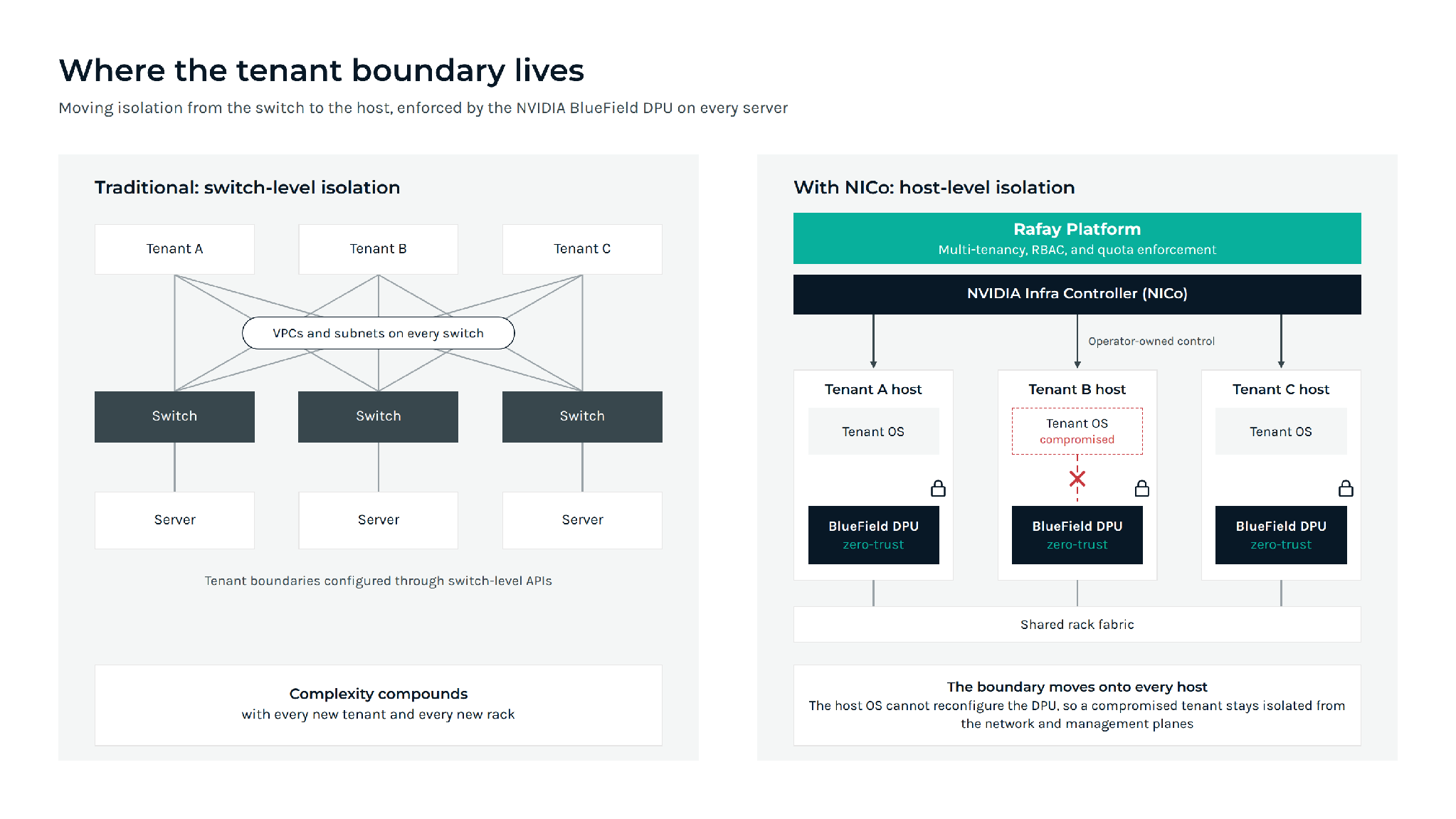
What makes rack-scale multi-tenancy hard is isolation. The traditional approach configures tenant boundaries at the switch, with VPCs and subnets carved through switch-level APIs, and that complexity compounds with every new tenant and every new rack. NICo moves the boundary onto the host itself, enforced by the NVIDIA BlueField™ DPU on each server. The DPU runs in zero-trust mode: the host OS can't reconfigure it, so it stays owned by the operator even after the host is handed to a tenant. If a tenant's workload or OS is ever compromised, the network and management planes stay isolated.
Rafay's multi-tenancy, RBAC, and quota enforcement sit directly on this host-level model, which is why the validation treats attestation, per-tenant isolation, and sanitization as first-class checks.
Figure 1. Moving the tenant boundary from the switch to the host
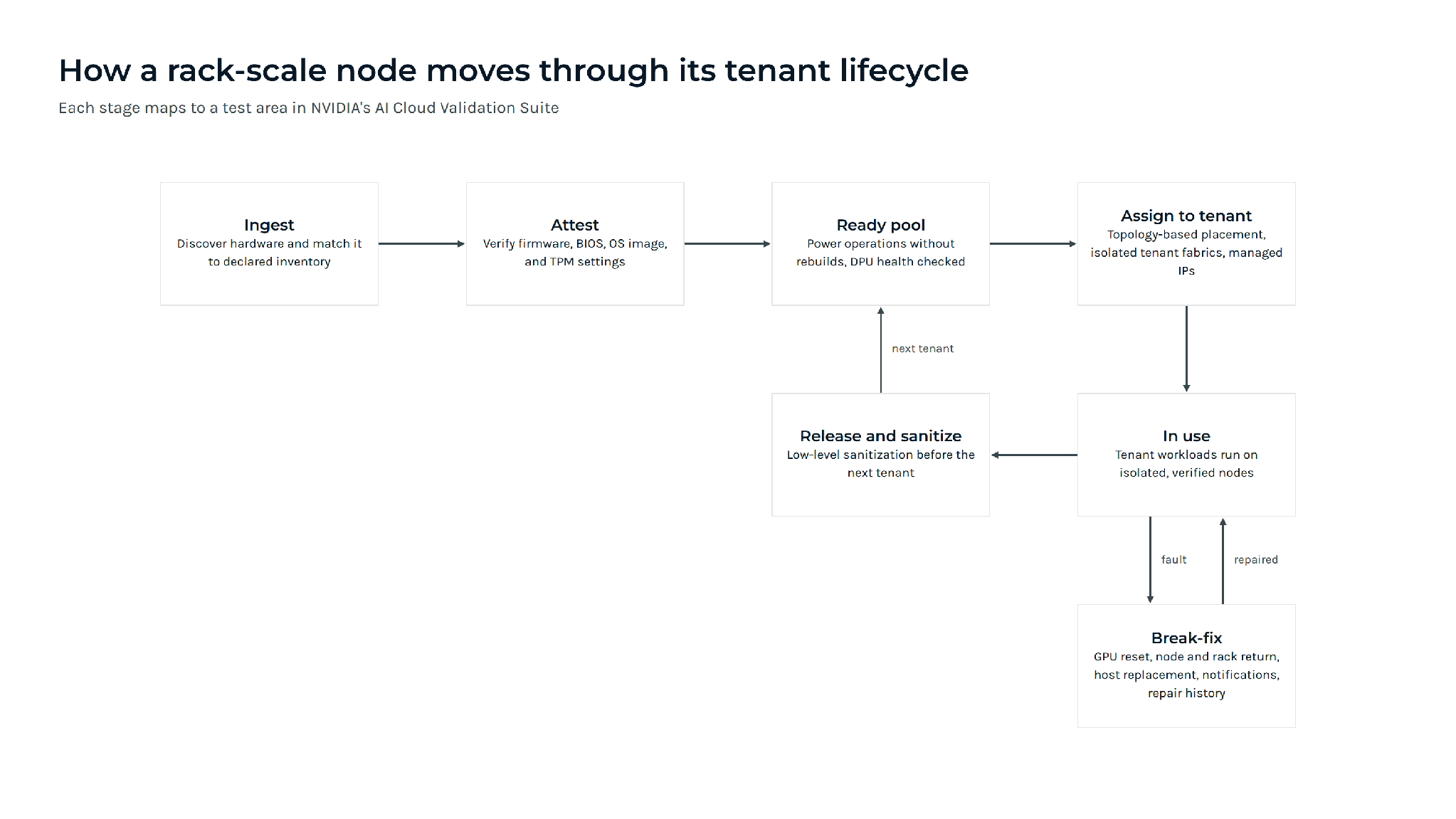
The validation focuses on network management, compute provisioning, and workload orchestration. The rack-scale tests probe these areas:
Figure 2. How a node moves from ingest to reuse, including break-fix
Area
What the suite checks
Why operators care
Hardware ingestion
All hardware is discovered and matches declared inventory
The basis for billing and capacity planning
Attestation
Firmware, BIOS, OS image, and TPM settings are verified
Tenants receive trusted nodes
Bare-metal lifecycle
Power operations without rebuilds; DPU health at instantiation
Faster recovery
Topology and fabric
Topology-based placement; tenant isolation on the TAN (north-south), CIN (east-west), InfiniBand (partition keys) and NVLink (partitions)
Performance and isolation
Networking
Healthy switches; platform-managed IP addressing
Predictable tenant networks
Sanitization
Low-level sanitization on delete
Clean reuse between tenants
What it means for operators
Validation on the same class of hardware shortens the distance between racking a system and selling it.
Neoclouds reduce integration risk and turn new racks into self-service, multi-tenant offerings sooner.
Sovereign AI clouds get evidence of attestation, isolation, and sanitization on rack-scale hardware.
Enterprises and telcos get a control plane aligned with the NVIDIA reference stack, without assembling and testing it themselves.
What comes next
The goal is the same at every scale: let operators run AI infrastructure, from a single server to a full NVL72 rack, as a governed, self-service platform from day one.
To learn how Rafay can help you bring rack-scale capacity to market, talk to Rafay.
NVIDIA Dynamo in Practice: Scaling Disaggregated Inference on Rafay Token Factory
Inference now defines AI infrastructure economics. See how NVIDIA Dynamo splits prefill and decode across GPU pools, and how Rafay Token Factory turns it into a priced, multi-tenant service.
How the Rafay Platform Integrates with NVIDIA DSX OS Across the AI Factory
From workload scheduling and inference to GPU fleet health, the Rafay Platform integrates with NVIDIA DSX OS across the layers operators run every day, and turns the reference stack into services operators can sell.
Governed Agents, Protected Tokens: Open Agent Safety Platform Meets the Sovereign Token Factory
Hosted AI agents raise two security questions: what the agent can do, and what the platform sees of its data. NVIDIA OpenShell, Protopia AI, and Rafay together let NeoClouds and sovereign AI providers sell governed Agent-as-a-Service and protected Tokens-as-a-Service on shared GPUs.