Most neoclouds are working on the same problem right now, which is making bare metal GPU capacity available without the user having to open a ticket. It is the right problem. Manual bare metal provisioning stops scaling well before the fleet does, and every provider eventually feels it.
But that is only half the problem.
There are two gaps between selling GPU hardware and operating a GPU cloud, and they are easy to confuse. The first is that a request portal is not self-service. Customers submit a form, and behind it, infrastructure teams still coordinate server, network, storage, OS imaging, security, and access manually. Closing that gap requires automating the full bare metal provisioning and lifecycle workflow.
The second gap opens right after the first one closes. A provider can deliver fully automated, API-driven bare metal. But as customers scale their fleet, the same team that required raw hardware at 64 GPUs starts asking for managed Kubernetes, SLURM (Simple Linux Utility for Resource Management), workbenches, inference services, or other higher-level environments. If the service catalog ends at bare metal, that demand doesn’t disappear; it shifts somewhere else.
So automating bare metal provisioning is necessary, harder than it looks, and worth doing. It is also the foundation of a GPU cloud, not the offering itself. This post maps both gaps, and is an introduction to a series that goes deep on each one.
What Separates GPU Hosting, Bare Metal as a Service, and a GPU Cloud?
It helps to name the three positions before arguing about the distance between them.
GPU hosting provides the hardware, networking, facilities, and engineering support. Capacity exists, and customers reach it through requests and human coordination.
Bare Metal as a Service (BMaaS) makes that same capacity consumable. Requests arrive through a portal or API, get validated against capacity, quota, and policy, and executed through repeatable provisioning and lifecycle workflows without a routine infrastructure ticket.
A GPU cloud exposes the same physical capacity through multiple consumption models so customers can choose how much of the stack they want to own.
When Should a Neocloud Automate Bare Metal and When Should It Move Up the Stack?
The two gaps produce different signals.
Signals that bare metal needs automating
The strongest signal is repeated provisioning against the same set of SKUs, with the same server configuration, OS image, network profile, storage configuration, and access policies. Others appear across the server lifecycle: capacity is reassigned often, servers need regular re-imaging, or customer delivery waits on server, network, storage, and security handoffs. If operations headcount grows with deployed GPU capacity, fulfillment is scaling with the fleet instead of running programmatically. Customer requests for portal or API access to provisioning, rebuilds, and power operations point the same way.
Signals that bare metal alone is no longer enough
The clearest signal is direct demand for managed Kubernetes, SLURM, AI workbenches, or inference services, because those requests arrive against a catalog that cannot serve them. Related signals include customers asking for availability or performance commitments instead of hardware specifications, node failures and GPU health events becoming continuous concerns as fleets grow, and competitive losses where the hardware was equivalent and the service portfolio was not.
A neocloud should evaluate two things. First, whether its current model can absorb higher provisioning volume, lifecycle events, and customer availability requirements without adding equivalent ticket volume, handoffs, and operations labor. Second, whether the services customers will ask for next can be delivered on the same platform, or whether each one becomes a separate build.
Turn Bare Metal Capacity Into a Repeatable Service With Rafay
Rafay helps neoclouds turn dedicated GPU capacity into self-service infrastructure. Bare Metal GPUs as a Service (BMaaS) automates server allocation and bring-up across the OS, drivers, networking, storage, security, and customer access workflow.
Rafay Self-Service Compute allows providers to package approved configurations as reusable SKUs and expose them through portals and APIs with tenant, RBAC, quota, and policy controls. Standard provisioning and lifecycle requests then execute within provider-defined boundaries rather than requiring infrastructure teams to coordinate each deployment.
Rafay Services You Can Launch brings these consumption models together as services that providers can package and deliver on top of their compute infrastructure. Bare metal automation provides the first layer, turning physical GPU capacity into a repeatable service that can sit alongside higher-level compute and AI offerings.
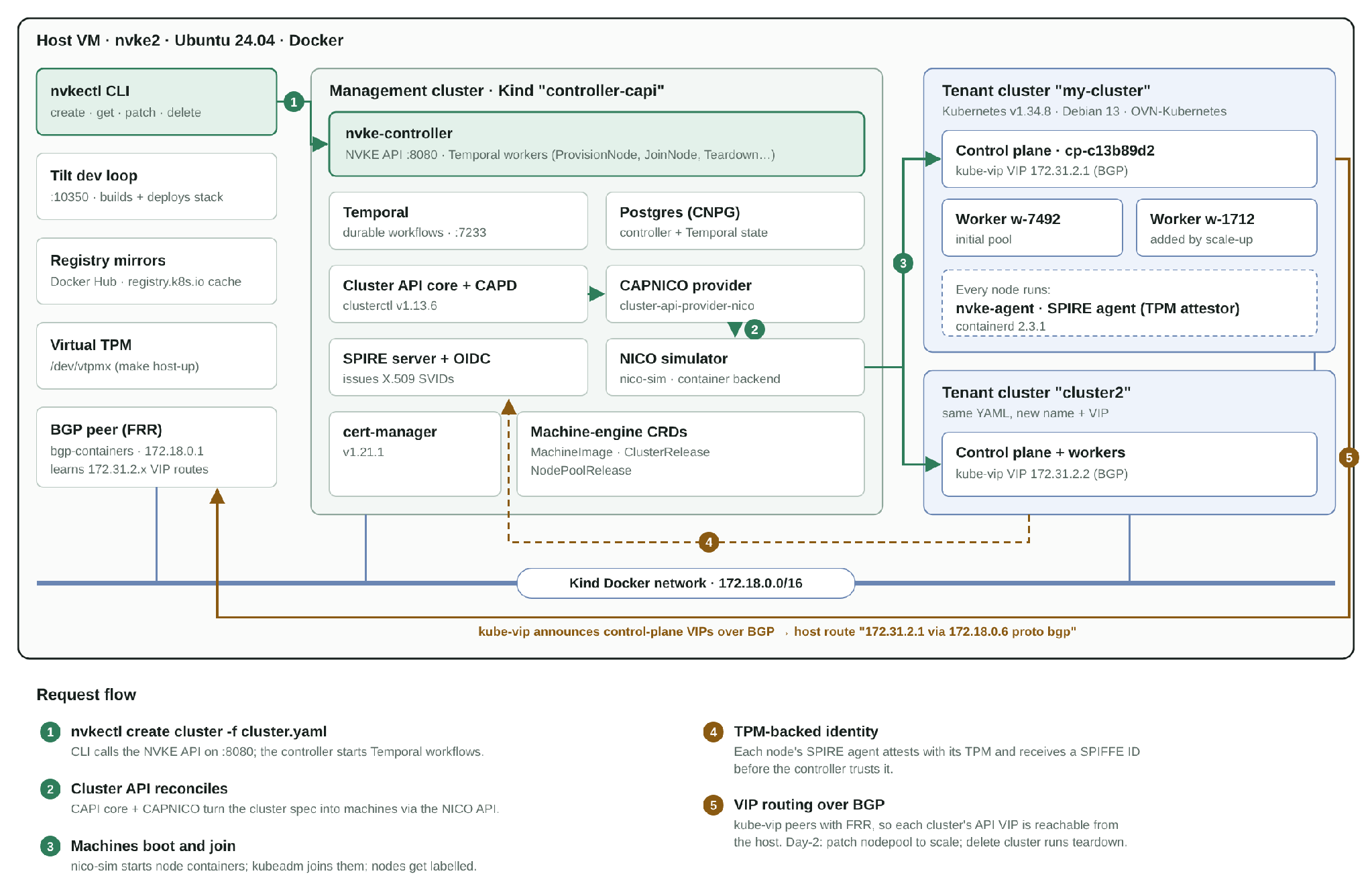
Rafay is bringing NVIDIA Kubernetes Engine (NVKE) into its Kubernetes-as-a-Service (K8s) offering
A working tenant cluster about 21 minutes after logging in to a bare VM. Each new cluster after that in about three minutes. The whole lifecycle in five nvkectl verbs.
NVIDIA AI Cloud-Ready at Rack Scale: Rafay on GB200 NVL72 with NVIDIA Infra Controller
The rack is becoming the unit of AI compute. Rafay is extending its NVIDIA AI Cloud-Ready validation from single systems to full GB200 NVL72 racks with NVIDIA Infra Controller.
NVIDIA Dynamo in Practice: Scaling Disaggregated Inference on Rafay Token Factory
Inference now defines AI infrastructure economics. See how NVIDIA Dynamo splits prefill and decode across GPU pools, and how Rafay Token Factory turns it into a priced, multi-tenant service.