Configure and Manage GPU Resource Quotas in Multi-Tenant Clouds


In multi-tenant GPU cloud environments, effective resource management is critical to ensure fair usage and prevent contention. GPU resource quotas allow organizations to allocate computing capacity at multiple levels—across the entire organization, at individual project scopes, and even down to the per-user level. In this blog, we will describe how GPU Clouds can provide fine grained control of limited resources to their tenants and their admins.

Understanding the Organizational Quota Model
The diagram below illustrates a best-practice quota allocation model for GPU cloud providers supporting multi-tenant customers. At the top level, the GPU Cloud Provider offers services to multiple tenant organizations (Org-1, Org-2, etc.). Each tenant (i.e. Org) receives a predefined GPU quota segmented by SKUs such as Small, Medium, and Large GPU instances.
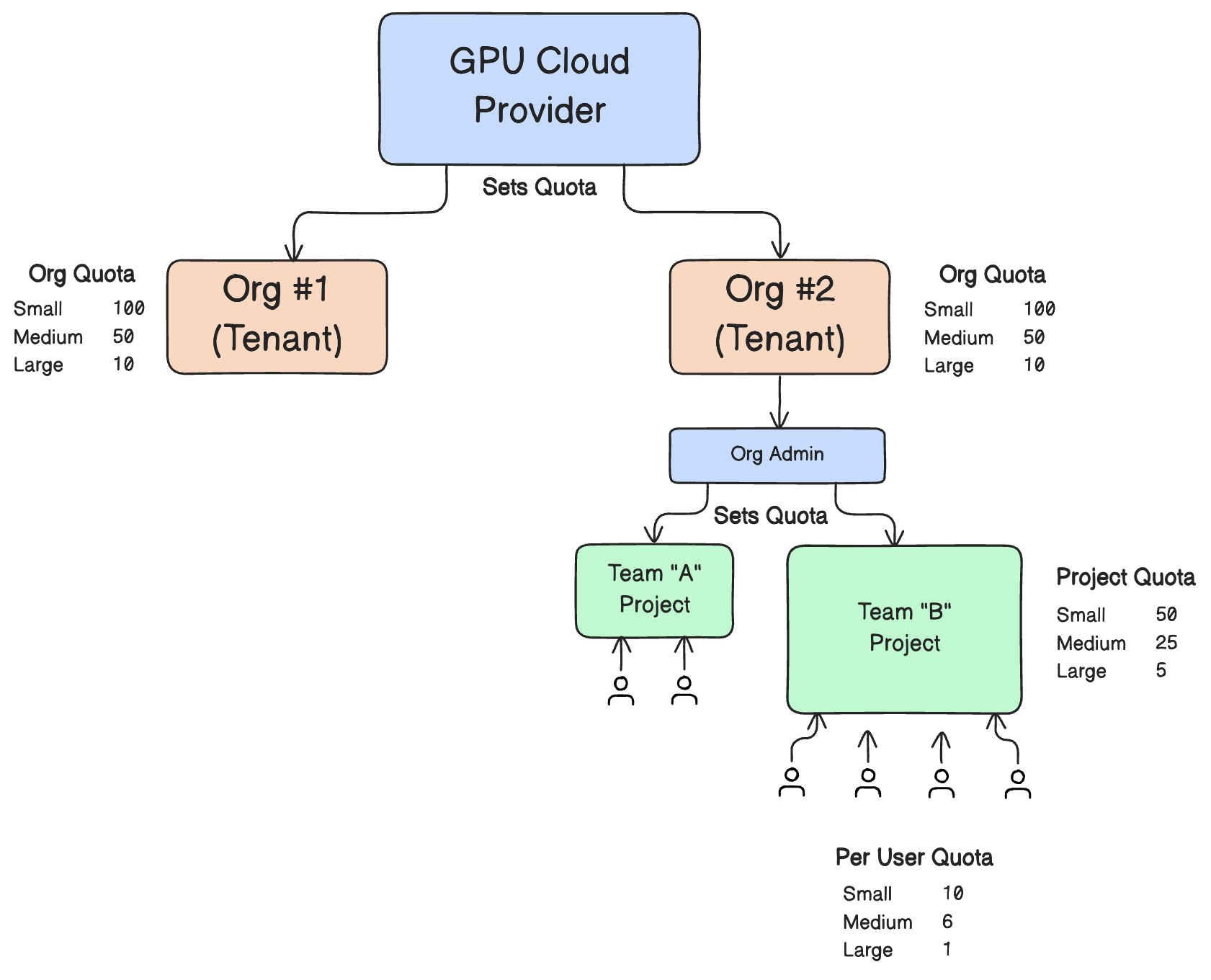
In the example above, Org-2 is allocated:
- 100 instances of the Small SKU
- 50 instances of the Medium SKU
- 10 instances of the Large SKU
This top-level quota acts as the upper bound on total GPU consumption by the organization. It is typically assigned based on subscription tier, enterprise needs, or negotiated service agreements.
Role of the Organization Admin
The Org Admin is responsible for partitioning the organization’s total GPU quota across internal teams and projects. This is essential to:
- Delegate capacity fairly among internal groups
- Prevent over allocation by individual projects
- Maintain control over GPU utilization and cost
In the example, Org-2 contains two internal projects supporting two different teams:
- Team “A” Project
- Team “B” Project
Each project receives a subset of the org’s total quota. Team B, being a larger or more GPU-intensive project, is granted:
- 50 Instances of Small SKU
- 25 Instances of Medium SKU
- 5 Instances of Large SKU
This allocation is made by the Org Admin within the boundaries of the overall quota available to Org-2.
Project-Level Quota Governance
Once a project has its GPU quota, it can internally manage how those resources are consumed. This is particularly useful when multiple users or sub-teams work under the same project.
Per User Quotas
In our example, Team B has four users, and the project-level quota is further subdivided using per-user quotas.
- 10 Instances of Small SKU
- 6 Instances of Medium SKU
- 1 Instance of Large SKU
This structure ensures that no single user can monopolize project resources, supporting parallel workloads and enabling team-wide productivity.
Benefits of Hierarchical Quota Management
This multi-level quota strategy offers several advantages such as:
1. Isolation & Fairness
This prevents resource starvation or overuse by any single entity
2. Scalability
Easily accommodates new projects or users
3. Cost Control
Enforces limits that align with billing agreements and budgets
4. Operational Transparency
Each tier has clear visibility and accountability for its GPU usage
Conclusion
The illustrated GPU quota model exemplifies how cloud admins can efficiently manage compute resources across tenants, projects, and users. This approach not only optimizes GPU utilization but also aligns with enterprise governance, operational efficiency, and customer satisfaction. Learn more about this here.