AI workloads are growing more complex by the day, and platform teams are under immense pressure to deliver them at scale—securely, efficiently, and with speed. Modern AI workloads require specialized hardware such as GPUs and TPUs to provide the computational power necessary for large-scale data processing, model training, and complex algorithm execution. Yet despite skyrocketing investment in artificial intelligence, many organizations still struggle to operationalize AI workloads across hybrid and multi-cloud environments.
The challenge isn’t just about accessing GPU compute—it’s about simplifying the delivery, orchestration, and governance of AI/ML pipelines. Supporting these workloads demands significant computational power and high performance computing infrastructure to manage large datasets and complex algorithms efficiently. In 2025, successful platform teams will be the ones that bridge this operational gap with automation, policy enforcement, and developer self-service.
In this post, we explore what’s making AI workload delivery so difficult, and how platform teams can simplify the process to unlock faster innovation with less operational overhead. The term AI workloads refers to the collection of resource-intensive computational tasks involved in developing, training, deploying, and running AI models.
What Are AI Workloads and Machine Learning?
AI workloads refer to the set of compute-intensive processes involved in developing and running artificial intelligence models. These can include:
- Training: Ingesting large datasets as training data to refine and optimize model parameters. Training AI models is a resource-intensive process that involves preparing high-quality training data, feature extraction, and leveraging advanced hardware such as tensor processing units (TPUs) to accelerate the training process and improve efficiency.
- Inference: Using trained models to make predictions or decisions in real time.
- Fine-tuning: Adapting pre-trained models to specific use cases or data sources.
- Data preprocessing and preparation: Cleaning, transforming, and preparing raw data into a usable format for model training and analysis. Data preparation is a crucial initial step, ensuring that the data processed—including unstructured data like images and text—is suitable as training data for AI workflows.
AI workloads often involve complex computations, parallel processing tasks, large scale data processing, and distributed computing parallelization to efficiently handle vast datasets and accelerate AI operations.
These processes require scalable infrastructure, access to accelerators like GPUs and tensor processing units, and efficient orchestration across environments. Machine learning models and artificial intelligence systems rely on these processes and require advanced hardware to perform parallel computations efficiently. AI workloads differ from traditional software workloads in that they’re data-hungry, GPU-reliant, and highly sensitive to latency and throughput.
Why Delivering AI Workloads Is So Difficult
For most platform teams, the complexity of AI workload delivery comes down to three core issues: Unlike traditional workloads, which typically involve conventional enterprise applications with predictable data and processing requirements, implementing AI workloads introduces unique challenges due to increased technical and infrastructural complexities, as well as more demanding data management and deployment strategies.
1. Infrastructure Fragmentation
AI workloads often span multiple environments—on-prem data centers, public clouds, and edge locations. Managing consistency, observability, and security across these domains is resource-intensive and error-prone.
2. Manual Operations in Model Training
Provisioning GPUs, setting up Kubernetes clusters, configuring access policies, and managing cost monitoring is still largely manual in many enterprises. These tasks delay innovation and lead to underutilized resources.
3. Developer Friction
Data scientists and AI engineers want self-service access to infrastructure and tools—but platform teams often lack the automation to enable this safely. Without role-based access controls and policies, platform sprawl and shadow IT become serious risks.
Trends Reshaping AI Infrastructure and Large Language Models in 2025
As AI becomes a first-class citizen in enterprise technology stacks, new trends are shaping how workloads are built and delivered:
- Model-as-a-Service (MaaS): Teams are packaging models as APIs for internal and external use.
- Hybrid and multi-cloud standardization: Enterprises want consistent control across AWS, Azure, GCP, and on-prem infrastructure.
- AI workflow orchestration: There’s a growing demand for platforms that coordinate training, deployment, and monitoring of AI models, efficiently process new data, and support low latency for real-time AI applications.
- Compliance automation: AI workloads are now subject to stricter governance policies, requiring integrated audit trails and policy controls.
These trends highlight the benefits of AI workloads, including improved efficiency, innovation, and faster decision-making for organizations.
The bottom line? Platform teams need a streamlined, scalable, and secure way to manage AI/ML infrastructure—without building everything from scratch.
Data Management for AI Workloads
Effective data management is at the heart of successful AI workload delivery. The quality, consistency, and accessibility of data directly influence the performance and reliability of AI models. As organizations work with increasingly vast datasets, robust data management strategies become essential for optimizing data processing, ensuring data integrity, and supporting scalable AI systems.
Modern AI workloads require a comprehensive approach to data management that spans the entire lifecycle—from data ingestion and preprocessing to storage and retrieval. By implementing best practices in data processing and storage, platform teams can streamline the flow of data, reduce bottlenecks, and enable faster, more accurate AI model development.
Data Preprocessing: Preparing Data for AI Success
Data preprocessing is a foundational step in the AI pipeline, setting the stage for effective model training and deployment. This process involves cleaning, transforming, and structuring raw data into a consistent format that AI algorithms can efficiently process. High-quality data preprocessing is crucial for ensuring data quality, which in turn leads to more accurate and reliable AI models.
Data scientists employ a range of preprocessing techniques, such as data normalization, feature scaling, and data augmentation, to enhance the quality and consistency of their datasets. These steps help eliminate noise, handle missing values, and standardize inputs, making it easier for AI models to learn from the data. By prioritizing data preprocessing, organizations can significantly improve the outcomes of their model training efforts and ensure that their AI models deliver trustworthy results.
Data Processing Workloads: Scaling Data Pipelines
As organizations collect and analyze ever-larger volumes of data, managing data processing workloads becomes increasingly complex. Data processing workloads encompass the computational tasks required to transform, analyze, and prepare large datasets—often including unstructured data such as text, images, or video—for use in AI models.
To handle these vast amounts of data efficiently, organizations are turning to distributed computing and parallel processing techniques. By breaking down data processing workloads into smaller, parallel tasks, teams can leverage multiple processors or nodes to accelerate data pipelines and reduce processing times. This approach not only improves the efficiency of data processing but also enables organizations to scale their AI workflows and support more sophisticated AI models. Optimizing data processing workloads is key to unlocking the full potential of AI, allowing teams to move from raw data to actionable insights faster than ever before.
Distributed Computing and Storage for AI
As AI workloads grow in scale and complexity, distributed computing and storage have become indispensable for meeting the computational and data-intensive demands of modern AI systems. These technologies enable organizations to efficiently manage and process the massive datasets and complex algorithms that power today’s AI applications.
Distributed computing and storage solutions provide the foundation for scalable, high-performance AI infrastructure. By distributing both computation and data across multiple nodes or locations, platform teams can ensure that their AI workloads remain responsive, resilient, and capable of handling rapid growth in data volume and model complexity.
Distributed Computing: Powering Scalable AI
Distributed computing is a game-changer for organizations looking to scale their AI initiatives. By spreading computational tasks across multiple processors, nodes, or even entire clusters, distributed computing enables the efficient training and deployment of large-scale AI models—including deep learning models and large language models (LLMs).
This approach is especially valuable for data scientists working with large datasets and complex deep learning algorithms, where single-machine processing would be prohibitively slow or resource-intensive. Technologies such as Apache Spark, Hadoop, and TensorFlow have become essential tools for implementing distributed computing in AI, allowing teams to parallelize model training, accelerate data processing, and improve overall workflow efficiency.
With distributed computing, organizations can tackle the most demanding AI workloads, from training deep learning models on vast datasets to deploying generative AI and natural language processing solutions at scale. By leveraging these technologies, platform teams can deliver faster insights, support more advanced AI applications, and stay ahead in the rapidly evolving world of artificial intelligence.
What Platform Teams Need to Simplify AI Workload Delivery
A modern platform team needs to think beyond raw infrastructure. Integrating comprehensive AI solutions is crucial to effectively address the challenges of AI workload delivery. Here’s what’s essential:
Kubernetes-Native Orchestration
Kubernetes has emerged as the de facto standard for deploying containerized applications—including AI workloads. But vanilla Kubernetes doesn’t offer GPU scheduling, fine-grained role control, or workload-aware autoscaling out of the box.
A Kubernetes-native platform should offer:
- GPU-aware scheduling
- Multi-tenant isolation
- Workload-based autoscaling
- Integration with AI/ML toolchains like Kubeflow and MLflow
Automated Infrastructure Provisioning
AI workloads are dynamic. Platform teams need to provision resources—compute, storage, networking—on-demand with automation and zero manual intervention.
This includes:
- Dynamic GPU provisioning
- Role-based access controls (RBAC)
- Automated namespace and project creation
- Templated configurations for repeatability
Policy-Driven Governance
AI workloads require strict governance, especially when dealing with sensitive data. Platform teams should enforce:
- Usage quotas and cost controls
- Network security policies
- Access policies for data and models
- Audit logs for compliance
Observability Built for AI Workloads
Traditional observability tools don’t account for GPU performance, inference latency, or model-specific metrics. Platform teams need observability tailored for AI/ML, including:
- GPU utilization dashboards
- Model performance metrics (accuracy, latency, drift)
- Cost visibility across teams and projects
How Rafay Simplifies AI Workload Delivery for Platform Teams
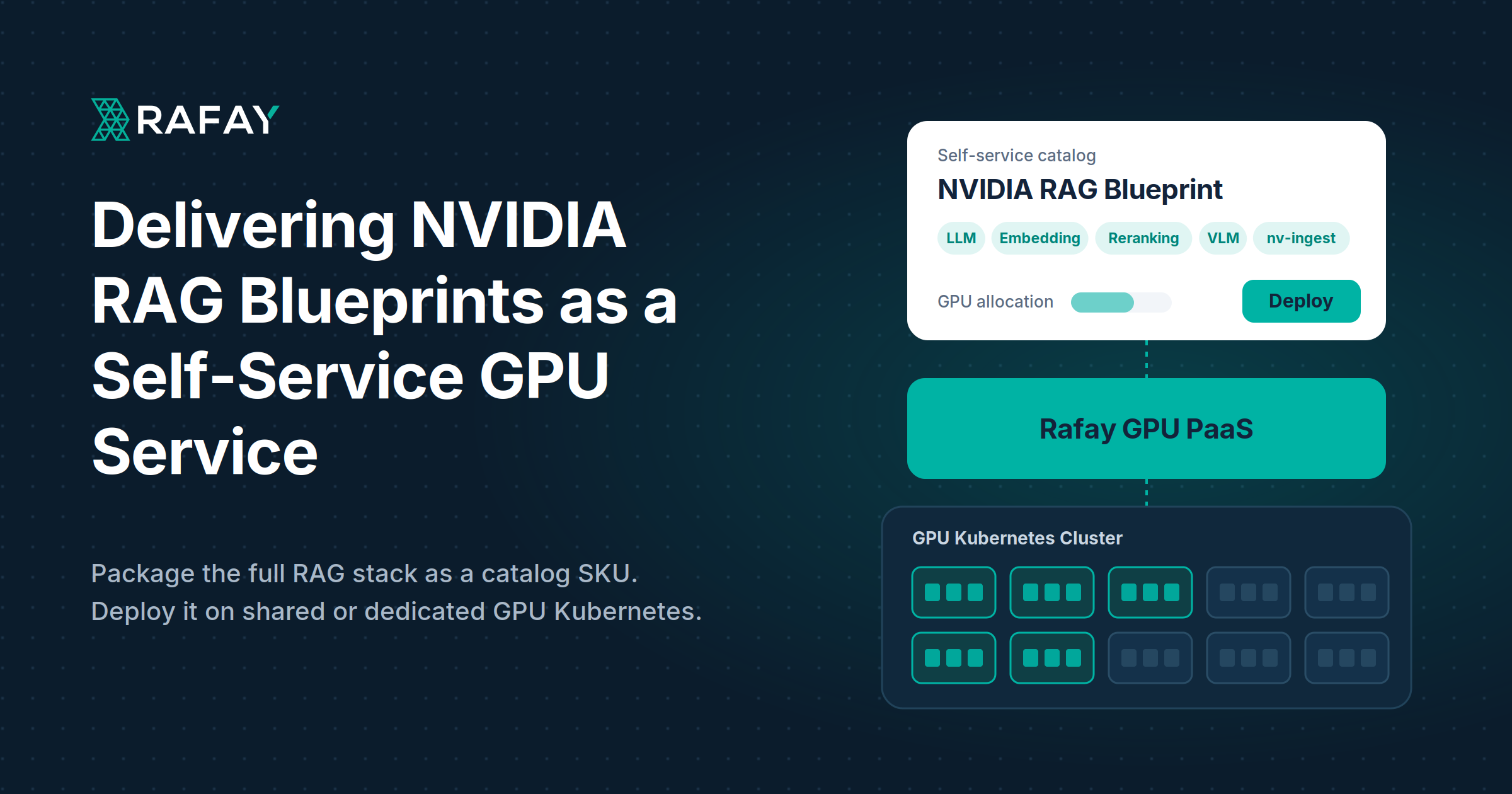
Rafay’s infrastructure management and orchestration platform is designed to help platform teams deliver AI workloads faster and more reliably—no matter where they’re running. The platform enables access to substantial computational resources required for demanding AI workloads, such as those needed for training complex neural networks.
With Rafay, platform engineers can:
- Provision GPU resources on demand across any environment
- Enable developer self-service with guardrails and RBAC
- Enforce policies and governance without slowing down innovation
- Monitor and optimize GPU usage to reduce waste and costs
- Integrate seamlessly with MLOps toolchains to accelerate model deployment
Whether you’re delivering AI models from NVIDIA GTC demos or supporting enterprise inference pipelines, Rafay gives platform teams the control and automation they need to succeed.
Use Cases: What This Looks Like in Practice
Here are some examples of how Rafay is helping platform teams simplify AI workload delivery in the real world:
- Cloud Providers: Enabling multi-tenant, serverless AI model hosting across Kubernetes clusters, supporting data analytics and the ability to analyze large volumes of data for various AI and machine learning use cases.
- Pharma Companies: Running secure, high-performance AI workloads in regulated environments with full policy controls, including deep learning models involving multiple layers to identify patterns in complex biomedical datasets.
- Retail Enterprises: Deploying real-time inference models to edge locations while maintaining central governance, and supporting fraud detection in finance by enabling machine learning models that identify suspicious behaviors.
- Manufacturing: Facilitating predictive maintenance by processing sensor and IoT data to forecast equipment failures, reduce downtime, and improve operational efficiency.
- Automotive: Powering autonomous vehicles by delivering AI workloads that drive technological advancements and operational efficiencies, including real-time analysis of visual data from cameras and LiDAR.
- Computer Vision Workloads: Rafay supports computer vision workloads that process visual data for tasks such as object detection, image classification, and facial recognition, leveraging high-performance computing resources to meet demanding real-time requirements.
- Natural Language Processing (NLP): Enabling AI workloads to analyze large volumes of text data for tasks like sentiment analysis, language translation, and speech recognition, as well as supporting data analytics for extracting insights from unstructured text.
Conclusion: Operationalizing AI Starts with the Platform
AI success in 2025 won’t just be about the models or the data—it will come down to how well platform teams can deliver, scale, and manage AI workloads.
It is also crucial to address ethical considerations, such as bias in AI algorithms and the broader societal impact, when operationalizing AI workloads.
The right platform unlocks:
- Faster time to market for AI products
- Lower TCO through smarter infrastructure management
- Increased developer productivity with automated pipelines
- Better security and compliance across environments
If you’re building out your AI infrastructure strategy, start by simplifying the delivery. Let Rafay help you get there.
Ready to Simplify AI Workload Delivery?
See how Rafay accelerates operational excellence for AI infrastructure.
Schedule a Demo