What Is an AI Factory?
An AI factory is an operational model for continuously building, training, deploying, and managing AI systems at scale.
Rather than treating AI as a collection of experiments or isolated GPU workloads, an AI factory treats AI as a production system. It combines high-performance compute, data pipelines, orchestration, governance, and deployment workflows into a unified platform designed to generate AI outcomes repeatedly and efficiently.
In simple terms, an AI factory industrializes AI.
Where the Concept of the AI Factory Comes From
The term “AI factory” gained prominence through NVIDIA’s framing of AI infrastructure as a production engine rather than a research environment. The metaphor is intentional. Just as a manufacturing plant transforms raw materials into finished goods, an AI factory transforms data and compute into trained models, inference services, and AI-powered applications.
But the concept extends beyond hardware.
While GPUs and accelerators are essential, an AI factory is not just a high-performance cluster. It is the system that enables continuous AI throughput, predictable delivery, and scalable operations.
For enterprises and cloud providers alike, this shift represents a move from experimentation to industrialization.
Why Enterprises and Cloud Providers Are Building AI Factories
AI is no longer a side initiative. It is becoming core to product differentiation, operational efficiency, and revenue generation.
Enterprises are building internal AI factories to:
- Standardize model development and deployment
- Govern GPU consumption and control costs
- Enable multi-team collaboration
- Support internal chargeback or cost recovery models
Cloud providers and neoclouds are building AI factories to:
- Package GPU-backed infrastructure into differentiated AI services
- Move beyond commoditized GPU resale
- Monetize inference, managed training, and AI platforms
- Create durable customer relationships
In both cases, the goal is the same: transform AI from a project into a scalable production capability.
Core Layers of an AI Factory
An AI factory is not a single product. It is a layered architecture.
1. Compute Layer
High-performance GPUs and accelerators provide the raw processing power for training and inference.
2. Data Layer
Pipelines that ingest, transform, and prepare large datasets for model development.
3. Orchestration Layer
Kubernetes environments, workload scheduling, automation, and environment standardization that coordinate how compute and data are consumed.
4. Governance and Consumption Layer
Multi-tenancy, metering, policy enforcement, and cost visibility to ensure AI usage is controlled and economically sustainable.
5. Application Layer
Models, APIs, and AI services deployed into production environments.
Together, these layers create a system capable of producing AI outputs continuously rather than sporadically.
AI Factory vs. AI Data Center
It is easy to confuse an AI factory with an AI data center. The difference is strategic.
An AI data center provides hardware capacity.
An AI factory operationalizes that capacity.
A data center focuses on machines.
An AI factory focuses on throughput, governance, and outcomes.
This distinction matters. Without orchestration, metering, and standardized workflows, high-performance infrastructure remains underutilized and difficult to monetize.
Why Orchestration Is the Missing Layer
Hardware alone does not create an AI factory.
To industrialize AI, organizations need a control plane that enables:
- Self-service provisioning of AI environments
- Policy-based governance
- Multi-team resource sharing
- Metered consumption
- Standardized deployment pipelines
This orchestration layer transforms raw GPU capacity into a consumable AI platform.
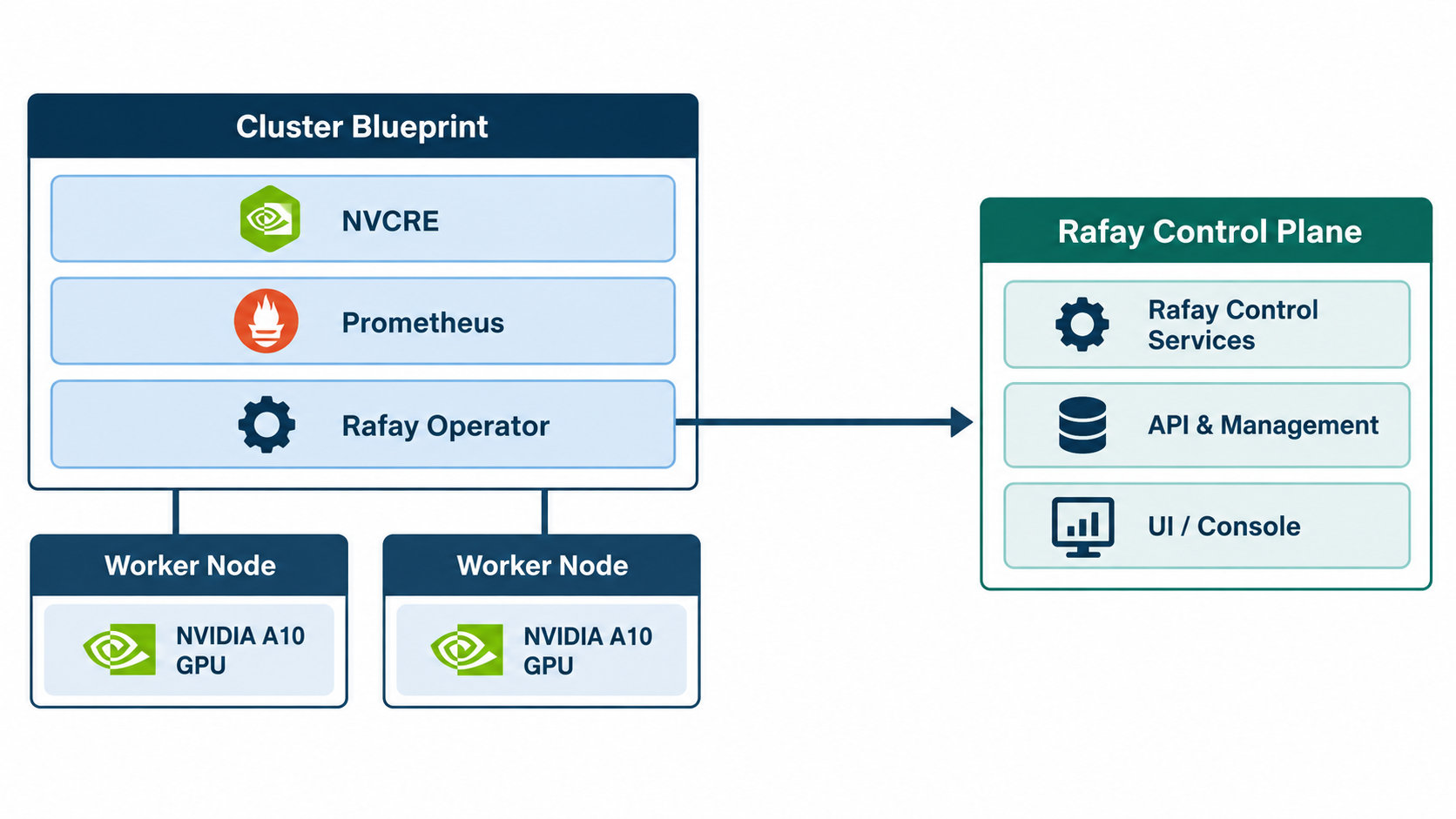
This is where companies like Rafay fit into the AI factory model. Rafay provides the orchestration and governance layer that enables enterprises and cloud providers to operate AI infrastructure as a scalable, multi-tenant production system rather than a collection of clusters.
Without this layer, organizations are managing infrastructure. With it, they are operating an AI factory.
AI Factory FAQs
Is an AI factory just a GPU cluster?
No. A GPU cluster provides compute capacity, but an AI factory includes orchestration, multi-tenancy, governance, metering, and deployment workflows. It transforms raw infrastructure into a scalable AI production system.
How is an AI factory different from an AI data center?
An AI data center focuses on hardware capacity. An AI factory focuses on operationalizing that capacity. It adds orchestration, consumption controls, and standardized workflows to enable continuous AI production rather than isolated workloads.
Who needs an AI factory?
AI factories are built by enterprises standardizing internal AI development and by cloud providers packaging GPU-backed services for customers. Any organization moving from AI experimentation to production-scale delivery can benefit from an AI factory model.
What role does orchestration play in an AI factory?
Orchestration coordinates how compute, data, and workloads are provisioned and governed. It enables self-service access, policy enforcement, multi-team collaboration, and usage visibility—turning infrastructure into a managed AI platform.
How do AI factories generate revenue?
For cloud providers, AI factories enable monetization through usage-based pricing, managed AI services, inference billing, and packaged service tiers. For enterprises, they support internal chargeback models and improved cost accountability.
Is NVIDIA the only provider of AI factories?
No. While NVIDIA popularized the term, an AI factory is an architectural model rather than a single vendor product. Organizations can build AI factories using GPUs and accelerators from multiple providers, combined with orchestration and governance platforms.
Can enterprises build internal AI factories?
Yes. Many enterprises are building internal AI factories to standardize AI development, govern GPU usage, control costs, and accelerate model deployment across multiple teams.
Why is governance important in an AI factory?
Without governance, AI workloads can lead to uncontrolled GPU consumption and rising costs. Metering, policy enforcement, and multi-tenancy ensure AI infrastructure remains scalable and economically sustainable.