At Rafay, we are continuously evolving our platform to deliver powerful capabilities that streamline and accelerate the software delivery lifecycle. One such enhancement is the recent update to our GitOps pipeline engine, designed to optimize execution time and flexibility — enabling a better experience for platform teams and developers alike.
Integrated Pipeline for Diverse Use Cases
Rafay provides a tightly integrated pipeline framework that supports a range of common operational use cases, including:
System Synchronization: Use Git as the single source of truth to orchestrate controller configurations
Application Deployment: Define and automate your app deployment process directly from version-controlled pipelines
Approval Workflows: Insert optional approval gates to control when and how specific pipeline stages are triggered, offering an added layer of governance and compliance
This comprehensive design empowers platform teams to standardize delivery patterns while still accommodating organization-specific controls and policies.
From Sequential to Parallel Execution with DAG Support
Historically, Rafay’s GitOps pipeline executed all stages sequentially, regardless of interdependencies. While effective for simpler workflows, this model imposed time constraints for more complex operations.
With our latest update, the pipeline engine now supports Directed Acyclic Graphs (DAGs), allowing stages to execute in parallel, wherever dependencies allow.
What Does This Look Like in Action?
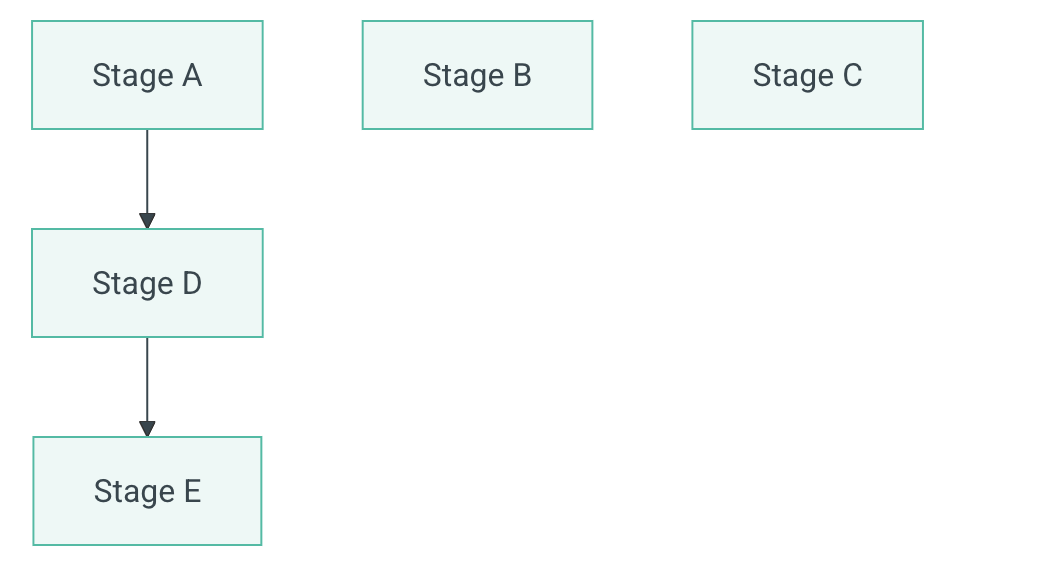
Consider a pipeline with five stages: A, B, C, D, and E.
Stages B and C are independent and can run at any time
Stage D depends on the completion of Stage A
Stage E depends on the completion of Stage D
With DAG-based execution:
A, B, and C can run in parallel
Once A completes, D is triggered
After D finishes, E is executed
This structure ensures that the pipeline respects stage dependencies while maximizing concurrency where possible, dramatically improving overall efficiency.
DAG Visualization
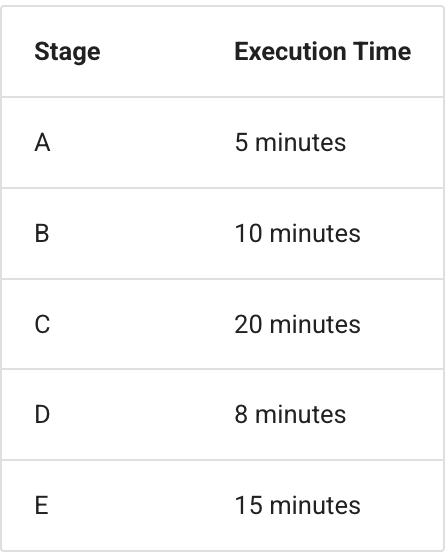
Example Execution Timeline
With sequential execution, total time could exceed 58 minutes.With DAG-based parallelism, the pipeline can complete in approximately 28 minutes, depending on system resources, a significant performance gain.
Try it on Preview
Support for executing stages in parallel will be available in Rafay's Preview Environment for all customers before rolling out to Production/SaaS.
Please contact Rafay CS if you do not have access to a Preview Org. We would love to hear your feedback! Please let us know how it’s helping you move faster, manage smarter, and innovate confidently.
GitOps Principles and Workflows Every Team Should Know
An Operating Model for Dynamic, Distributed Kubernetes Environments Kubernetes clusters have a lot of moving parts—and so does each application running on a cluster. With frequent application and environment updates, the state of every cluster can change rapidly.
Rafay Enhances Kubernetes Operations Platform with Enterprise-Grade Security, Standardization and Automation Capabilities
Over the past several years we’ve experienced a tremendous amount of change in the Kubernetes management and container orchestration market. Years ago, Kubernetes was used to support a relatively small number of clusters in lab environments, handling mostly corner use cases, and seen as a simple cluster management tool that was used by DevOps and IT Ops.
Top Kubernetes Takeaways From the 2020 AWS Container Security Survey
Amazon Web Services (AWS) recently published the 2020 AWS Container Security Survey results. This survey is a follow-up to the 2019 AWS Container Security Survey .