Introduction: Why Multi-Tenancy Matters for Modern Infrastructure
Multi-tenancy is an architectural model where multiple teams, applications, or customers share the same underlying infrastructure while keeping their environments fully isolated. In a multi-tenant model, tenants share compute, networking, and storage resources, but operate within fully isolated logical boundaries. This approach is foundational to running scalable, efficient Kubernetes platforms—especially as organizations support more internal teams, more environments, and more workloads. Multi-tenancy is a key principle in cloud computing, where cloud services enable resource sharing, cost savings, and scalability by hosting applications and data on remote servers accessible via the internet.
Platform engineering teams use multi-tenancy to reduce operational overhead, standardize governance, and maximize resource efficiency across shared infrastructure. This guide breaks down how multi-tenancy works, its benefits and challenges, and how Rafay helps enterprises implement it securely at scale.
What is Multi-Tenancy?
Multi-tenancy refers to a shared infrastructure model in which multiple tenants operate independently within isolated environments. In this architecture, a single software instance serves multiple tenants, ensuring that each tenant's data and operations remain isolated and secure.
Each tenant has access to the resources, policies, and tooling they need—without affecting other tenants on the same platform.
Examples of tenants include:
Internal development teams
Business units
Product lines
External customers (SaaS model)
Application groups
This model helps organizations scale infrastructure faster while maintaining strict policy, access, and security controls.
How Multi-Tenancy Works
Shared Underlying Infrastructure
All tenants share computing resources—such as CPU, memory, storage, networking, or Kubernetes clusters—within the environment. In multi-tenant architectures, these shared resources allow multiple tenants to leverage common hardware and software, reducing costs and simplifying management. All tenants operate on the same physical infrastructure while maintaining logical separation to ensure data security and customization.
Isolation Through Software Controls
Isolation is enforced through mechanisms such as data isolation, which is a primary goal to ensure each tenant's data remains secure and independent. Ensuring data isolation is critical to prevent cross-tenant data access and maintain strong security boundaries.
Namespaces
Network policies
Resource quotas
Secrets management
Policy engines
Virtual Kubernetes clusters
Strict access controls to protect tenant data and maintain proper data filtering
Identity, Access, and Policy Enforcement
Authorization is managed through:
Role-based access control (RBAC)
Identity federation (SSO, LDAP, SAML)
Identity management (using solutions like Okta, Auth0, or Azure Active Directory) for secure authentication and authorization
Policy guardrails
Tenant-specific configuration constraints
Business rules can also be customized per tenant, allowing each tenant to define specific behaviors and policies within the shared environment.
Control Plane vs Tenant Environments
Some models share a Kubernetes control plane, while others provide virtualized control plane instances for deeper isolation. In some architectures, separate instances or a dedicated instance are deployed for each tenant, offering enhanced isolation, security, and customization compared to shared environments.
Key Characteristics of Multi-Tenant Architecture
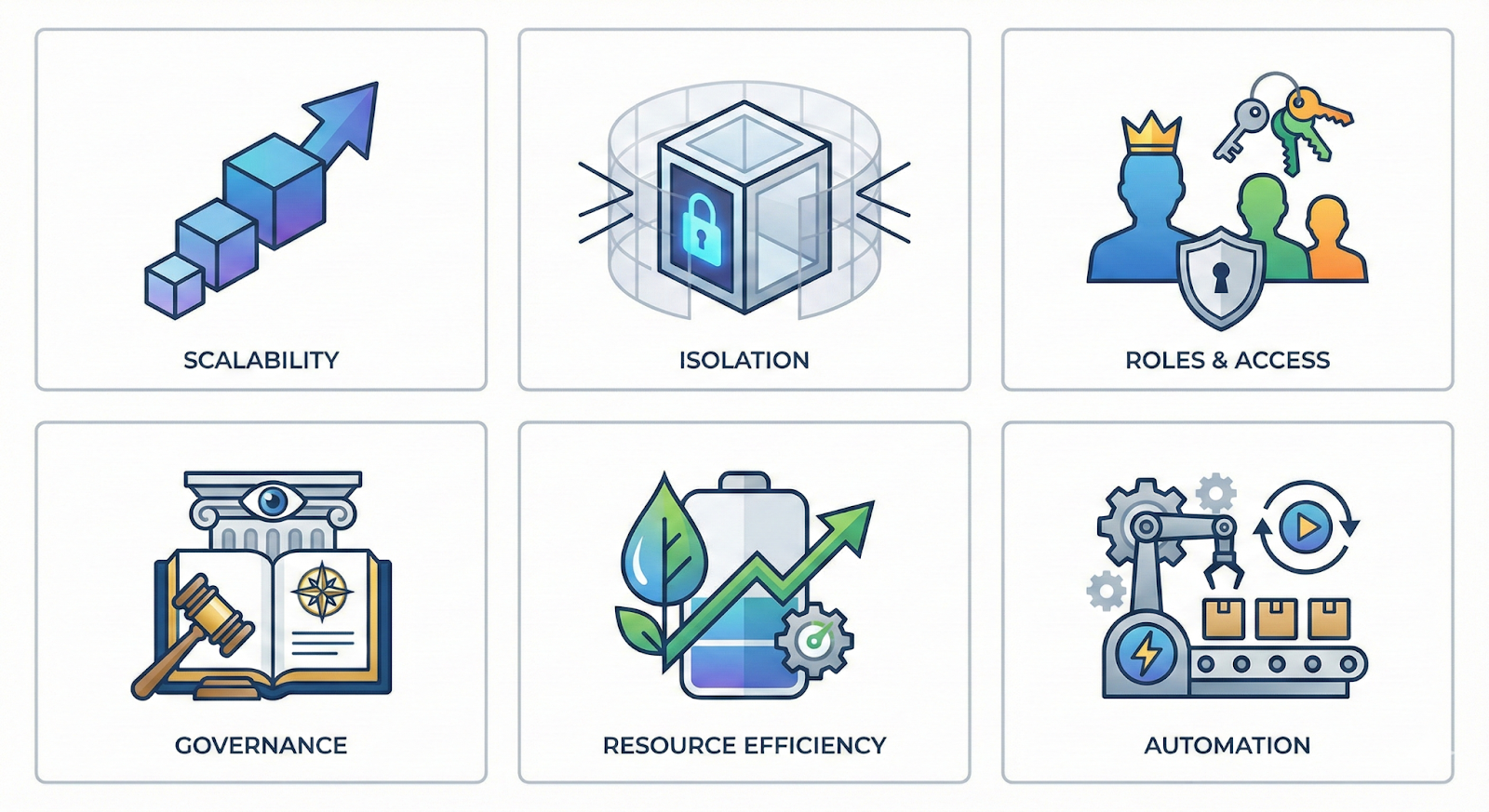
Shared infrastructure with isolated tenant environments: Multiple tenants operate securely on the same physical infrastructure while keeping their data and operations separate.
Strong identity and access controls: Robust authentication and authorization mechanisms ensure each tenant accesses only their own resources.
Centralized governance and standardization: Policies and controls are managed centrally to maintain consistency and compliance across tenants.
Consistent policy enforcement: Uniform application of security, resource, and operational policies for all tenants.
Scalability across teams and workloads: The architecture supports growth by efficiently handling increasing numbers of tenants and their workloads.
Efficient resource utilization: Shared resources are dynamically allocated to maximize performance and reduce costs.
Automation and repeatability: Automated provisioning and management streamline tenant onboarding and maintenance.
Tenant-specific customization within a multi-tenant system: Multi-tenant architectures enable each tenant to customize their environment and business rules without affecting others, ensuring tenant isolation, data security, and tailored resource management.
Benefits of Multi-Tenancy
Reduced Infrastructure Costs: Sharing resources minimizes the need for dedicated clusters for every team.
Faster Tenant Onboarding: Onboarding new tenants is streamlined through automation and standardized processes, allowing new teams or applications to be provisioned in minutes using templates or blueprints.
Higher Resource Utilization: Unused capacity can be shared across tenants, reducing waste and enabling better resource utilization by dynamically allocating unused capacity across tenants.
Centralized Governance: Policies, controls, and standards can be applied across all tenants from a single place.
Operational Efficiency: Platform teams spend less time managing redundant environments.
Accelerated Development: Developers get rapid access to environments without waiting for cluster provisioning.
Challenges and Risks of Multi-Tenancy
Resource Contention: Workload spikes from one tenant can affect others without proper quotas.
Noisy Neighbor Effects: Spikes in one tenant’s workload can degrade performance for other tenants when isolation controls are insufficient.
Workload Interference: Imperfect isolation can lead to unpredictable behavior or degraded service quality.
Security and Access Risks: Misconfigured RBAC or policies can expose sensitive resources.
Governance Complexity: More tenants = more rules to maintain and enforce.
Compliance Requirements: Regulated industries require strict auditability and isolation guarantees.
Operational Overhead Without Automation: Manual processes do not scale across tens or hundreds of tenant environments.
How Rafay Mitigates These Risks Rafay provides automated policy enforcement, drift detection, resource governance, audit logging, zero-trust access controls, and virtual cluster support—all designed to eliminate multi-tenant risk.
Examples of Multi-Tenant Systems
Multi-Tenant Platforms
DevOps platforms, orchestration systems, and container management layers.
Multi-Tenant Databases
Multi-tenant databases can be implemented using a shared database with isolated schemas or data segmentation, where multiple tenants share the same database instance but have their data separated for security and compliance. Multi-tenant database architectures are designed to securely store data for multiple tenants while ensuring strict row-level or schema-level isolation. Alternatively, a separate database per tenant—or even multiple databases—can be used to provide stronger data isolation and reduce the risk of cross-tenant data leakage.
Each approach carries different trade-offs related to scalability, operational overhead, security, and resource efficiency. Managing separate databases increases isolation but requires more maintenance, while shared-database architectures simplify operations at scale.
Multi-Tenant Kubernetes Environments
A single Kubernetes cluster can support multiple tenants by allowing them to share the same underlying infrastructure—typically through namespaces or virtual clusters. This model optimizes resource utilization and simplifies management by enabling tenants to run workloads in logically isolated environments while relying on common cluster resources.
This approach allows organizations to deploy, scale, and manage multiple tenant environments efficiently, without duplicating entire clusters for every team or customer.
Multi-Tenancy in Kubernetes
Namespace-Based Multi-Tenancy
Best for:
Application teams
Developers
Lightweight environments
CICD-driven workflows
Namespace-based multi-tenancy involves tenants sharing the same cluster resources, such as application instances or hardware, while maintaining logical separation through namespaces. This approach allows for data isolation, security, and scalability benefits even as tenants share the underlying infrastructure.
Namespaces provide:
Scoped access
Resource quotas
Network segmentation
Fast provisioning
Virtual Kubernetes Clusters (vClusters)
Ideal for:
Teams needing cluster-level privileges
Custom controller development
CRD or operator testing
Environments that must closely resemble production
Virtual clusters provide deeper isolation without requiring physical clusters for every use case. Similar to how virtual machines offer isolated environments within shared hardware, virtual clusters enable secure and efficient multi-tenancy within a shared Kubernetes infrastructure.
Common Use Cases for Multi-Tenant Infrastructure
Internal platform teams supporting multiple dev teams or serving multiple clients across different projects
Enterprises with many business units or different tenants, each with unique requirements and data management needs
SaaS providers isolating customer environments to securely support multiple customers and maintain data separation for multiple clients
Regulated organizations requiring strict separation for different tenants to comply with varying regulations
Multi-cluster and hybrid infrastructure deployments designed to efficiently serve multiple customers and different tenants while ensuring security and cost efficiency
While native Kubernetes offers foundational primitives for multi-tenancy, enterprises require stronger isolation, governance, security, and lifecycle automation to operate at scale.
How Rafay Enables Secure Multi-Tenant Kubernetes at Scale
Rafay provides a purpose-built, enterprise-grade multi-tenancy framework designed to help platform engineering teams securely scale Kubernetes across hundreds of tenants, clusters, and environments. The platform delivers deep isolation, centralized governance, and automation—ensuring every tenant receives the right level of access, security, and resources without increasing operational overhead.
Why Choose Rafay for Multi-Tenancy Infrastructure?
Virtual and Runtime Isolation
Rafay supports both namespace-based and virtual cluster (vCluster) isolation models. Teams can:
Provision virtual Kubernetes clusters (vClusters) for deeper isolation
Segment tenants using dedicated namespaces
Enable secure container runtimes like Kata Containers for VM-level sandboxing
Meet strict compliance and multi-environment requirements
This ensures tenants receive strong workload isolation without requiring separate physical clusters.
Network and Cluster Policies
Rafay centralizes governance by enforcing fine-grained network and cluster-level controls across all tenants.
Capabilities include:
Network segmentation between namespaces and tenants
Yes—when isolation, policies, RBAC, and audits are correctly implemented.
When should teams use virtual clusters?
When they require cluster-level privileges, custom resources, or production-like environments without full cluster overhead.
How does Rafay support multi-tenancy?
Through automated isolation, RBAC, policy enforcement, drift detection, auditing, and virtual cluster management.
Conclusion
Multi-tenancy has become a critical architectural pattern for teams running Kubernetes at scale. It enables consistent, secure, and efficient use of shared infrastructure while supporting rapid growth in users, workloads, and environments. By allowing multiple tenants to share the same resources, operate on the same infrastructure, and often utilize a single instance of the application, multi-tenancy delivers significant efficiency and scalability benefits.
Bottom Line: Rafay delivers the full multi-tenancy lifecycle—provisioning, isolation, governance, security, cost management, and self-service—allowing enterprises to scale Kubernetes environments confidently and securely.
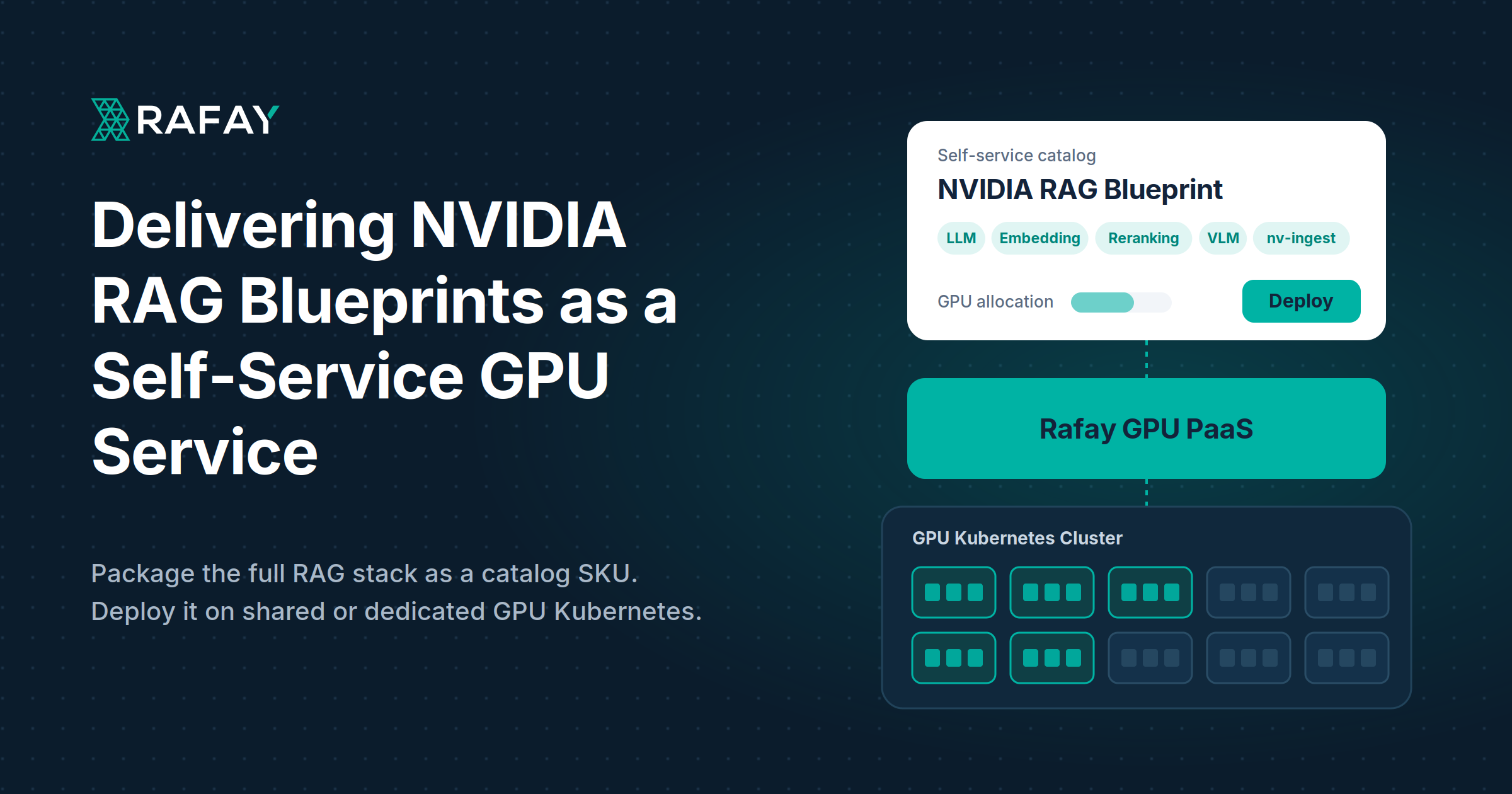
Delivering NVIDIA RAG Blueprints as a Self-Service GPU Service
A production RAG stack spans LLMs, embedding and reranking models, ingestion, and search. See how Rafay GPU PaaS turns the NVIDIA RAG Blueprint into a repeatable, self-service catalog offering for neoclouds.
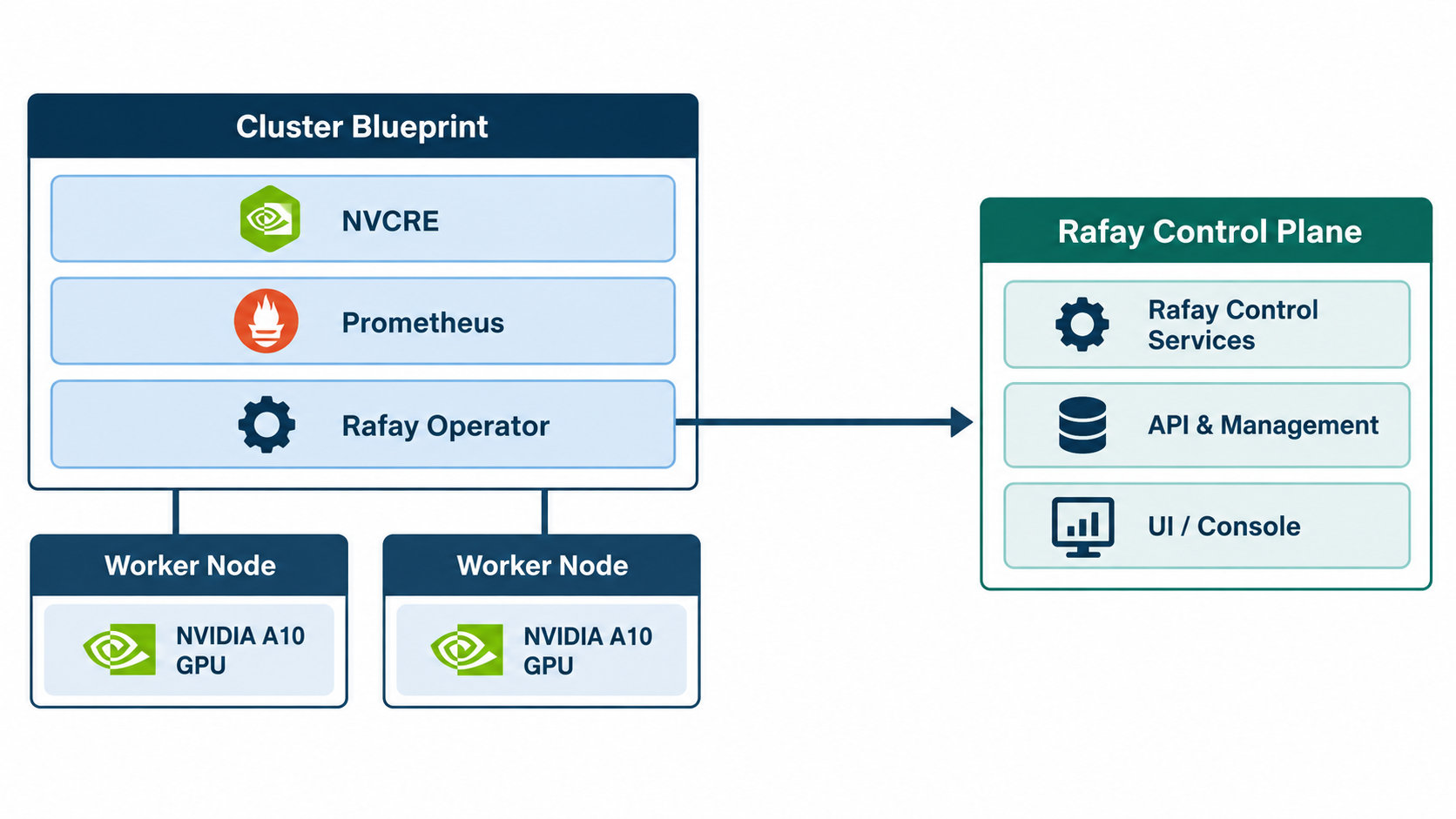
Certifying Tenant GPU Kubernetes Clusters with NVIDIA Cluster Readiness Engine
Learn how NeoClouds can use NVIDIA Cluster Readiness Engine to certify GPU Kubernetes clusters before tenant handoff and validate AI workload readiness.