What Is Programmable Edge? Operating Distributed AI and Cloud-Native Infrastructure
Read Now
No items found.
2026-08-31

To compete with online shopping, retailers have to bring the advantages of technology to their in-store experience. However, that’s easier said than done. Delivering the best customer experience often means bringing complex hardware into the store. Embracing “edge computing” creates a host of challenges that retailers have to contend with.This blog discusses the challenges associated with edge computing in a retail environment, explores the pros and cons of using Kubernetes to address those challenges, and explains how Rafay enables Kubernetes at the edge.
You may already know you need to increase your “smart store” capabilities, but why would you even consider deploying specialized computing hardware in each store? Wouldn’t it be easier to run the necessary applications in the cloud? For many store locations, bandwidth, latency, and connectivity issues make it impossible to deliver the desired customer experience without local hardware.But deploying and operating local hardware and software in each store can be fraught with challenges. First, there’s the problem of expertise. Even if you could find enough technical experts, it would be prohibitively expensive to have a tech team in each location. This means you need a way to manage the necessary hardware and software remotely.Then there’s the problem of choosing hardware and software solutions. Many traditional solutions for retail are proprietary and expensive. Yet these solutions are often behind the power curve and evolving too slowly to meet your needs.
Many retailers are looking at Kubernetes as an alternative solution for edge retail locations. By processing data locally, the amount of data sent is drastically reduced, requiring far less bandwidth or connectivity time than might otherwise be necessary.Developing custom applications and running them in each location, creates the opportunity for unique differentiation that delights customers and keeps them coming back. If you choose this path, Kubernetes offers many potential advantages:
However, Kubernetes comes with some challenges of its own. It has a reputation for being complex and hard to manage. As already discussed, it simply isn’t practical to have someone in each store with the expertise to keep everything running and up to date. This means there are some important questions you’ll need to ask yourself as you plan a Kubernetes deployment:
This is where Rafay comes in. Rafay helps you solve the challenges of operating Kubernetes at the edge, providing centralized and intuitive management for hundreds of Kubernetes clusters and associated applications.To learn more about Kubernetes at the edge and critical capabilities read the recent Rafay blog, Critical Factors for Managing Applications and Kubernetes at the Edge.
Rafay makes it simple to run Kubernetes in each of your retail locations, giving you the ability to centrally manage the infrastructure and applications your stores will depend on. Rafay’s Kubernetes Operations Platform for Edge gives you the capabilities you need, including centralized, policy-based management, automation, standardized operations, and advanced security.And, because KOP is a SaaS-based service, there’s nothing to install or manage so it’s easy to get started.
Rafay’s Multi-Cluster Management Service (part of the Rafay KOP) lets you deploy, manage, and upgrade Kubernetes clusters and applications in every store from a centralized console. It provides all the necessary features to manage the entire Kubernetes and application lifecycle.By automating and standardizing common cluster and application operations, you can manage more locations with less effort while avoiding misconfigurations due to human errors. Rafay capabilities include:
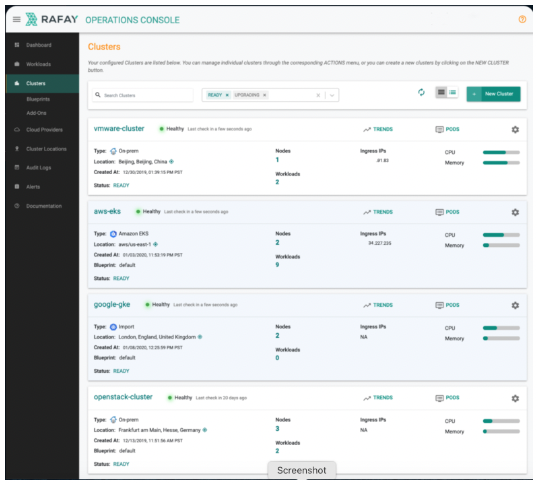
When you are deploying to hundreds of stores it is important to have a standardized configuration. “Snowflake” clusters create management challenges. Kubernetes by itself doesn’t provide a means to create a standard cluster.Rafay offers multiple capabilities that make it easy to standardize cluster and application deployments at the edge or anywhere:
To learn more read the recent Rafay blog Choosing the Best Kubernetes Cluster and Application Deployment Strategies.Manually deploying applications to tens or hundreds of retail locations is an impossible task. Automation is essential. GitOps is taking over the world, it’s great for the edge, and the Rafay GitOps service makes it fast and easy to get started.To learn more about GitOps, read GitOps Principles and Workflows Every Team Should Know.
Local computing means storing some data locally. This is also essential so that stores can operate autonomously for short periods if connectivity challenges arise. With each store containing customer information—and serving as a potential entry point for would-be attackers—you need the highest-level of security and control. Rafay’s Zero-Trust Access Service delivers stringent access control that can be standardized across all your retail locations.
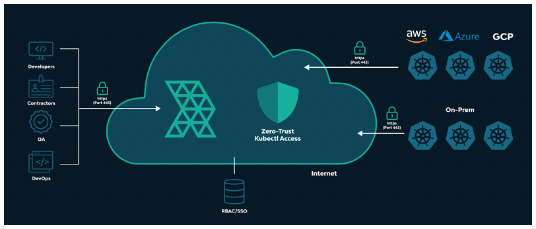
Rafay eliminates the burden of having to configure and manage Kubernetes Role Based Access Control (RBAC) for each cluster. Streamline and consolidate access control for your fleet of clusters spanning stores, data centers, and cloud environments. A single login gives authorized users seamless and secure access where they need it.To learn more read the Rafay white paper Best Practices for Securing Kubernetes.You can learn more about Rafay Kubernetes Operations Platform for the Edge here to discover how Rafay can help you simplify, standardize, and secure your retail operations. Ready to find out why so many enterprises and platform teams have partnered with Rafay for Kubernetes at the edge? Sign up for a free trial.
Read Now
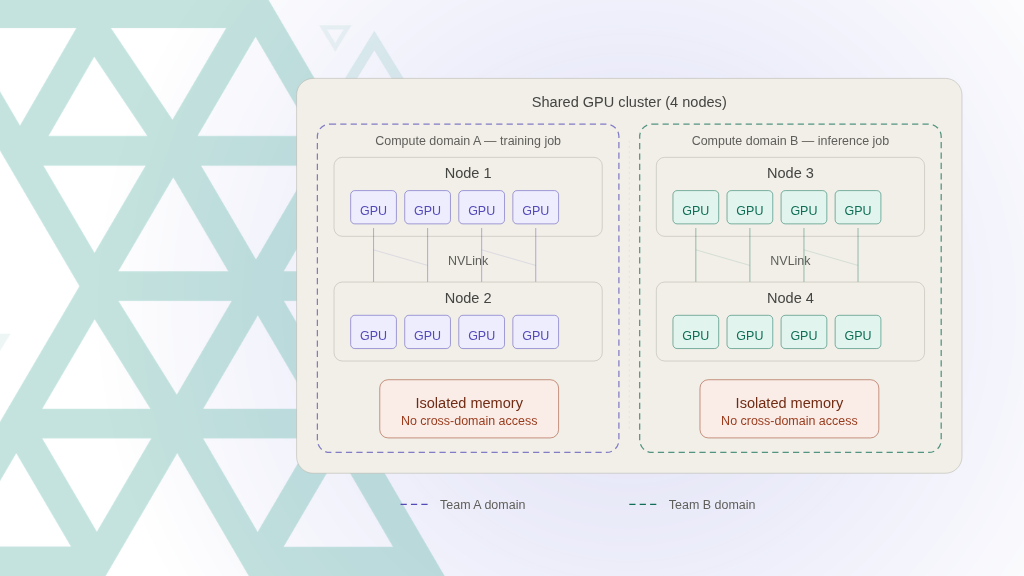
Learn how compute domains and multi-node NVLink enable high-performance, distributed GPU workloads in Kubernetes, improving scalability, resource utilization, and AI infrastructure efficiency.
Read Now
Business is being driven to the network’s edge because of several advantages it provides. Autonomous vehicles, remote asset monitoring, in-hospital patient monitoring, and real-time defect detection in factories are just a few examples of business applications that leverage the responsive performance, scalability, and reduced latency found at the network edge.
Read Now