What’s New in Kubernetes v1.24?
Kubernetes v1. 24 is almost here.
Read Now
No items found.
2022-04-22

How Team Rafay is extending Kubernetes to meet the needs of large enterprises and service providersIt's been a fast-paced 2 years here at Rafay, with the company maturing into a healthy startup with engaged customers and a very busy engineering team focused on delivering . a turnkey solution for Multi-Cluster Management& Application Operations. Many of us on the team also get to directly interact with customers’ DevOps and Operations engineers. Version-1 of our core platform has racked up a lot of miles in the field, allowing the team to collect enough data about where vanilla Kubernetes falls short for enterprises.Over the last 6 months, my colleagues and I have been working on a number of extensions to Kubernetes that address a myriad of use cases. Our customers have expressed a lot of interest in better understanding our implementation, specifically the components that reside on their Kubernetes clusters. As our work output rolls out as part of the platform’s Version-2 release, we would like to share the implementation’s core design with the community. We also intend to open-source our implementation.High-Level Goals and ArchitectureOur deep-rooted customer engagements helped us put together a clear list of requirements that needed to be addressed by the platform:
1. Must not need inbound ports to be opened on firewalls: Enterprises will operate Kubernetes clusters in heterogeneous environments. Be it in a VPC in Amazon or in a data center, enterprise security teams prefer to not have any entity requiring inbound access from the Internet. Furthermore, any artifact on a cluster that needs to reach out to an external service must be able to carry out all external interactions over HTTPS (tcp:443). Mutually authenticated TLS sessions are always desirable.
2. Must be able to federate multiple clusters into a manageable fleet: Enterprises tend to operate multiple Kubernetes clusters across public cloud regions, data centers, and the Edge. Customers must be able to manage all clusters as a fleet, not each cluster individually.
3. Must provide cluster bringup workflows with fleet-wide customization capabilities: If an enterprise has standardized on a certain methodology for logs & metrics collection (e.g. use fluentd and prometheus, respectively), TLS termination (e.g. use nginx as the ingress controller), etc., there must be an easy workflow for the DevOps team to apply such requirements across the entire fleet as needed, be it in the cloud, on premises, or at the Edge.
4. Must provide a way to normalize multiple configuration formats: An enterprise is likely to have multiple teams spread across multiple geographies and working independently on different applications. Enforcing a single configuration management framework across the enterprise may be highly impractical. Teams should be able to use their prefered format: Helm, Kustomize or k8s native YAML. The platform should be able to normalize across any configuration into a single format.
5. Must guarantee real-time reconciliation of configuration across clusters: When operating a fleet of Kubernetes clusters, ensuring that no single cluster experiences configuration drift (due to pilot error, for example), is a non-trivial task. The platform should be able to detect configuration drifts across the fleet and resolve them quickly.
In addition to the above objectives, we also wanted to keep our implementation’s footprint on the cluster as small as possible to maximize the resources available for the customer applications.With these objectives in mind, we came up with the following architecture:
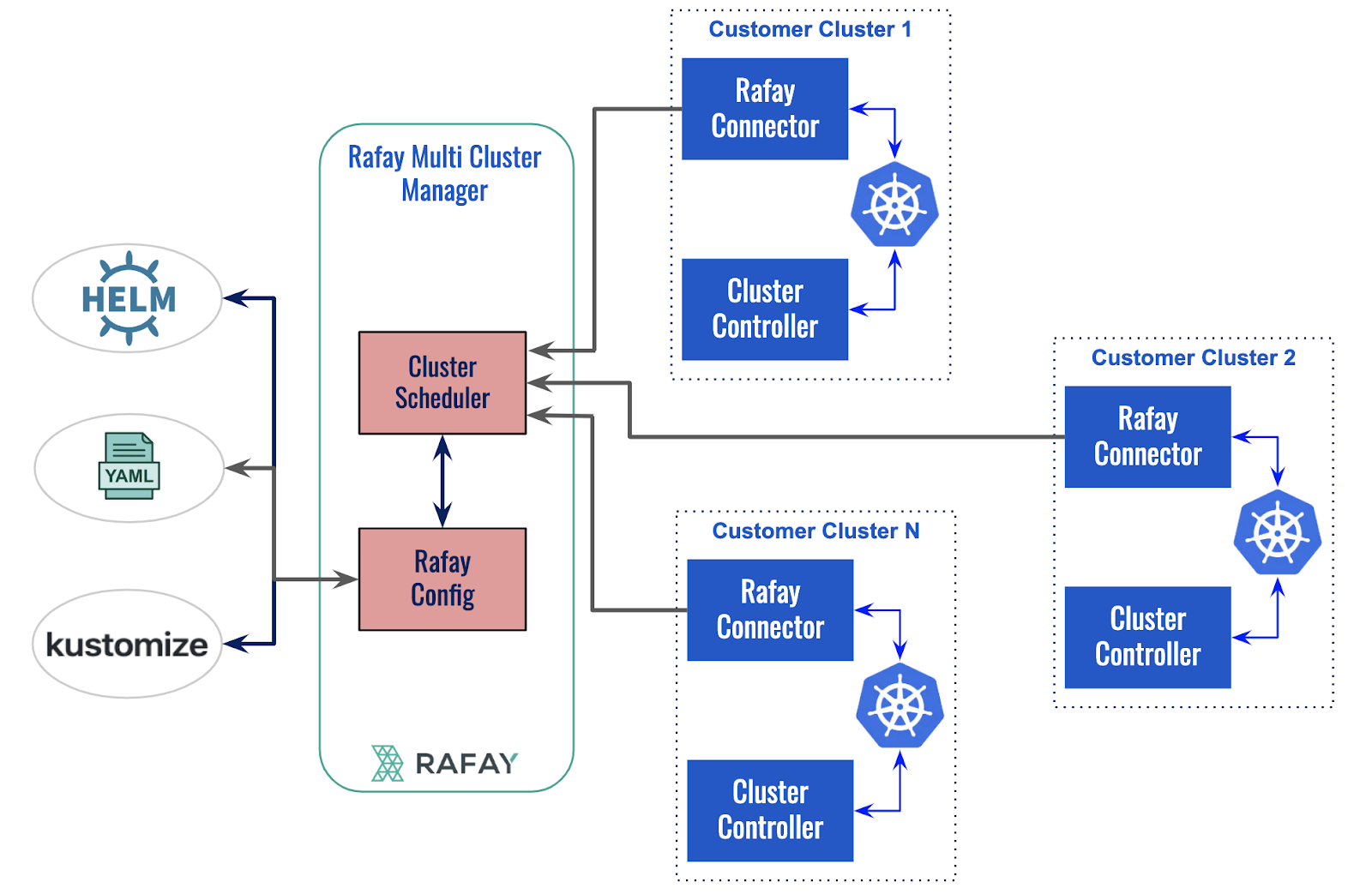
These four components are the fundamental framework of our platform, helping us achieve our design objectives and more. The flexibility of our normalized representation, along with the platform’s multi-cluster federation capabilities helped our teams rapidly implement a number of enterprise focused features on top of our base platform.We’ve had this implementation deployed in production for some time now, which means all of our customers are already leveraging our differentiated framework for Kubernetes. If you’d like to learn more about it or try it out, please get in touch via email. If you would like to try out our platform, please, sign-up at https://app.rafay.dev for a free trial account. You can learn more about Rafay on our blog, LinkedIn posts or on Twitter. Also feel free to reach out to me directly via LinkedIn.Last but certainly not least, I’d like to take this opportunity and thank my colleagues Amudhan Gunasekaran, Andy Zhou, Hruday Gudepu and John Dilley for their invaluable contributions to developing this framework.

Rafay Systems has been recognized as a Representative Vendor in the 2022 Gartner® Market Guide for Container Management Rafay Systems has been recognized as a Representative Vendor in the 2022 Gartner® Market Guide for Container Management. * We believe that being included in this market guide report underscores that Rafay’s global customer base and Infrastructure and Operations (I&O) teams recognize value in the company’s unique approach for operating Kubernetes infrastructure and modern, containerized applications.
Read Now

Many people already have eyes on the upcoming Kubernetes v1. 24, which is scheduled for an official rollout on Tuesday, April 19, 2022.
Read Now