From GPUs to Revenue: What We Heard at the AI Infrastructure Leadership Summit in Barcelona

For two days in Barcelona, nearly 150 AI infrastructure leaders from across the NeoCloud, enterprise, technology, investment and partner ecosystem came together around a deceptively simple question:
What does it take to turn AI infrastructure into a sustainable AI business?
The answer was much bigger than GPUs.
Across sessions from NVIDIA, Accenture, Lenovo, DDN, Netris, Rafay customers and AI infrastructure operators, the conversation repeatedly moved beyond acquiring compute. The harder questions are now about utilization, power, inference economics, enterprise demand, sovereignty, automation and the operating model required to turn infrastructure into services customers actually want to consume.
Day 1 centered on the economics of building profitable AI infrastructure businesses. Day 2 looked further ahead at inference, enterprise AI, sovereign deployments and what operators will need as AI factories scale.
Here are the speaker highlights and the themes that stood out.
Day 1: Building an AI infrastructure business, not just AI capacity
Haseeb Budhani, CEO, Rafay: Focus on the business, not assembling the stack
Rafay CEO Haseeb Budhani opened the summit with a message that became a recurring theme throughout the event: AI infrastructure operators should spend their scarce time and capital building their businesses, not recreating every element of the technology stack themselves.
The market has matured rapidly. Access to GPUs is still important, but success increasingly depends on how quickly operators can bring capacity online, make it consumable, integrate the surrounding ecosystem and begin generating revenue.
“When you implement an AI factory, you should not stress about software. You should not stress about implementation, you should not stress about services.”
His advice to operators was straightforward: focus on power, real estate and customers, then lean on the ecosystem for the capabilities required to operationalize the infrastructure.
Warren Barkley, NVIDIA: Compute needs to become revenue faster
Warren Barkley, who leads DSX and DGX Cloud at NVIDIA, offered a view into the scale and complexity of the AI factories now being built.
Factory-scale systems introduce extraordinary operational challenges across networking, power, memory, storage and supply chains. That makes standardization and ecosystem collaboration increasingly important.
But Barkley connected the technology challenge directly to the business challenge:
“Compute is revenue. How do we actually accelerate compute being revenue super quickly?”
He also emphasized NVIDIA’s ecosystem philosophy, recounting one of the questions Jensen Huang repeatedly asks his team:
“Who in the ecosystem is using your stuff, and how happy are they with it? Is it moving things forward?”
That perspective captured a broader truth from the summit. No single company is going to build every layer of the AI factory. The competitive advantage increasingly comes from getting the ecosystem to operate as one.
Andrew Leece, Sharon AI: Growth can move extraordinarily fast
Sharon AI provided a concrete example of just how quickly demand can scale for AI infrastructure providers.
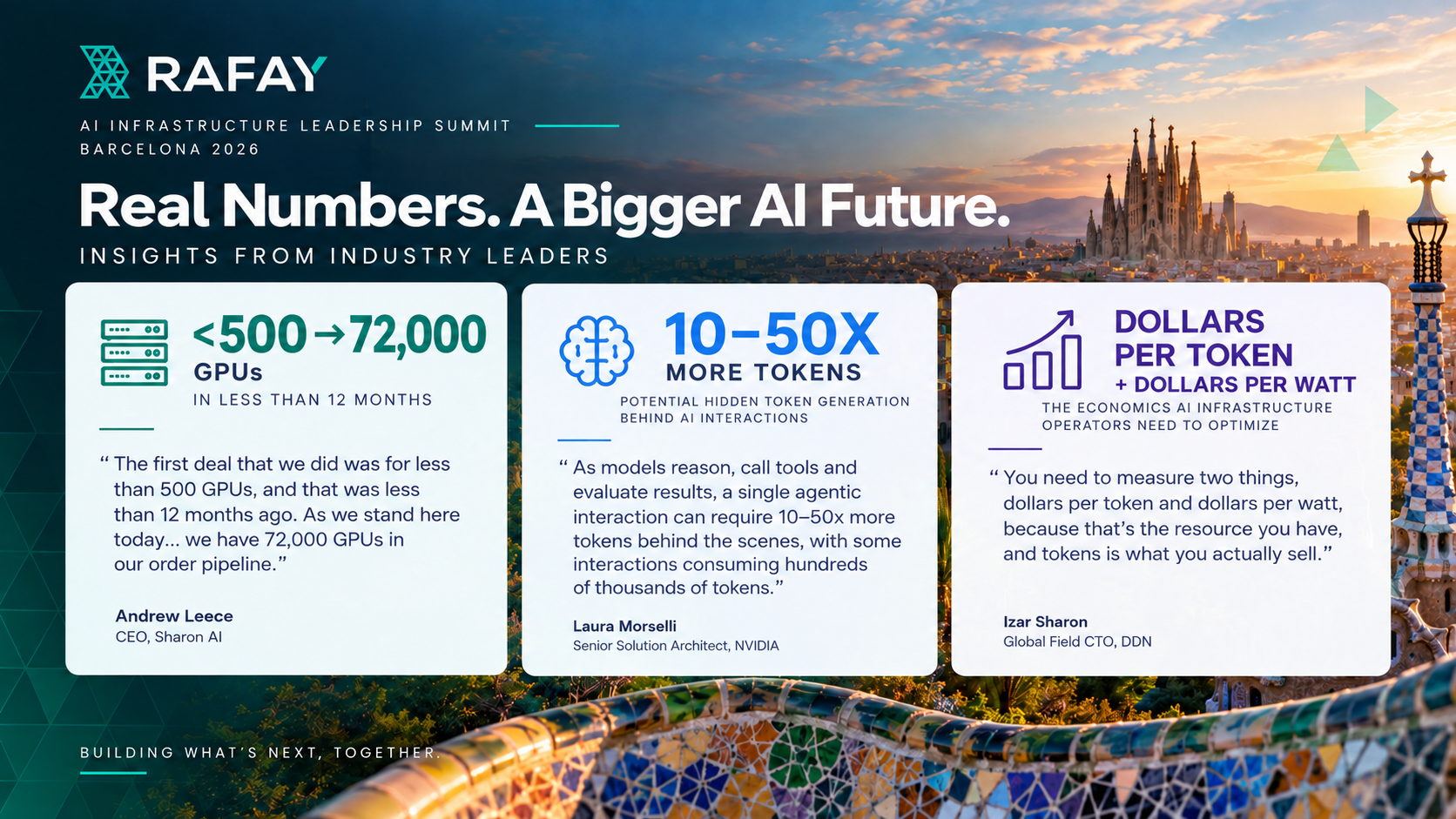
Andrew Leece described a company that had gone from an initial deployment of fewer than 500 GPUs to a pipeline measured in tens of thousands in less than a year.
“The first deal that we did was for less than 500 GPUs... As we stand here today... we have 72,000 GPUs in our order pipeline.”
That pace has major implications for infrastructure architecture. Processes that work for several hundred GPUs can collapse when demand moves into the tens of thousands. Automation, standardized architectures, multi-tenancy and repeatable operations have to be considered early.
Noam Rosen, Lenovo: Shift from maximizing tokens to maximizing outcomes
Lenovo’s Enterprise AI session reframed a metric that came up repeatedly throughout the summit.
For the last several years, AI discussions have focused heavily on access to models, token consumption and infrastructure capacity. Noam argued that enterprise buyers are beginning to ask a more important question: what business outcome did those tokens produce?
“The next question is not how much tokens we are consuming, but what business outcome we are creating.”
He captured the shift succinctly:
“For me, this is the shift from token maxing to outcome maximizing.”
That has consequences for infrastructure providers. Enterprises ultimately care about productivity, control, economics and trust. Infrastructure has to disappear behind an experience that makes those outcomes easier to achieve.
Alex Saroyan, CEO of Netris: Standardize the first cluster, not the tenth
As AI infrastructure footprints expand, networking becomes another source of operational debt if it is handled differently in every deployment.
Netris CEO Alex discussed the importance of building automation, abstraction and multi-tenancy into network operations early rather than waiting until scale forces the issue.
“Your first cluster, you should do it right, and then it becomes your habit and it helps you grow.”
The message applied well beyond networking. Every custom implementation creates friction that compounds as the number of clusters grows. The operators who standardize early can increasingly replicate architectures rather than engineer every environment from scratch.
The finance panel: AI economics meet capital, utilization and power
The Day 1 finance panel brought together perspectives from infrastructure operators and investors to examine the economic realities underneath the AI boom.
Elvir Stupar, of Cisco described a financing market that has become increasingly active as AI infrastructure requirements expand. Cisco’s Global Infrastructure Funds organization is using equity and external investment partnerships to help support customer and partner growth.
Chester Reid, CFO of ERA4, highlighted AI’s impact on the operating side of the business as well. For knowledge work, a much smaller group can now accomplish work that previously required considerably larger teams.
“You find that one or two people can do a job that probably five or six would have iterated on in previous years.”
Nick Jacobs, co-founder of AI Mills, discussed the challenge from a European sovereign AI perspective, particularly the constraint created by grid congestion and the time required to expand power infrastructure.
“If we want to expand... quicker,” he said, operators have to rethink how and where capacity gets built.
Chirag Bhagat of Parinita AI brought another dimension to the discussion: alternative funding structures. His company has used crowdfunding both as a capital source and as a way to build an eventual customer base.
“The advantage of that is [it] also brings in a large customer base when we go out and launch.”
But the panel ultimately converged on the resource constraint underneath everything else. Chester summarized it best:
“Power and GPUs. They’re the two things that we need to solve for.”
Izhar Sharon, DDN: Measure the output that creates value
DDN Global Field CTO Izhar Sharon pushed the utilization discussion beyond whether a GPU appears “busy.”
Traditional utilization metrics can mask how much useful work the infrastructure is actually producing. That makes output-oriented measures increasingly important.
“You need to measure two things, dollars per token and dollars per watt, because that’s the resource you have, and tokens is what you actually sell.”
For AI factories, that distinction matters. High nominal GPU utilization does not automatically mean high economic productivity. Storage, networking, memory, orchestration and workload design all affect how many useful tokens the system ultimately produces.
Rod Evans, NVIDIA: AI factories are becoming factories in the literal sense
Rod Evans, NVIDIA’s VP of AI Infrastructure for EMEA, closed Day 1 by looking at the scale of AI infrastructure development, the economics behind it and the evolving role of sovereign capacity.
He argued that the “factory” analogy is becoming increasingly literal as AI campuses grow toward manufacturing-scale footprints.
“This concept of what we talk about a factory, the factory producing tokens.”
That changes how operators need to think about capacity. Power availability, financing, utilization and infrastructure output increasingly become interconnected parts of the same economic system.
Day 2: Inference, enterprise demand and operating the next generation of AI factories
If Day 1 was about the economics of building AI infrastructure businesses, Day 2 moved higher in the stack.
The central question became: What happens when AI providers stop primarily selling infrastructure and start delivering AI services?
Laura Morselli, NVIDIA: The AI factory turns power into tokens
Laura Morselli, Senior Solution Architect at NVIDIA, focused on optimizing inference at scale.
Her framing was simple:
“We talk about AI factories, AI factories that are able to turn power into tokens.”
As inference becomes an increasingly important workload, the objective is to produce more useful output from a finite power envelope.
That requires optimization across the entire system, including GPUs, models, memory, networking, serving software and orchestration.
Reasoning and agentic workloads make that particularly important. A single visible response can require dramatically more tokens behind the scenes as models reason, call tools, evaluate results and repeat steps.
For infrastructure operators, token throughput is becoming an economic metric, not merely a technical one.
David Wood, Accenture: The next opportunity is enterprise demand
David Wood of Accenture shifted the discussion from infrastructure supply to enterprise demand.
The first phase of the NeoCloud market centered on acquiring GPUs. Then operators ran into power and capital constraints. The emerging challenge is figuring out how to capture the demand that sits higher in the stack.
“You’re not selling infrastructure, you’re understanding the workload and how that translates into infrastructure.”
That requires a very different commercial and operational model.
Enterprise buyers expect governance, budgeting, security, compliance, chargeback, support and predictable experiences. They generally do not want to assemble those capabilities themselves.
Wood also argued that despite the huge growth already visible in enterprise AI, the market remains remarkably early:
“We’re at like inning zero right now in terms of where we’re projecting the amount of consumption to come from.”
Inference was one of the areas he identified as especially important:
“I think inferencing is the hottest opportunity right now.”
Farul, Aras Integrasi: Sovereign AI needs adoption, not only infrastructure
Farul of Aras Integrasi brought the conversation to Malaysia and the practical realities of sovereign AI.
Governments can invest heavily in sovereign infrastructure, but infrastructure alone does not guarantee utilization.
Aras Integrasi found that many potential government users were still at an early stage of AI adoption. Agencies knew they wanted AI but often began with a basic request: “Can I have a chatbot?”
That led the team to focus on applications, integrations and user adoption alongside the infrastructure itself.
The larger question is economic. Sovereign AI infrastructure must maintain control and data residency while still being shared efficiently enough to justify the investment.
As Farul put it when discussing the utilization case that must ultimately be made to government:
“We need to go back to the government and say... that’s the utilization that you can get.”
Sovereign infrastructure needs sovereign demand.
Mohan Atreya and Hemanth Kavuluru, Rafay: Rack scale and Day 2 operations are moving to the forefront
Rafay CPO Mohan Atreya and CTO and co-founder Hemanth Kavuluru closed the event by distilling what Rafay is seeing across its customer base.
One shift is particularly pronounced: infrastructure is increasingly arriving and operating at rack scale.
Rather than thinking only in terms of individual GPUs or servers, operators need to manage the rack as a system encompassing compute, networking, storage, cooling, health and lifecycle operations.
Mohan summarized the trend directly:
“Rack scale is where the action appears to be.”
The second major theme was observability.
As customers grow from hundreds to thousands and potentially tens of thousands of GPUs, operations become exponentially more complicated. Monitoring one subsystem at a time is not enough.
Rafay discussed an approach that combines existing observability systems with multi-tenant context, synthetic monitoring, AI-assisted triage and repeatable remediation workflows.
Importantly, the goal is not to displace the operator’s existing telemetry.
“The source of truth is still you.”
Instead, the opportunity is to connect infrastructure signals with tenant and workload context so operators can understand not only what failed, but who it affected and how to resolve it faster.
Ultimately, the operational goal is economic:
“As you grow your infrastructure... your OpEx doesn’t need to grow linearly.”
That may become one of the defining requirements of the next generation of AI factories.
What Barcelona made clear: the market is moving from GPUs to outcomes
Across two days, the conversation revealed a market progressing rapidly through several stages.
The earliest race was for GPUs.
Then came power, capital and deployment capacity.
Now operators are confronting the next set of questions:
- How much productive work can every GPU perform?
- How many tokens can every watt generate?
- How quickly can infrastructure become revenue?
- How do you create enterprise-ready services rather than simply sell capacity?
- How do you preserve sovereignty while maintaining utilization?
- How do you operate tens of thousands of GPUs without scaling operations teams at the same rate?
- And how do you build a platform that can absorb whatever comes next?
The answer is increasingly about the operating model around the infrastructure.
AI factories need infrastructure orchestration, multi-tenancy, network and storage automation, self-service consumption, governance, observability, metering and increasingly a path from GPUs to models, APIs and token-based services.
The companies that succeed will not necessarily be those that accumulate the most infrastructure.
They will be the ones that make infrastructure easiest to operate, easiest to consume and most productive economically.
Or, put another way, the opportunity is no longer simply getting from metal to token.
It is getting from metal to token to revenue and outcomes.
That was the conversation in Barcelona. And based on what we heard across two days, the next phase of AI infrastructure is already taking shape.