
Key takeaways
- AI model serving turns a trained model into a production service. It runs the model where applications can send data and receive predictions or generated responses.
- Inference has different infrastructure needs than training. Training runs for a defined period, while inference is ongoing, demand-driven, and sensitive to response time.
- Serving does not end at deployment. Canary or blue/green rollouts, automated scaling, request routing, and drift monitoring keep models reliable after launch.
- Rafay provides the infrastructure operating layer underneath serving platforms, with self-service GPU provisioning, multi-tenant governance, policy enforcement, and usage visibility.
AI model serving is the bridge between a trained model and the applications that rely on it. Once a model moves into production, organizations need more than a working model—they need infrastructure that can deliver predictions reliably, scale with demand, manage costs, and meet security requirements.
This guide explains how AI model serving works, the architectures and deployment strategies involved, and how to evaluate serving platforms for different workloads and environments.
What Is AI Model Serving?
AI model serving is the process of making a trained machine learning model available for applications and users to access. It takes a model developed during training and runs it in a production environment so it can receive data and return predictions or generated responses.
Model serving can support many types of AI applications, from traditional machine learning models that make predictions to large language models that generate text. The serving infrastructure handles the compute, APIs, scaling, and other resources needed to deliver these outputs reliably.
The goal is to make trained models available as dependable production services that can respond to demand while maintaining the required performance, security, and cost efficiency.
Why AI Model Serving Matters in Production
A trained model only creates value when it can reliably power a real application. Moving from development to production introduces new requirements around performance, scalability, infrastructure, and cost.
From Trained Models to Production
A model that performs well in a notebook can behave very differently when it needs to support thousands of users. Production environments need to handle changing demand while maintaining reliable performance and efficient resource use.
Serving at Scale
As usage grows, model serving becomes an infrastructure challenge. A model handling a few requests per second can require a very different architecture when it needs to support thousands of concurrent requests, low response times, or deployments across multiple regions.
Training vs. Inference
Training and inference have different infrastructure requirements. Training is typically resource-intensive and runs for a defined period, while inference is ongoing, demand-driven, and often more sensitive to response time. This means they can require different scheduling strategies, scaling approaches, and hardware.
Why Production Performance Matters
Every recommendation, prediction, or generative AI response delivered to a user depends on the serving infrastructure behind the model. Efficient model serving helps organizations deliver reliable AI experiences while managing the infrastructure and costs required to support them.
How AI Model Serving Works
A model serving environment brings together the model, the software that runs it, the interface applications used to access it, and the infrastructure underneath. Each part plays a role in delivering reliable AI predictions or responses in production.
The Model
The process starts with a trained model that has been prepared for production. The model format and size influence which infrastructure and serving tools can run it efficiently.
The Serving Layer
The serving layer runs the model and manages requests as they arrive. It handles tasks such as loading models, processing requests, and making efficient use of available compute resources.
The API
An API provides the connection between the model and the applications that use it. Applications send data to the model through the API and receive a prediction or response in return.
The Infrastructure
Underneath the serving layer is the infrastructure that provides the compute, storage, networking, and other resources the model needs. A single model running on one machine can be relatively simple to manage. Supporting many models across multiple environments introduces greater challenges around scaling, resource allocation, security, and reliability.
Real-Time vs. Batch Serving
Model serving generally falls into two broad patterns. Real-time serving responds to requests as they arrive and is commonly used for user-facing applications where response time matters. Batch serving processes larger volumes of data asynchronously and is often used for analytics, reporting, or scheduled predictions.
Organizations may need to support both approaches, making flexible infrastructure and workload management important as AI deployments grow.
How to Manage Models in Production
Deploying a model is only the beginning. Production AI requires a repeatable way to update models, handle changing demand, and monitor performance over time.
Deploying Model Updates Safely
Organizations can use different deployment approaches to reduce the risk of introducing a new model version. Canary deployments gradually introduce a new version to a small portion of users before expanding it, while blue/green deployments maintain separate environments to make switching between versions easier. The right approach depends on the risk, infrastructure requirements, and speed of rollback needed.
Scaling to Meet Demand
AI workloads can change significantly throughout the day. Automated scaling helps add or remove resources as demand changes, avoiding unnecessary infrastructure costs during quiet periods while maintaining capacity during peaks.
Routing Requests Efficiently
When multiple instances of a model are running, requests need to be distributed efficiently. Routing based on factors such as current workload and available capacity can help maintain more consistent response times, particularly for generative AI workloads where requests can vary significantly in size.
Monitoring Model Performance
Monitoring needs to cover more than whether a model is available. Teams should track response times, resource usage, and changes in model or data performance over time. Monitoring can help identify issues such as data drift and declining model quality before they affect business outcomes.
Together, these practices help organizations keep models reliable, responsive, and cost-efficient after they move into production.
Securing the AI Pipeline: Governance and Compliance
Securing AI model serving requires more than protecting the model endpoint. Organizations need controls that protect access, data, infrastructure, and model activity throughout the serving lifecycle.
API Security
Model endpoints need authentication, authorization, and rate limiting to control who can access them, what they can do, and how much they can use. These controls become especially important when multiple teams or customers share the same serving infrastructure.
Data Protection
Data should be protected both while it is being transferred and while it is stored. This includes model files, datasets, and other information used by the serving environment.
Access Control
Different teams need different levels of access. Data scientists may need to deploy models, application teams need to access endpoints, and platform and security teams need to manage and audit the underlying environment. Role-based access controls help provide the right access without creating unnecessary operational bottlenecks.
Auditability and Model Lineage
Audit logs provide a record of who accessed resources and what changes were made. Model lineage also helps teams identify which model version is running, when it was deployed, and which data was used to create it. Together, these capabilities support both compliance and faster troubleshooting.
Data Sovereignty
Organizations operating across jurisdictions may need to keep certain data and models within specific geographic boundaries. AI infrastructure should be able to enforce these requirements so that workloads and data remain in approved locations.
Evaluating Top AI Model Serving Platforms
The right model serving platform depends on your workloads, infrastructure, scale, and control requirements. The following three options represent different approaches to model serving.
Databricks: Unified Analytics and AI
Databricks Model Serving is strongest for organizations already using the Databricks platform. Its main advantage is bringing data, model development, and serving into one environment.
The platform supports classical ML, custom models, and generative AI, with managed infrastructure that can automatically scale to meet demand. Its integration with Databricks SQL and MLflow also makes it well suited to organizations that want model serving closely connected to their existing data and analytics workflows.
The tradeoff is reduced control over the underlying infrastructure. GPU selection, networking, and cluster configuration are largely abstracted, while teams operating across hybrid environments may have less flexibility.
StackIT: Data Sovereignty and Managed AI
StackIT takes a sovereignty-focused approach to AI model serving, making it particularly relevant for organizations with strict data residency and privacy requirements.
Its managed offering provides access to generative AI models without requiring organizations to operate the underlying infrastructure themselves. The tradeoff is a narrower focus and model selection compared with more general-purpose serving platforms.
KServe: Open-Source and Kubernetes-Native
KServe provides an open-source approach to model serving built around Kubernetes. It supports multiple model frameworks and provides capabilities such as autoscaling and controlled model deployments.
The benefit is flexibility and control over the serving environment. The tradeoff is that organizations take on responsibility for the Kubernetes infrastructure underneath it, including cluster management, GPU resources, security, and ongoing operations.
How to Choose the Right Model Serving Solution
When evaluating model serving platforms, focus on these five areas:
- Model compatibility: Make sure the platform supports the types of models you need to serve, whether that's large language models, classical machine learning models, or both.
- Performance requirements: Define your latency and throughput requirements before comparing platforms. Test with your own models, data, and expected traffic rather than relying only on vendor benchmarks.
- Cost structure: Consider how the platform charges for compute and whether its pricing model fits your workload. Variable workloads may benefit from flexible, usage-based pricing, while predictable workloads may be better suited to dedicated infrastructure.
- Security and compliance: Evaluate access controls, encryption, audit capabilities, certifications, and data residency requirements based on your organization's needs.
- Infrastructure alignment: Consider where your infrastructure runs today, whether on-premises, in the cloud, or across multiple environments. A platform should fit your existing infrastructure strategy rather than forcing unnecessary migration.
The Foundational Infrastructure Layer
Every model serving platform depends on the infrastructure underneath it. Reliable serving requires infrastructure that can provision resources, manage GPU capacity, enforce security, and scale with demand.
Infrastructure Management
The infrastructure layer manages the compute, Kubernetes environments, networking, and resources that model serving platforms rely on. As deployments grow across clusters and environments, centralized management becomes increasingly important.
Resource Utilization
Efficient resource allocation directly affects performance and cost. Scheduling workloads appropriately, managing GPU capacity, and reclaiming unused resources can help organizations get more value from their infrastructure.
Consistent Governance
AI workloads often run across multiple teams and environments, making consistent security, access controls, and resource policies important. A centralized approach helps organizations apply these controls without managing each environment independently.
Build Your AI Model Serving Infrastructure With Rafay
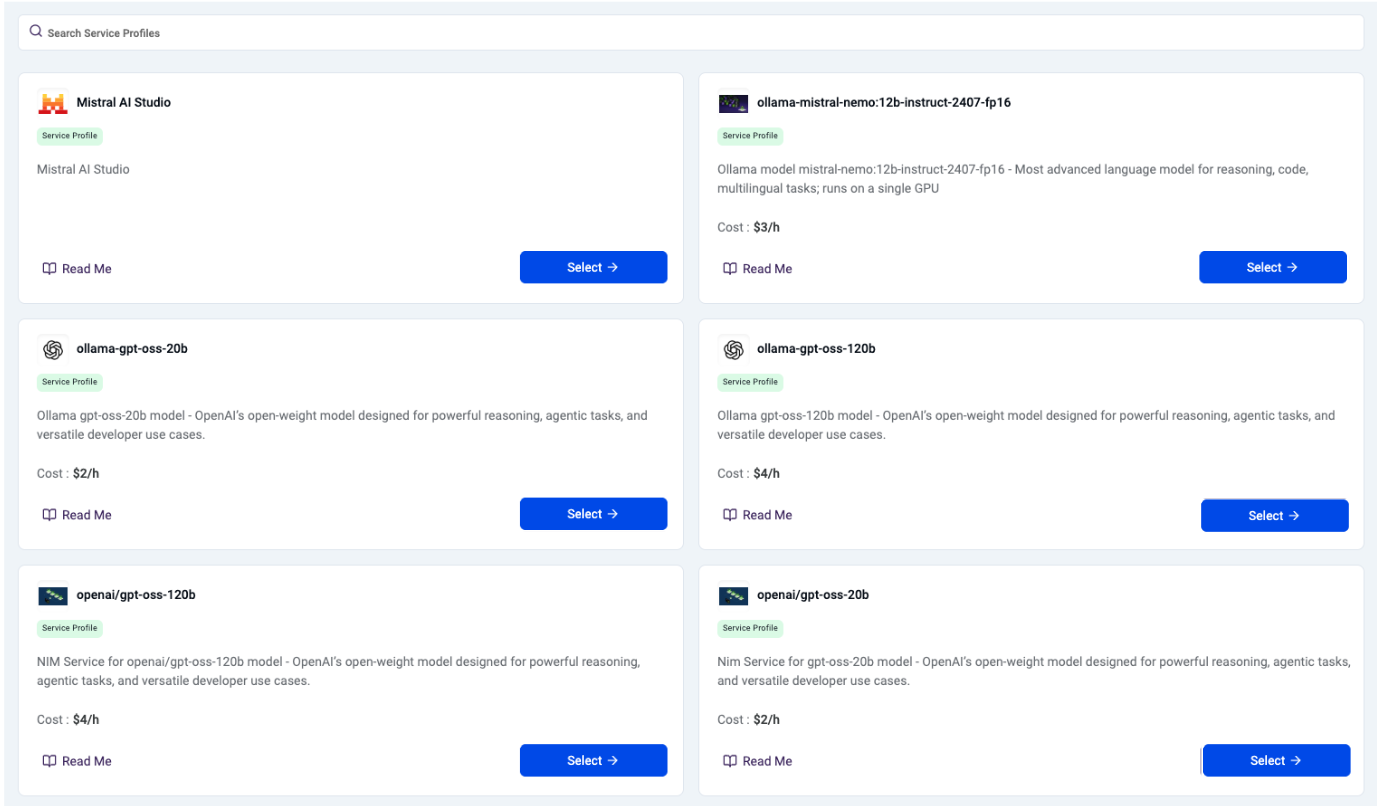
Rafay provides the infrastructure operating layer for AI model serving, helping organizations provision and manage GPU infrastructure across hybrid and multi-cloud environments. With self-service provisioning, multi-tenant governance, policy enforcement, and usage visibility, platform teams can give AI teams the resources they need without adding operational complexity.
Ready to simplify your AI infrastructure?
Frequently Asked Questions
Why is AI model serving considered an infrastructure problem, not just a deployment task?
AI model serving is primarily an infrastructure challenge because it involves managing complex resource demands, latency, and scaling for persistent, variable inference workloads. The model itself doesn't change, but the surrounding infrastructure must dynamically adapt to handle vast numbers of concurrent users and maintain performance across diverse environments. This differs significantly from bursty, GPU-intensive training.
What are the four essential layers of an AI model serving architecture?
A robust AI model serving architecture comprises four layers. The model artifact is the trained model file. The serving runtime executes the model. The API layer exposes the model's predictions to consumers. Finally, the underlying infrastructure layer provides the compute, networking, and storage resources required for efficient operation and scalability.
How do organizations typically update AI models in production safely?
Organizations safely update AI models using deployment strategies like canary, blue/green, or shadow deployments. Canary deployments route a small portion of traffic to the new model for validation. Blue/green involves switching traffic between two identical environments. Shadow deployments run the new model passively to compare outputs without affecting users.
What is the difference between data drift and concept drift in AI model monitoring?
Data drift occurs when the statistical properties of the input data to a model change over time, making predictions less reliable. Concept drift, conversely, happens when the relationship between the input data and the target variable changes, meaning the model's underlying assumptions are no longer valid. Both degrade model performance.
What security measures are crucial for protecting AI model endpoints and data?
Critical security measures for AI model serving include robust authentication, authorization, and rate limiting for API endpoints. Data encryption is essential both in transit (TLS) and at rest for model artifacts. Granular role-based access control and comprehensive audit trails are also vital for governance and compliance across the entire pipeline.
How do you choose the most suitable AI model serving platform for a specific project?
To choose a suitable platform, evaluate model type compatibility, performance requirements (latency, throughput), and cost structure. Assess security certifications, compliance needs (e.g., data residency), and alignment with your existing infrastructure, whether on-premises, single-cloud, multi-cloud, or hybrid. Matching the tool to the problem is key.