
Key takeaways
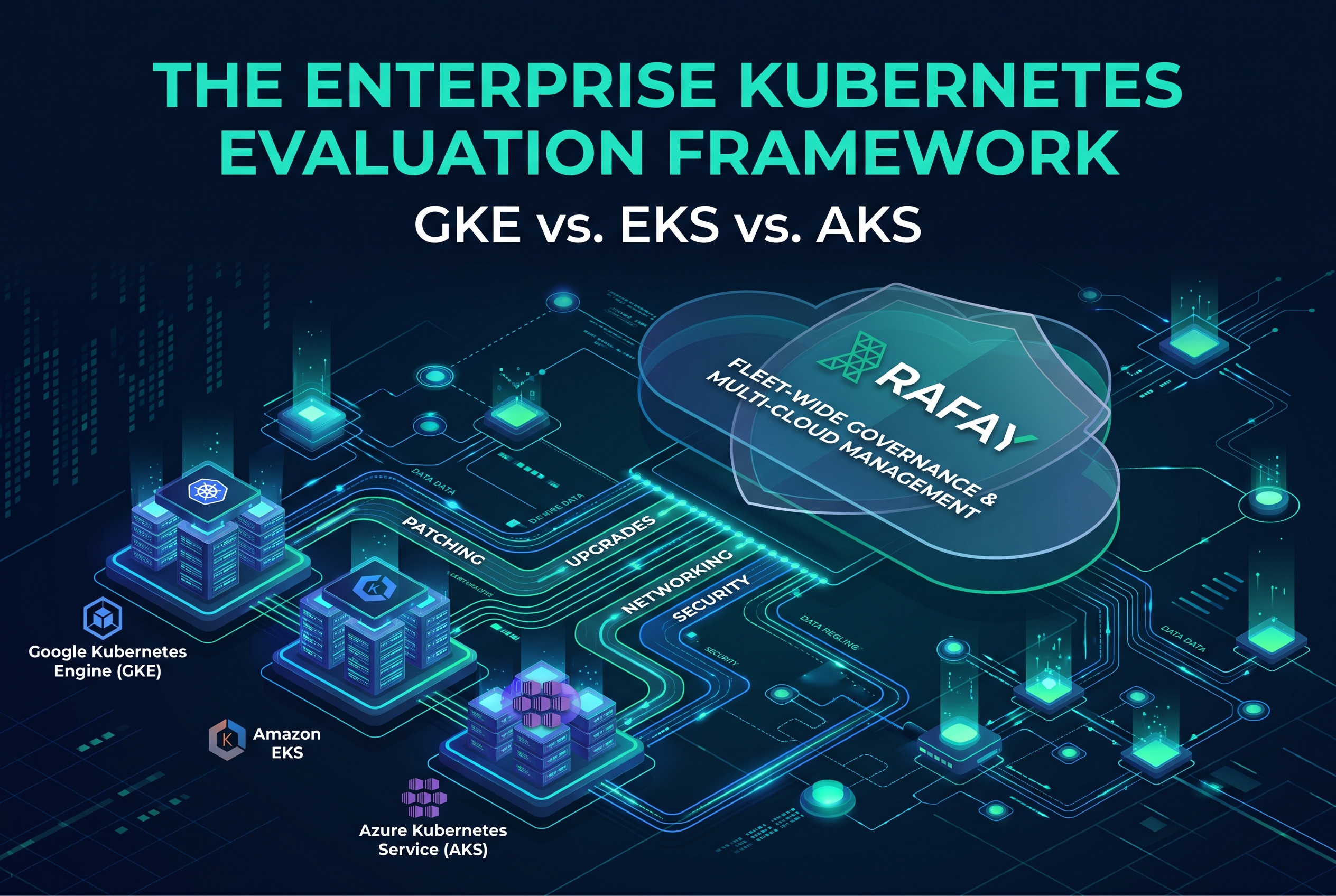
Enterprise teams running self-managed Kubernetes often spend significant engineering capacity on operational work such as patching, upgrades, networking, and security: patching, upgrading, troubleshooting networking, and firefighting security issues.
This article provides a structured evaluation framework for comparing GKE, EKS, and AKS across the criteria that actually matter for enterprise decisions, along with an honest assessment of what managed services solve and what they leave on the table.
Why Enterprises Are Moving Away From Fully Self-Managed Kubernetes
Self-managed Kubernetes gives enterprises more control, but that control comes with a significant operational workload. At scale, platform teams are responsible for keeping the cluster secure, available, and up to date.
What self-managed Kubernetes requires
Teams typically need to manage:
- Control plane availability: Maintaining high availability across zones and handling disaster recovery.
- Security and patching: Applying Kubernetes, API server, kubelet, and container runtime updates.
- Cluster maintenance: Managing certificates, RBAC policies, audit logging, and other core components.
- Upgrades: Planning and testing Kubernetes version upgrades, including changes caused by deprecated APIs.
- Infrastructure: Managing the underlying nodes, networking, storage, and other data-plane components.
These tasks require specialised Kubernetes expertise and ongoing engineering time. As the number of clusters grows, so does the operational overhead.
What managed Kubernetes changes
Managed services take much of the control-plane management off the platform team's plate. Depending on the provider and configuration, they can handle areas such as:
- Control plane availability
- Kubernetes version upgrades
- Control plane patching
- Certificate management
- Control plane infrastructure
Teams still manage their workloads and many aspects of the data plane, including networking, identity, nodes, and applications.
This shifts the focus from maintaining Kubernetes itself to improving developer platforms, governance, security, and deployment workflows.
The trade-off
Managed Kubernetes isn't a complete abstraction. It limits some control-plane customisation and can make certain specialised configurations harder to implement.
For most enterprises, that trade-off is worthwhile. The priority is usually to reduce operational overhead without giving up the Kubernetes ecosystem and flexibility their applications depend on.
The decision, then, isn't simply whether to use managed Kubernetes. It's which service best fits the organisation's workloads, cloud strategy, security requirements, and operational model.
Evaluation Criteria: What to Expect from a K8s Platform
Before comparing specific platforms, we need a consistent framework. These are the criteria we see enterprise teams weigh most heavily, roughly in priority order:
Security and Compliance
Does the platform meet the compliance requirements of your industry and region? For example, SOC 2 Type II may be a baseline for many organizations, while FedRAMP authorization can be important for U.S. government workloads and HIPAA eligibility for healthcare. Beyond certifications, assess the platform's security capabilities, including workload identity federation, pod security standards, network policies, secrets management, and supply chain controls such as image-signing verification.
Total Cost of Ownership
Control plane fees are only part of the cost. Factor in data egress, load balancers, persistent storage, logging, and monitoring, as well as the engineering time required to manage the platform and work around its limitations. Compare the full total cost of ownership (TCO), not just the per-cluster hourly rate.
Scalability and Performance SLAs
Assess the platform's scalability and performance, including cluster and pod capacity, control-plane and data-plane uptime SLAs, and how effectively its autoscaler handles sudden changes in demand. Also consider node provisioning times, particularly for workloads with rapid or unpredictable scaling requirements.
Integration Depth
Enterprise Kubernetes doesn't exist in isolation. You should evaluate how deeply the platform integrates with your existing CI/CD pipelines, identity providers, observability stacks, and data services. Remember, deep native integration reduces glue code, but it increases lock-in, and that tension requires an explicit, documented decision.
Multi-Cluster and Hybrid Support
Enterprise environments often span multiple clusters, regions, cloud accounts, and on-premises data centers. Evaluate how well the platform supports fleet management across these environments, including capabilities such as multi-cluster service mesh, cross-cluster networking and DNS, and centralized policy management.
Support and System Maturity
Support quality can vary significantly, particularly in response times and escalation options. Consider the strength of the partner and ISV ecosystem, the availability of managed add-ons, and the quality of the platform's documentation and training resources.
The Top Managed Kubernetes Solutions in 2026
The leading managed Kubernetes platforms offer similar core capabilities, but differ in areas such as automation, cloud integration, scalability, pricing, and hybrid support. Here's how GKE, EKS, and AKS compare across the factors that matter most to enterprise teams.
Google Kubernetes Engine (GKE): Features, Strengths, and Considerations
GKE benefits from Google's position as the original creator of Kubernetes. That lineage shows in the product's design decisions, particularly around automation and AI/ML workload support.
Architecture and Key Features
GKE Autopilot
- Abstracts node management, including provisioning and scaling.
- Lets teams focus on defining and deploying workloads while Google manages the underlying nodes.
- Applies security defaults such as restricted privilege escalation and no SSH access to nodes.
- Uses Workload Identity by default.
Fleet Management
- Provides centralized configuration, policy, and observability across clusters.
- Supports clusters running across Google Cloud and connected external environments.
- Multi-cluster Gateway capabilities can simplify traffic management across clusters.
Enterprise Strengths
GKE stands out for organisations already building on Google Cloud, particularly those with AI/ML workloads.
AI and ML
- Access to Google Cloud GPU and TPU infrastructure.
- Integration with Vertex AI for model serving and ML workflows.
- BigQuery integration for analytics workloads.
- A strong fit for teams already invested in Google's AI and data ecosystem.
Security
- Binary Authorization helps enforce image verification before deployment.
- GKE Security Posture provides vulnerability scanning and security monitoring.
- Workload Identity Federation lets workloads access Google Cloud resources without relying on service account keys.
GKE also has a strong track record of adopting new Kubernetes versions quickly, which can be useful for teams that want access to newer Kubernetes capabilities sooner.
Weaknesses and Considerations
Cost considerations
GKE pricing varies by operating mode and resource usage. Autopilot pricing is based on the resources requested by workloads, so setting requests significantly above actual usage can increase costs. Standard clusters also incur a cluster management fee alongside compute and other infrastructure costs.
Ecosystem and hybrid complexity
GKE benefits from a broad Google Cloud ecosystem, but organizations should check that their existing tools and integrations are supported. Hybrid deployments can also introduce additional complexity depending on the architecture and management tools involved.
Amazon EKS: Features, Strengths, and Considerations
EKS is deeply integrated with the broader AWS ecosystem and is widely adopted by enterprises already running workloads on AWS.
Architecture and Key Features
EKS combines a managed Kubernetes control plane with deep integration across the AWS ecosystem.
AWS infrastructure integration
- Networking: The Amazon VPC CNI provides native VPC networking for Kubernetes workloads.
- Identity: IAM integration, including IAM Roles for Service Accounts (IRSA), connects Kubernetes workloads with AWS permissions.
- Storage: CSI drivers support AWS services including EBS, EFS, and FSx.
- Hybrid environments: EKS Anywhere extends Kubernetes management to on-premises environments, with a different operating model from cloud-based EKS.
Compute and scaling
- AWS Fargate: Runs supported pods without requiring teams to manage the underlying nodes. Fargate and EC2-based nodes can be used within the same cluster.
- Karpenter: Provides flexible, workload-driven node provisioning and scaling.
Enterprise Strengths
EKS is particularly well suited to organizations already invested in AWS, with its Kubernetes services fitting into existing identity, networking, storage, and observability workflows.
AWS ecosystem
- IAM provides a direct connection between AWS identity and Kubernetes workloads.
- VPC networking integrates Kubernetes workloads with existing AWS network infrastructure.
- AWS observability services, including CloudWatch Container Insights and X-Ray, can integrate with EKS.
Ecosystem and integrations
EKS benefits from a broad ecosystem of Kubernetes tools, integrations, and partners, giving teams plenty of options for extending their platform.
Compliance
EKS supports a wide range of compliance requirements, including frameworks such as FedRAMP, HIPAA, and PCI DSS, making it suitable for many regulated workloads.
Weaknesses and Considerations
More configuration choices
EKS gives teams considerable flexibility, but that can mean more decisions around networking, DNS, logging, and monitoring. This can work well for experienced platform teams but may add complexity for smaller teams.
Cost considerations
The control plane has a per-cluster fee, while data transfer between Availability Zones, NAT Gateway usage, and compute choices can add to the overall cost. Fargate can also cost more than EC2-based node groups for some workloads.
Kubernetes version support
EKS has historically been slower to adopt new Kubernetes versions, although the gap has narrowed. Teams that keep clusters on older versions should also factor in the additional cost of extended Kubernetes support.
Azure Kubernetes Service (AKS): Features, Strengths, and Considerations
AKS has become the default choice for enterprises with deep Microsoft system investments, but it has also made aggressive moves to compete on its own merits, particularly around cost and hybrid cloud capabilities.
Architecture and Key Features
Pricing and service tiers
- The Free tier has no cluster management fee.
- Standard and Premium tiers add paid cluster management and uptime SLAs.
- Premium also includes long-term support for Kubernetes versions.
- Workloads still incur the usual compute, storage, and networking costs.
Identity and security
- Microsoft Entra ID integrates with AKS for authentication and access control.
- Kubernetes RBAC can be managed using Entra identities and groups.
- Azure Linux provides a container-optimised node OS designed for AKS workloads.
Enterprise Strengths
AKS is a natural fit for organisations already invested in the Microsoft ecosystem, particularly those using Azure identity, developer tools, and hybrid infrastructure.
Hybrid and multi-cloud management
- Azure Arc extends Azure management, policy, and monitoring to Kubernetes clusters running on-premises, at the edge, or in other clouds.
- This can help organisations manage distributed Kubernetes environments without moving every workload to Azure.
Developer tooling
- Integrates with GitHub Actions and Azure DevOps for CI/CD workflows.
- Works closely with Microsoft's developer tooling ecosystem.
Cost visibility
- AKS provides an integrated cost-analysis experience for supported Azure subscriptions, helping teams understand Kubernetes resource costs.
Weaknesses and Considerations
Networking choices
AKS offers several networking options, including Azure CNI and Azure CNI Overlay. The right choice depends on the cluster's networking requirements and can affect the architecture of the environment, so it should be considered early in the design process.
Ecosystem compatibility
Organizations using specialized Kubernetes tools should verify Azure support and integration requirements early, particularly when relying on niche or provider-specific tooling.
GKE vs. EKS vs. AKS: How They Compare
Here's a head-to-head comparison across the evaluation criteria we defined:
When to Choose GKE, EKS, or AKS
Each platform has strengths that may make it a better fit depending on your existing cloud environment, workloads, and operational priorities.
Choose GKE when:
- AI/ML workloads are a major part of your strategy.
- You want highly automated node management with Autopilot.
- You're already invested in Google Cloud's AI, data, and analytics services.
Choose EKS when:
- Your organisation already relies heavily on AWS.
- You need extensive integration with the AWS ecosystem.
- Your platform team values flexibility and control over a more opinionated setup.
Choose AKS when:
- Your organisation relies on Microsoft Entra ID and Azure services.
- You're already using Microsoft's developer and DevOps tooling.
- Azure Arc's hybrid and multi-cloud capabilities fit your infrastructure strategy.
When to Consider an Alternative
GKE, EKS, and AKS are strong options for running managed Kubernetes, but managing Kubernetes at scale can involve more than operating individual clusters.
If your environment spans multiple clouds, regions, and on-premises infrastructure, you may also need a consistent way to handle:
- Fleet-wide governance and policy management
- Cluster lifecycle and upgrades
- Developer self-service
- Security and compliance controls
- Cost visibility across cloud providers
- Centralized observability
This is where a platform such as Rafay can complement managed Kubernetes services by providing an operational layer across heterogeneous Kubernetes environments.
Other Managed Kubernetes Service Platforms to Consider
GKE, EKS, and AKS aren't the only managed Kubernetes options. Other platforms may be a better fit when simplicity, hybrid deployment, existing infrastructure, or a specific cloud ecosystem is a priority.
Red Hat OpenShift
OpenShift takes a more opinionated approach to Kubernetes, combining the platform with tools for application development, security, container management, and operations.
- Runs across major public clouds and on-premises environments.
- Includes an integrated developer console and container registry.
- Provides built-in CI/CD and operator-based application management.
- Can be a strong option for organizations that want a more integrated application platform rather than assembling their own Kubernetes tooling.
The trade-off is additional cost and a more opinionated operating model, which may be less attractive to teams that want to choose and manage individual Kubernetes components themselves.
DigitalOcean Kubernetes
DigitalOcean Kubernetes (DOKS) targets teams that prioritize simplicity and straightforward cloud infrastructure over the breadth of enterprise features offered by the major cloud providers.
- No separate control-plane fee.
- Straightforward infrastructure and Kubernetes management.
- A simpler operating model for smaller teams.
- Less suited to organizations that need extensive enterprise governance, compliance, or complex multi-cloud management.
Linode Kubernetes Engine
Linode Kubernetes Engine (LKE), now part of Akamai, provides managed Kubernetes alongside Akamai's broader cloud infrastructure services. It can appeal to teams looking for a simpler alternative to the larger hyperscalers or organizations already using Akamai's infrastructure.
Oracle Kubernetes Engine
Oracle Kubernetes Engine (OKE) is particularly relevant for organizations already invested in Oracle Cloud Infrastructure.
- Integrates with Oracle Cloud infrastructure and networking services.
- Fits naturally into environments running Oracle databases and other Oracle workloads.
- Supports both virtual machine and bare-metal compute options.
- Can be worth considering when Oracle infrastructure is already a significant part of the technology stack.
The right alternative ultimately depends on the environment you're starting with. For organizations with specialized infrastructure or requirements that don't align neatly with GKE, EKS, or AKS, these platforms can provide another path to managed Kubernetes.
Addressing Vendor Lock-In and Multi-Cloud Realities
Vendor lock-in with managed Kubernetes is more subtle than most teams realize. The Kubernetes API provides meaningful portability, but production environments also depend on cloud-specific identity, storage, networking, ingress, DNS, secrets, and observability services.
The Kubernetes API provides a level of portability, but production environments often rely on cloud-specific services. Vendor lock-in can come from areas such as:
- Identity: IAM policies and cloud-specific identity systems.
- Storage: Persistent volumes tied to provider-specific storage services.
- Networking: Ingress controllers configured for cloud load balancers.
- DNS: Cloud-native DNS services and configurations.
- Secrets: Secrets stored in provider-specific vaults.
- Observability: Monitoring and dashboards built around proprietary tools.
Best Practices for Reducing Vendor Lock-In
There are practical ways to limit vendor lock-in without trying to make every part of your Kubernetes environment cloud-agnostic. The goal is to keep the workload layer portable while using cloud-native services where they provide clear value.
- Use portable infrastructure-as-code. Terraform and Pulumi can define infrastructure across cloud providers, but portability depends on how the modules are designed. Building for portability from the start can reduce migration work later, although it may add complexity upfront.
- Prefer open-source and CNCF projects where practical. Tools such as Prometheus, cert-manager, and External Secrets Operator can reduce dependence on provider-specific services. The trade-off is that your team may take on more operational responsibility.
- Standardize on the Kubernetes API. Where possible, use Kubernetes-native capabilities instead of provider-specific CRDs and configurations. Gateway API and CSI provide examples of standards that can help maintain portability across environments.
- Accept some lock-in where it makes sense. Full portability can be expensive and unnecessary. Using native cloud services can be worthwhile when they provide significant value, as long as teams understand the resulting dependency.
In practice, many organizations adopt multiple clouds for reasons other than portability. Different business units may use different providers, acquisitions can introduce new environments, or specific workloads may have requirements around AI infrastructure or data sovereignty. The challenge is often less about avoiding lock-in entirely and more about managing this heterogeneity effectively.
Managing Kubernetes Across Clouds with Rafay
GKE, EKS, and AKS can each manage individual Kubernetes clusters, but running clusters across multiple clouds and environments creates another challenge: keeping operations consistent at scale.
Common challenges include:
- Governance: Applying consistent security, network, and RBAC policies across clusters.
- Developer self-service: Giving teams a consistent way to provision and manage workloads across different environments.
- Fleet lifecycle management: Coordinating upgrades, patches, and other cluster operations at scale.
- Cost visibility: Understanding Kubernetes spend across multiple cloud providers.
How Rafay Helps
Rafay provides a management and orchestration layer across GKE, EKS, AKS, and on-premises Kubernetes environments. Platform teams can define policies, workflows, and guardrails centrally and apply them across their Kubernetes estate.
Rafay complements managed Kubernetes services rather than replacing them. The cloud provider manages the underlying cluster infrastructure, while Rafay helps teams manage the operational layer across their fleet.

Ready to simplify Kubernetes operations across clouds?
Explore how Rafay can help your platform team govern, automate, and manage Kubernetes at scale.
Contact Us Today
Frequently Asked Questions
How do I choose between GKE, EKS, and AKS?
The right choice depends largely on your existing cloud investment, workload requirements, security needs, and preferred tooling. GKE is a strong fit for organizations invested in Google Cloud and AI/ML; EKS fits naturally into AWS environments, while AKS is well suited to organizations using Microsoft Azure and Entra ID.
What should I consider when comparing managed Kubernetes costs?
Look beyond the control plane fee. Total costs can include compute, storage, networking, data transfer, load balancers, observability, and other managed services. Your team's operational requirements and the way workloads are configured can also have a significant impact on overall TCO.
Can I run Kubernetes across multiple cloud providers?
Yes. Kubernetes workloads can run across GKE, EKS, AKS, on-premises clusters, and other environments. The challenge is maintaining consistent governance, security, lifecycle management, and developer workflows across those environments.
How can Rafay help manage multiple Kubernetes clusters?
Rafay provides a management and orchestration layer across Kubernetes environments, including GKE, EKS, AKS, and on-premises clusters. It helps platform teams centralize governance, automate lifecycle operations, provide developer self-service, and apply consistent policies across their Kubernetes fleet.
Does Rafay replace managed Kubernetes services?
No. Rafay complements managed Kubernetes services rather than replacing them. GKE, EKS, and AKS continue to provide the underlying managed Kubernetes infrastructure, while Rafay provides an operational layer for managing clusters and workloads consistently across environments.
What alternatives are there to GKE, EKS, and AKS?
Other options include Red Hat OpenShift, DigitalOcean Kubernetes, and Oracle Kubernetes Engine (OKE). The right alternative depends on factors such as your existing infrastructure, level of Kubernetes expertise, compliance requirements, and need for hybrid or specialized environments.
When should I use a multi-cluster management platform?
A dedicated management platform becomes more useful as Kubernetes environments grow across multiple clusters, clouds, regions, or on-premises infrastructure. It can help centralise governance, automate lifecycle operations, and give platform teams a consistent way to manage workloads across different environments.