Owning GPU infrastructure is not the same as owning an AI cloud business. An infrastructure provider may have racks of accelerators and fast networking. Yet, it may still lack the software layer to turn that capacity into a usable product for developers and customers.
That layer exposes models as APIs, isolates tenants, controls access and quotas, meters consumption, integrates with billing, and provides a self-service experience. Without it, the operator is still primarily selling only infrastructure rather than inference as a service.
This is where Nebius Token Factory vs Rafay comes in.
Nebius Token Factory bridges the gap by managing inference infrastructure and handling the underlying serving stack. Rafay Token Factory gives infrastructure owners the software to turn their GPU capacity into multi-tenant, token-metered AI services.
Choosing Nebius shifts infrastructure responsibilities away. Building with Rafay lets the operator control the service catalog, pricing, tenants, branding, and customer relationship.
So, the question is no longer whether you need AI inference but whether you want to offer it as a service or run a full AI business.
What Is Nebius Token Factory and What Do You Get When You Buy Its Inference?
Nebius Token Factory is a managed production inference platform for running open and custom AI models. It lets you avoid the hassle of managing GPU infrastructure yourself.
Nebius Token Factory runs on Nebius AI infrastructure and provides an OpenAI-compatible API for various models, such as Llama, DeepSeek, Qwen, Mistral, GPT OSS, and Nemotron. It supports over 60 open-source models as well as custom and fine-tuned models for production workloads.
Nebius offers two different inference operating models.
Public serverless endpoints run on shared, multi-tenant capacity. Nebius manages scaling and capacity allocation, applies dynamic rate limits, serves base models, and charges based on token consumption.
Dedicated endpoints reserve resources for an organization with options to select the deployment region, GPU type, number of GPUs per replica, and minimum and maximum replicas. Unlike public endpoints, pricing here is based on GPU usage instead of tokens.
What you gain by buying inference from Nebius
Nebius changes the operating model by moving most of the serving stack out of the application team’s responsibility. Advantages include:
Faster deployment: Application teams can move from model selection to an API endpoint without building a serving stack.
No need to operate the underlying GPU serving infrastructure: Nebius handles the underlying compute, inference software, and infrastructure lifecycle.
Managed scaling: Public endpoints scale on Nebius-managed shared capacity, while dedicated endpoints expose configurable replica ranges.
Shared and isolated deployment options: Teams can experiment on serverless endpoints and move production workloads to dedicated capacity.
Custom model support: Dedicated endpoints can run eligible custom weights, while Nebius also provides fine-tuning and post-training workflows.
OpenAI-compatible integration: Existing applications can use familiar chat completion, response, embeddings, reranking, and related API patterns.
The trade-off is ownership of the service. Nebius defines the hosted catalog, pricing, supported regions, GPU templates, and platform boundaries. The customer builds on top of a Nebius inference service rather than owning the end-to-end infrastructure and commercial layer.
That puts Nebius parallel to other managed platforms such as Microsoft Foundry serverless deployments and Amazon Bedrock. Microsoft hosts serverless models on Microsoft-managed infrastructure and exposes them through APIs. Bedrock provides serverless access to models without requiring customers to manage the underlying infrastructure.
What Is Rafay Token Factory and What Do You Build With It?
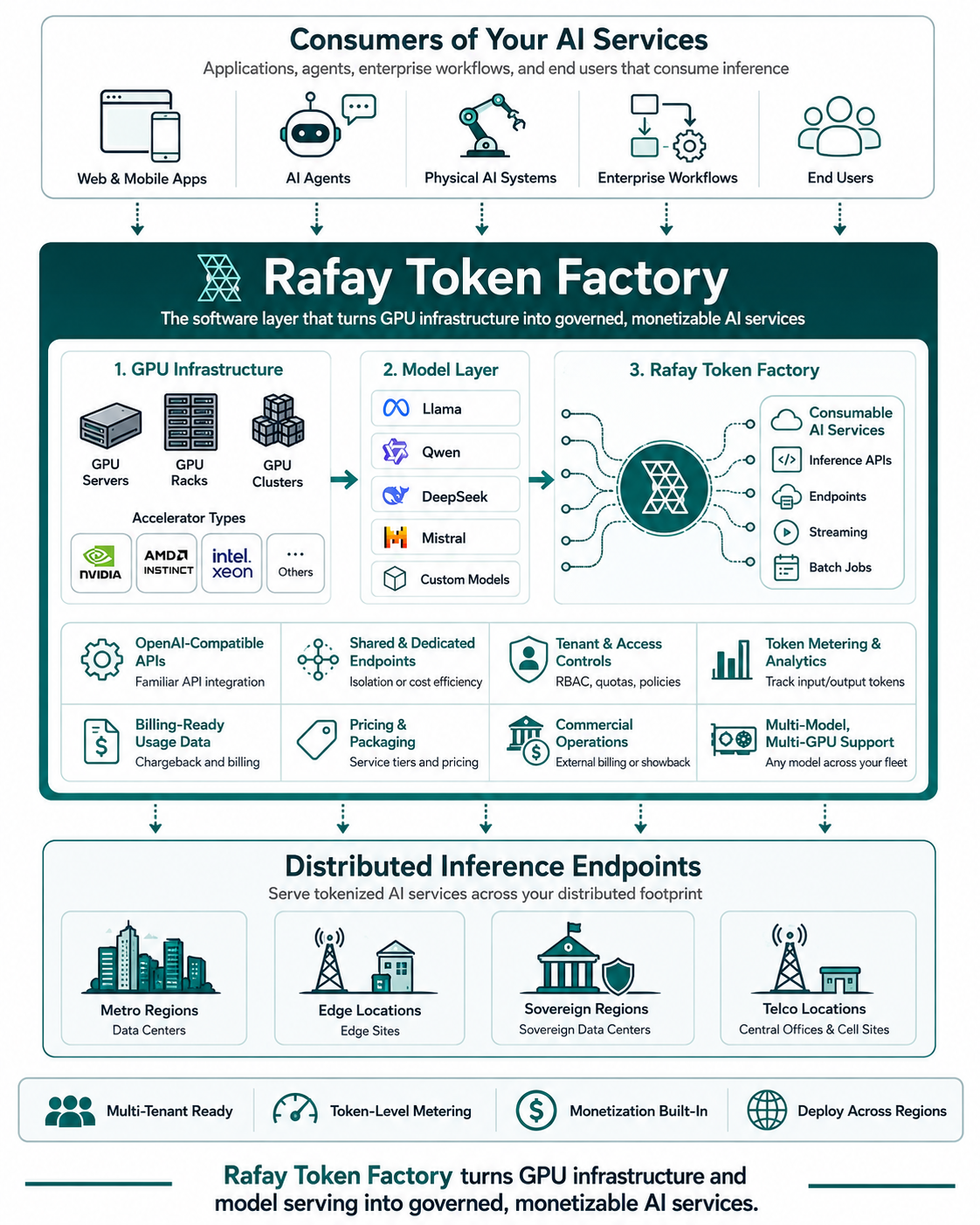
Instead of buying inference, the operator builds an inference service. Rafay provides the framework to publish OpenAI-compatible model APIs through shared or dedicated endpoints, isolate tenants, meter consumption, enforce policies, and connect usage to billing or chargeback.
The underlying workflow is more explicit than a managed inference API.
An operator first registers GPU resources, creates an inference endpoint, and onboards a model. A model deployment then binds that model to an endpoint and defines its runtime configuration, including inference engine, replicas, CPU, memory, GPU allocation, and storage.
For example, an operator can deploy vLLM by explicitly selecting the runtime image and resource allocation. This gives production operators the precision to optimize for throughput and margin across any accelerator fleet.
On the commercial side.
Rafay Token Factory counts input and output tokens separately. For each deployment, the operator can set the pricing and currency for every million tokens. Models and deployments can then be shared only with selected tenant organizations. Tenant users access approved models through the Developer Hub, generate API keys, and call the resulting endpoints.
Rafay Serverless Inference handles the model serving side of that stack, while Token Factory provides the commercial engine to package and sell it.
What the operator gains
Rafay changes the operating model by giving infrastructure owners the software layer needed to package GPU capacity as a governed AI service. Key capabilities include:
OpenAI-compatible model APIs: Expose multiple models through shared or dedicated OpenAI-compatible endpoints, allowing existing AI applications to integrate using familiar APIs while the operator controls access and governance.
Multi-tenant AI services: Define which models and deployments each tenant can access through Rafay Multi-Tenancy Infrastructure, with RBAC, quotas, policies, and tenant isolation.
Commercial operations: Support external billing, internal chargeback, and showback using token-level usage data generated by Rafay Token Factory.
Neocloud service delivery: Control service packaging, pricing, branding, geography, and customer access through the Rafay platform for Neoclouds, including white-labeled portals and self-service catalogs.
Regional and sovereign AI deployments: Deliver private, regional, or sovereign inference services through Rafay Sovereign AI Cloud, while enforcing residency, compliance, and governance requirements.
Own the business: Retain control of the customer relationship, pricing, and service economics instead of simply reselling another provider's inference APIs.
From GPU infrastructure to AI services: Rafay Token Factory layer for deploying, governing, metering, and monetizing distributed inference endpoints.
What remains the operator's responsibility
Rafay does not remove the responsibilities of running an inference business. The operator still needs to source GPU infrastructure, forecast capacity, select models and inference engines, and design service levels. They also need to manage support, set pricing, and meet applicable security and data-governance requirements.
Rafay provides the software layer for service delivery, governance, and monetization. But the operator remains responsible for the infrastructure, commercial strategy, and the service's long-term success.
Nebius Token Factory vs. Rafay: How Do Their Operating Models Compare?
The key difference in Nebius Token Factory vs Rafay comes down to control. With Nebius, the API is a product you buy that solves a consumption problem. With Rafay, the API is a product you build and deliver to your own customers, and it creates a new revenue stream.
Here’s a summary of the comparison table:
Comparison area
Nebius Token Factory
Rafay Token Factory
Primary buyer
AI application teams and enterprises consuming inference
Neoclouds, GPU providers, telcos, sovereign clouds, and infrastructure operators
Core decision
Buy managed inference
Build and operate an inference service
GPU ownership
Nebius operates the underlying infrastructure
Customer or provider operates the GPU infrastructure
Service operator
Nebius
Rafay customer
Model access
Nebius-hosted catalog plus supported custom models
Operator-defined model catalog
API delivery
Managed OpenAI-compatible API
Operator-delivered APIs for its tenants and users
Tenant model
Customer projects and enterprise access controls
Operator-controlled organizations, tenants, models, and deployments
Token pricing
Nebius defines the service price
Operator defines input and output token rates
Billing role
Nebius bills its customer
Operator uses usage records for billing, chargeback, or monetization
Capacity risk
Largely carried by the managed provider
Carried by the infrastructure operator
Branding and market offer
Nebius service
Operator's own service or product
Best fit
Consuming production inference
Productizing owned GPU infrastructure
How Do Buying Inference and Building an Inference Business Differ Economically?
Buying inference optimizes for application economics. Building an inference service requires the operator to balance infrastructure and service economics in parallel.
For Nebius customers, inference is an operating expense that supports an application. Success is measured by model quality, price per token, throughput, time to first token, and latency.
For Rafay operators, inference becomes the product being delivered. That shifts the focus toward GPU costs, token generation, average utilization, replica idle time, model memory requirements, request concurrency, support cost, and the price customers will pay for each model.
For example:
Cost per million tokens = (Infrastructure + Platform + Network + Operating Cost) ÷ Tokens Served
The operator then decides how to price above that cost.
This makes utilization critical, as even a competitive token price can mask poor unit economics if expensive GPUs spend too much time idle or underutilized. So operators need to monitor throughput, queue depth, autoscaling behavior, model mix, and demand by tenant.
Token metering also changes how services are offered, allowing model consumption to be packaged in familiar units such as input tokens, output tokens, API requests, or service tiers.
Rafay supports that transition through token-level usage metering, billing-ready data, chargeback and showback, and tenant controls. But profitable economics depend on demand, utilization, model efficiency, pricing strategy, and operational execution.
When Should You Buy Inference, and When Should You Build the Service?
Choose managed inference if inference is just an input to your product. Build the service if inference itself is integrated into your product offering.
Nebius is relevant when for your teams needing reliable model access without managing infrastructure, especially if you lack GPU capacity, need to deploy quickly, or want to focus engineering efforts on your application.
Rafay fits best when you already have GPU resources and want multiple customers, departments, or tenants to use them as services (GPU-as-a-Service).
Four questions help clarify the difference:
Do you already control significant GPU capacity? If not, buying inference avoids unnecessarily creating an infrastructure business.
Who should own the customer relationship? If customers should buy model access from your company, you need control over the service layer.
Do you need your own pricing, tenant policies, regions, or branding? Those requirements point toward operating the platform.
Can you sustain the operational model? Building requires demand forecasting, capacity management, model operations, reliability engineering, support, and commercial strategies.
Turn GPU Capacity Into a Token-Metered AI Service With Rafay
Running models on GPUs is only one step in delivering AI services. Operators also need a way to expose those models to developers, govern tenant access, measure consumption, and connect usage to commercial workflows.
Rafay brings those capabilities together into a unified AI platform. Token Factory packages models as consumable services, Multi-Tenancy Infrastructure governs how organizations access those services. And the AI Factory provides the operational foundation for managing infrastructure, AI workspaces, models, applications, and self-service delivery.
This allows neoclouds, sovereign clouds, telecom providers, and enterprise infrastructure teams to move beyond selling raw GPU capacity. Instead, they can deliver branded AI services with consistent governance, commercial controls, and a developer experience that scales across multiple regions and customer organizations.
GPU infrastructure creates compute capacity. Rafay helps turn that capacity into AI services customers can discover, consume, and pay for.
No. Rafay provides the platform that enables organizations to deploy and deliver inference services on GPU-backed infrastructure they own, lease, or control.
Does Rafay Token Factory provide OpenAI-compatible APIs?
Yes. Rafay can expose deployed models through OpenAI-compatible endpoints that tenants and applications access using API keys.
Who sets the token price in Rafay Token Factory?
The operator sets the currency and separate rates per million input and output tokens for each deployment.
Does Nebius support dedicated inference endpoints?
Yes. Nebius offers isolated dedicated endpoints with configurable GPU capacity, regions, autoscaling, and custom weights for eligible models.
Is Rafay only for external AI service providers?
No. Rafay also supports internal enterprise use cases involving governed access, usage visibility, quotas, showback, and chargeback.
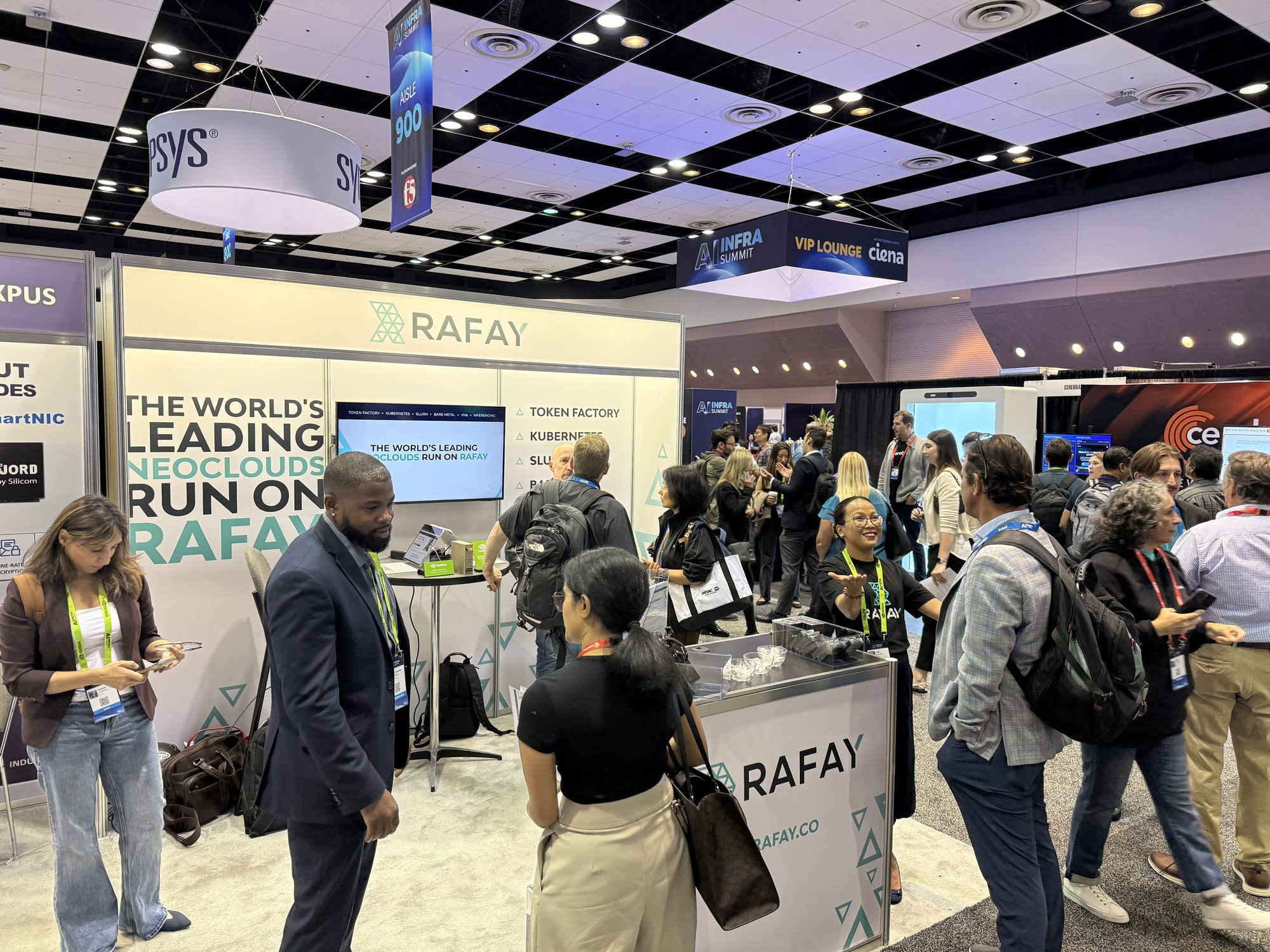
Compute Is the New Revenue: What I Heard at the AI Infra Summit
At the AI Infrastructure Summit, leaders from NVIDIA and Rafay discussed the financial shift in AI buildouts. Explore the four tiers of AI infrastructure monetization and discover why scaling up the value chain efficiently is critical for operators.
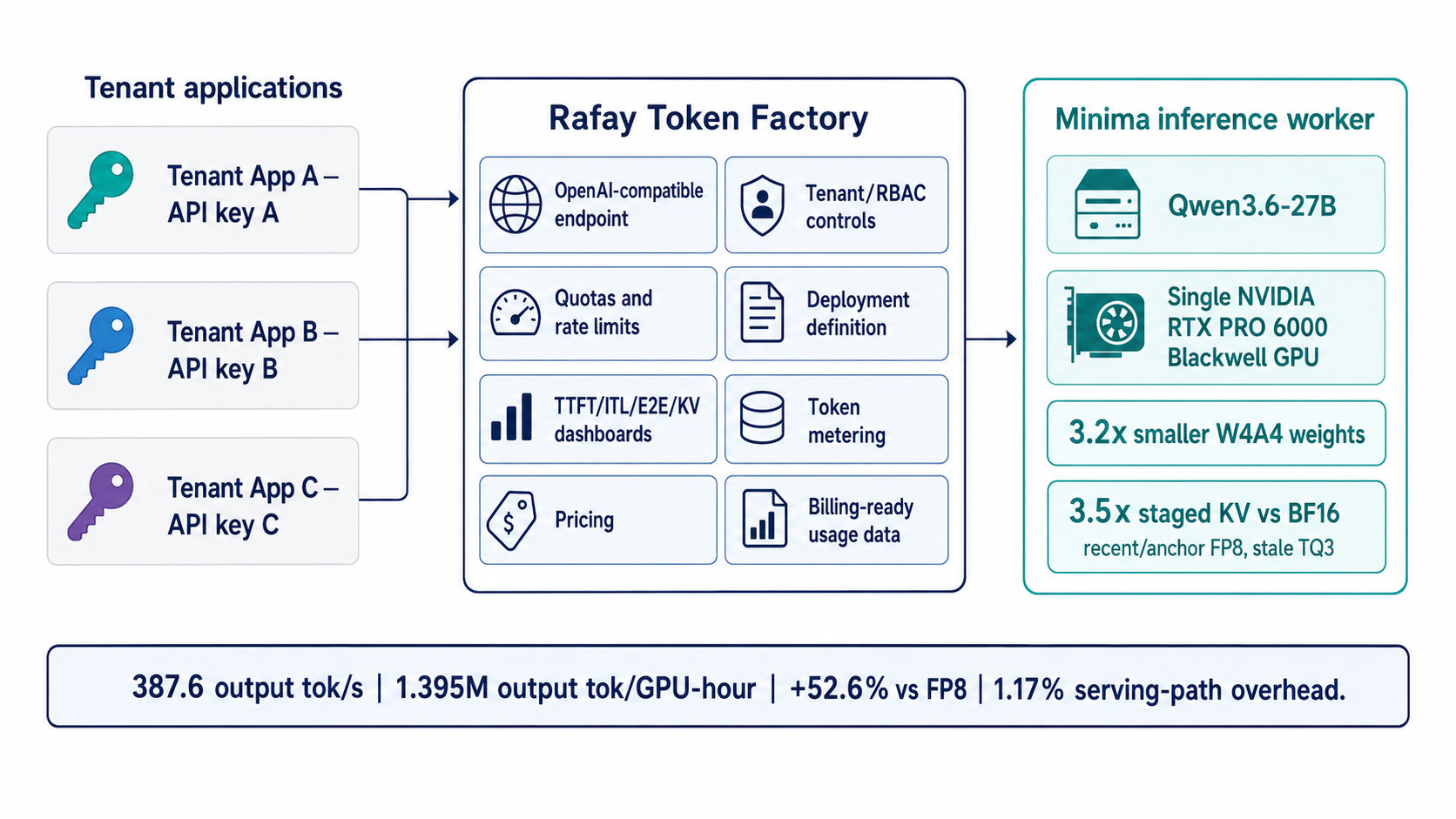
52.6% More Tokens, 1.53× Less GPU Time: Production Inference with Minima and Rafay
A single NVIDIA Blackwell GPU, an optimized Qwen3.6-27B worker from Minima, and Rafay Token Factory around it. The result was a governed, multi-tenant, token-metered service that delivered 52.6% more output than a strong FP8 baseline, with usage records reconciled at 99.97% for billing
Certifying Tenant GPU Kubernetes Clusters with NVIDIA Cluster Readiness Engine
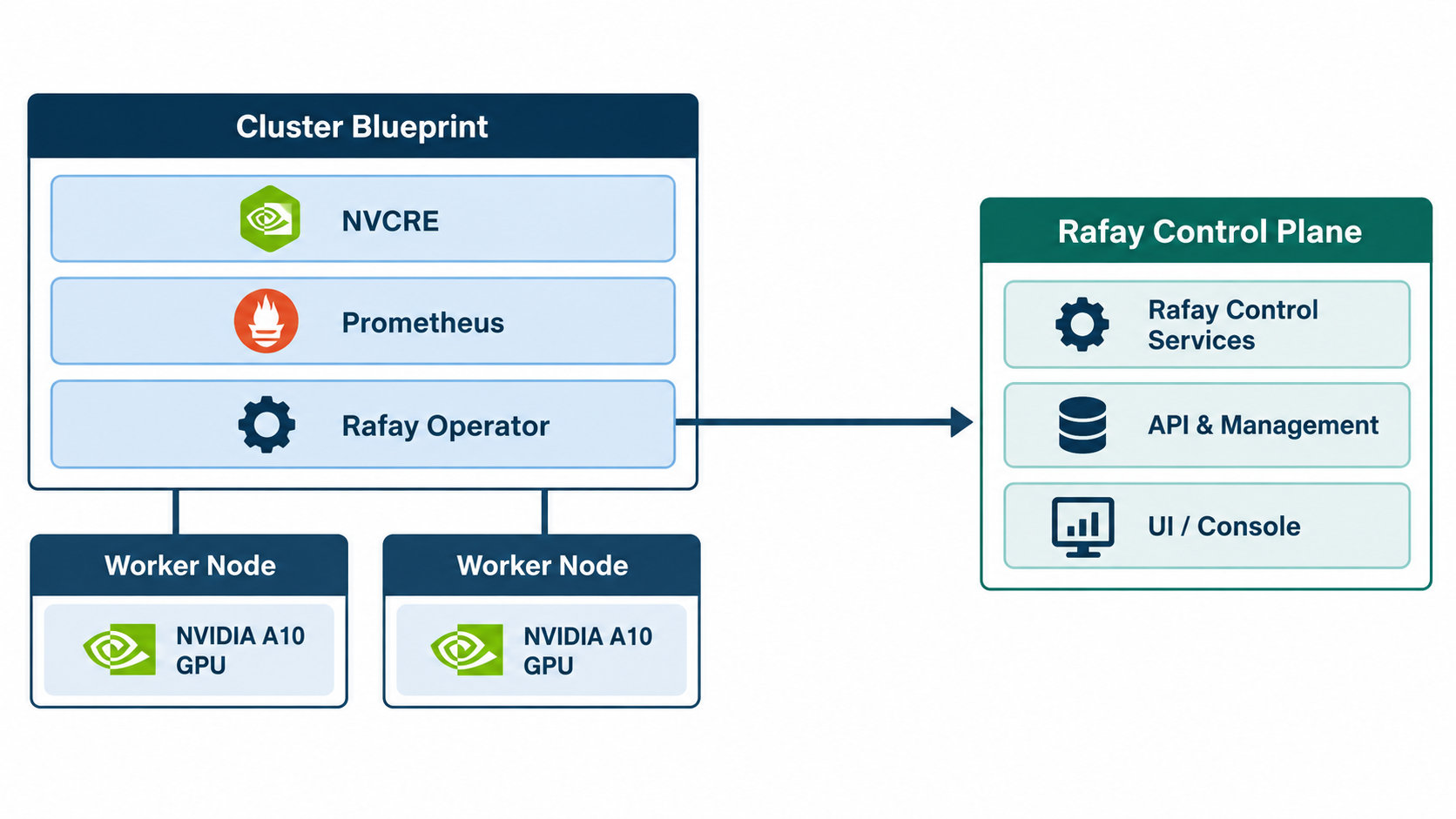
Learn how NeoClouds can use NVIDIA Cluster Readiness Engine to certify GPU Kubernetes clusters before tenant handoff and validate AI workload readiness.