From GPU Provider to AI Factory
Neoclouds and AI factory operators are leaving money on the table. Selling token-metered access to AI models is where the margin is, and it is what separates an AI factory from a commodity GPU rack.
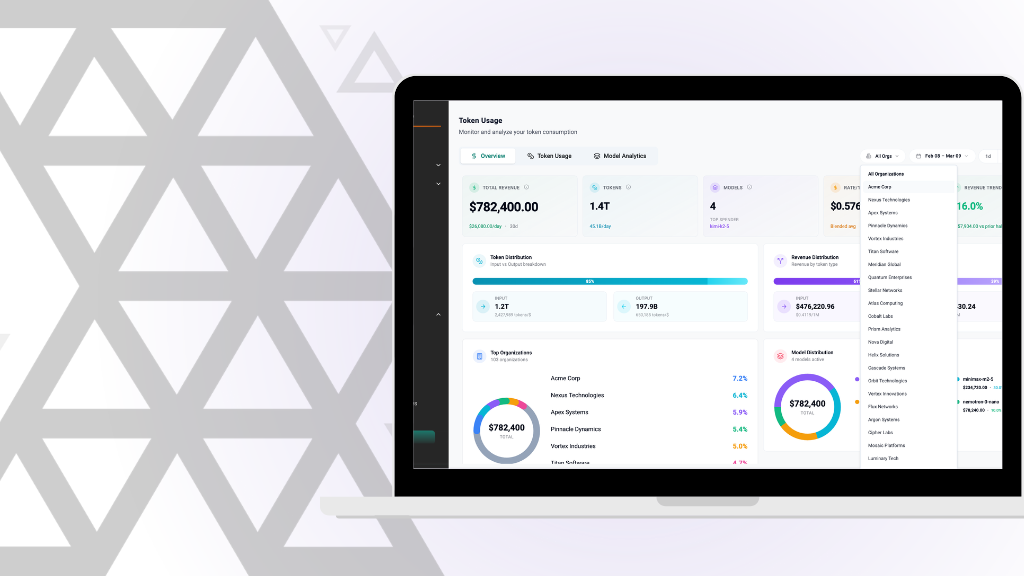
Today, Rafay Systems announces the general availability of Token Factory, a suite of capabilities in the Rafay Platform that delivers token-based access to AI models and services. With Token Factory, AI factory operators and neoclouds can immediately deliver token-metered access to AI models as a service through developer-friendly consumption workflows, without needing to build the orchestration and monetization stack from scratch.
The Tokenomics Inflection Point
This general availability announcement arrives at a pivotal moment. The AI industry has quietly crossed a threshold: tokens are becoming a unit of commerce. At GTC 2026, Jensen Huang made that explicit, elevating tokenomics to a keynote theme and signaling to the entire industry that token-based access is becoming the new standard. The GPU-as-a-Service market is projected to reach $26.43 billion by 2031 according to Research and Markets and that growth represents a generational opportunity for the operators closest to the infrastructure. Neocloud operators and sovereign AI clouds are uniquely positioned to capture that value because of the compute, the regional presence, and the customer relationships they have been building on.
Think of it this way: cellphone companies don't sell radio towers. They sell minutes. Rafay’s Token Factory gives telecom operators the same playbook for AI: stop selling GPU hours, start selling token plans. Pre-paid, post-paid, metered by consumption. That is the business model shift, and it's available now.
The Agentic Multiplier
Nothing is accelerating token demand faster than the rise of agentic frameworks. OpenClaw, the open-source AI agent platform that executes multi-step workflows, calls external tools, and runs continuously to complete real-world tasks, has become one of the fastest-adopted frameworks in the market. NemoClaw extends that model further with policy-based privacy and security guardrails built for production and enterprise deployments. Each agentic task consumes significantly more tokens than a conventional AI interaction, and as agentic adoption compounds, so does token demand. Today, most of that token spend flows to hyperscalers and foundation model companies. Token Factory enables infrastructure operators to serve that demand in their regions, on their own terms, and at attractive prices, turning GPU capacity into a token-based revenue stream.
How Token Factory Works
Token Factory adds a monetization and metering layer to the Rafay Platform. Operators expose AI models through API endpoints. Those endpoints are token-metered, with built-in pricing, access controls, and quota management. End users, whether enterprise teams or individual developers, get a clean consumption interface. The GPU complexity underneath is invisible to them
Already Deployed Across Six Continents
Token Factory builds on Rafay's partnerships with AI factory operators across six continents, and the breadth of those deployments tells its own story.
- Cassava Technologies is deploying Africa's first AI factories on the Rafay Platform, bringing sovereign AI infrastructure to a region that has historically been dependent on hyperscaler access.
- Firmus Technologies has integrated Rafay's PaaS capabilities into its green-energy-powered Australian AI Cloud, proving that performance and sustainability are not a trade-off.
- TELUS is building a sovereign AI Studio in Canada, giving enterprises and developers a governed, production-ready environment that keeps data entirely within Canadian borders.
Additional deployments are live and expanding across the Middle East, Latin America, and Southeast Asia, each one a signal that the shift from GPU provider to AI factory is happening now, at scale, across every major region in the world.
Get Started
Token Factory is available now as part of the Rafay Platform. For more information, visit : https://rafay.co/platform/ai-token-factory