The next phase of enterprise AI will not be won by choosing one model. It will be won by matching every workload to the right model, infrastructure, and economic model.
Introduction: AI Is Getting Cheaper - and More Expensive
The cost of an individual AI token has fallen dramatically. Yet many enterprises are discovering an uncomfortable paradox: their overall AI bills are still rising. The reason is not mysterious. AI applications are doing more work. A simple prompt-and-response interaction is giving way to agents that plan, retrieve information, call tools, check their own output, and try again when a step fails. Each useful customer interaction may now involve dozens of model calls and far more context than it did only a few years ago.
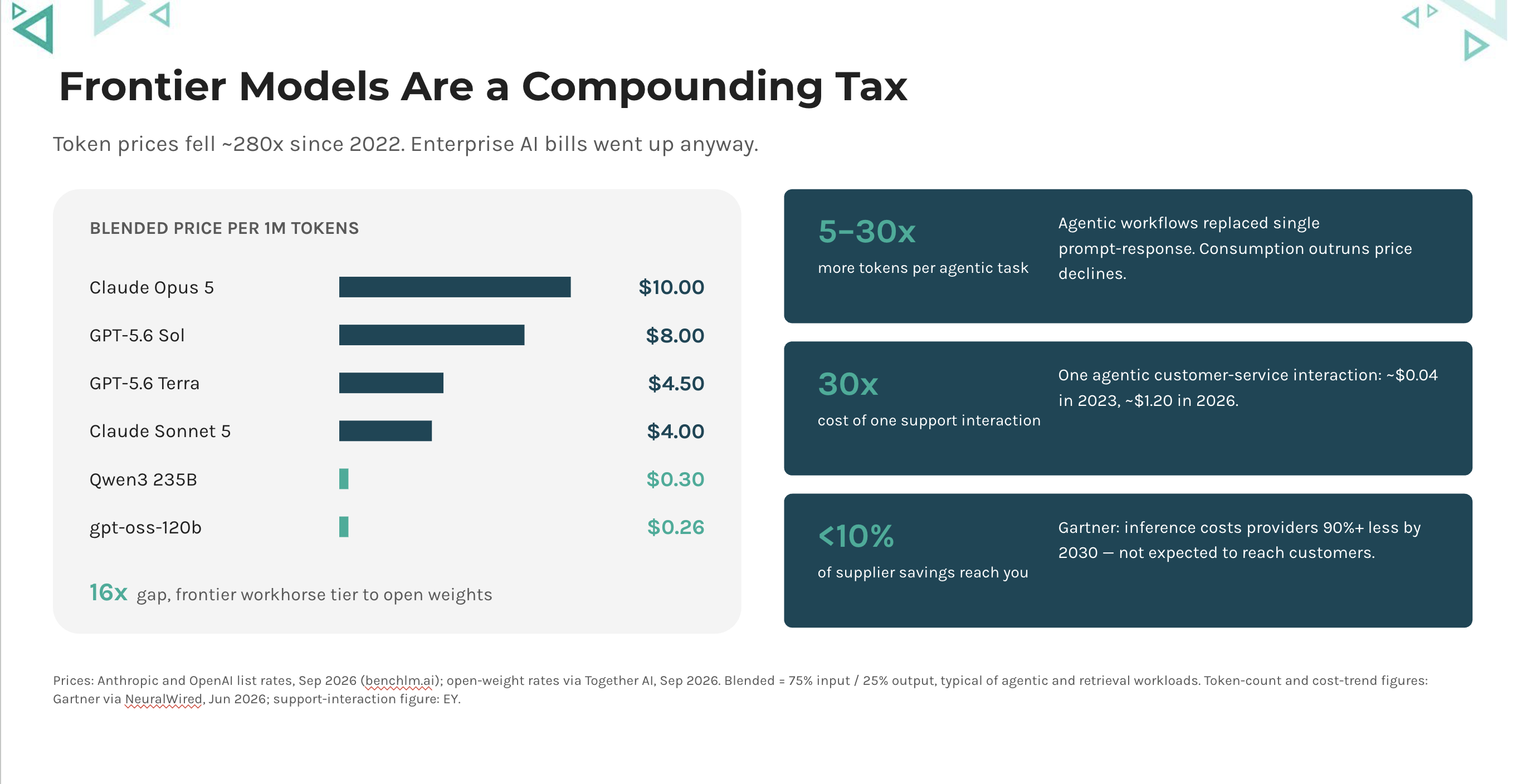
That growth in consumption can easily outpace the decline in price. Agentic workflows are estimated to use five to thirty times more tokens per task. The result is a compounding cost problem: every successful AI use case encourages broader adoption, and every new layer of autonomy increases the number of tokens consumed.
Open models offer a practical response. They are no longer limited to experiments or specialist teams. As their capabilities improve and the gap with frontier models narrows, enterprises and telecommunications providers can use them for a growing share of production workloads. The opportunity is not to abandon frontier models. It is to stop paying frontier prices for every task.
The Real Cost Problem Is Consumption
Enterprise AI discussions often begin with model price lists. Those prices matter, but they do not tell the full story. The more useful question is how many tokens are required to complete a business outcome. An agent that resolves a support request might review customer history, search a knowledge base, generate a response, validate it against policy, and summarize the interaction for a CRM system. The final answer may look simple, but the workflow behind it is not.
This is why a falling unit price does not guarantee a falling total bill. If the number of tokens per task rises faster than the price per token falls, spending still increases. This image illustrates the point with a customer-service interaction that grows from roughly $0.04 in 2023 to approximately $1.20 in 2026. The specific cost will vary by workflow, model mix, and contract, but the direction is what matters: consumption is becoming the dominant economic variable.
Open models change that equation because the price gap can be substantial. In the workhorse tier shown in the presentation, the blended price difference between frontier and open models is about sixteen times. That creates room to redesign the model portfolio without reducing the amount of AI the business can use.
Enterprises Are Building Model Portfolios
The enterprise response is already taking shape. Instead of standardizing every application on one provider, leading teams are building portfolios of models. Frontier systems remain valuable for tasks that require the strongest reasoning, the newest capabilities, or a specific commercial feature. Open models can handle many high-volume tasks where cost, control, latency, or data residency carries more weight.
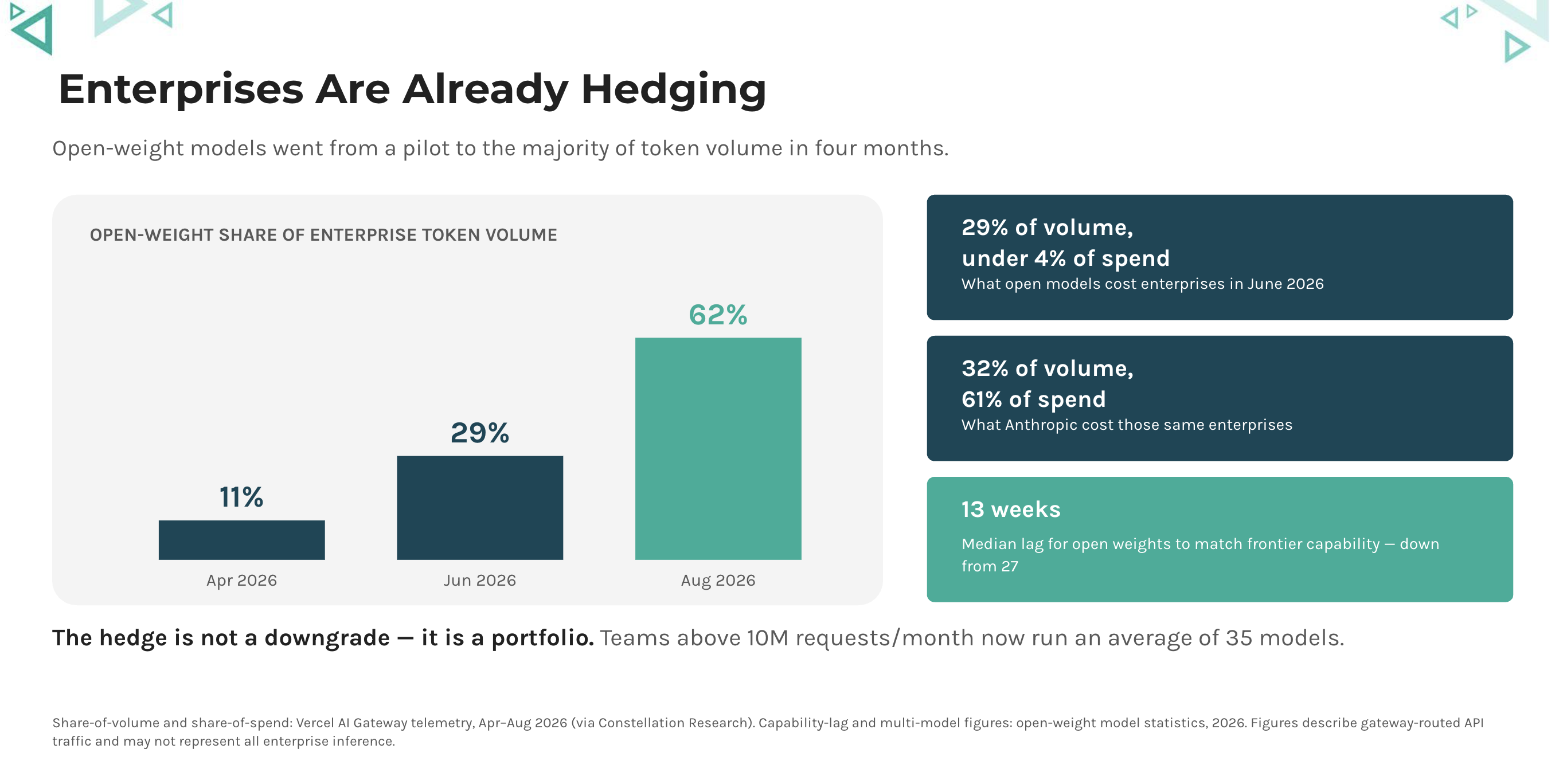
The usage trend highlighted in this image is striking: open-model share of enterprise token volume rises from 11% in April 2026 to 62% in August 2026. In a June snapshot, open models account for 29% of volume but less than 4% of spend. Those figures describe a particular gateway-routed data set rather than the entire market, but they capture the economic logic behind the shift.
This is not a downgrade strategy. It is a workload-placement strategy. A summarization task, document classification job, internal retrieval workflow, or routine service interaction may not need the most expensive model available. A complex planning task or sensitive executive analysis might. The goal is to define routing policies that consider quality, cost, latency, privacy, and availability, then send each request to the best-fit model.
A Hybrid Strategy Can Change the Economics
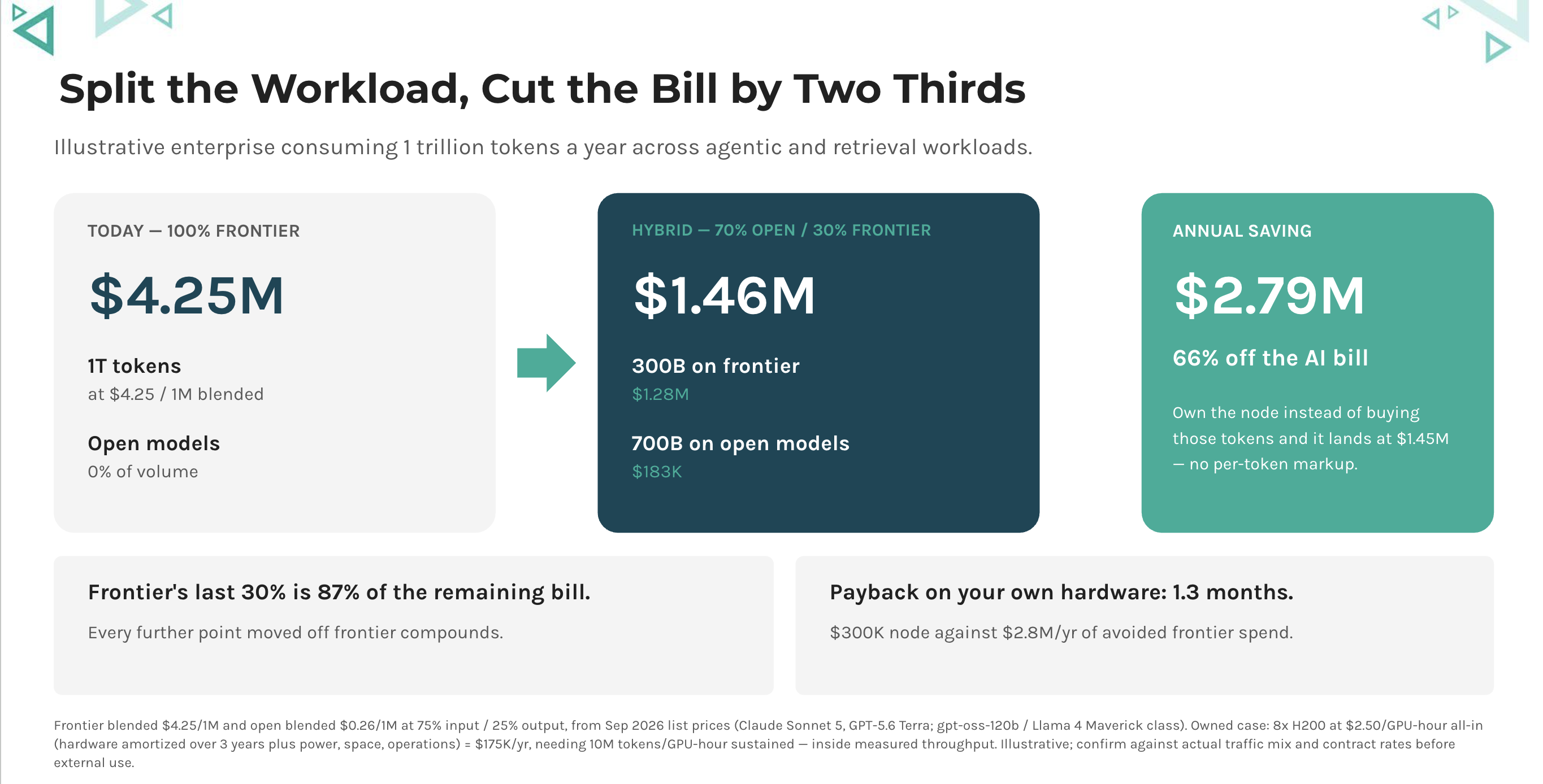
Consider the illustrative example from this image below: an enterprise consumes one trillion tokens per year across agentic and retrieval workloads. At an assumed blended frontier price of $4.25 per million tokens, the annual bill is $4.25 million.
Now split the workload. Keep 30% of the volume on frontier models and move 70% to open models at an assumed blended price of $0.26 per million tokens. The modeled annual cost falls to approximately $1.46 million, producing about $2.79 million in savings - a reduction of roughly 66%.
The example is intentionally simple, and every organization should validate it against its actual traffic mix, quality requirements, negotiated rates, and operating costs. Still, it reveals an important pattern: after the obvious workloads move to open models, the remaining frontier volume can represent most of the bill. That makes routing, evaluation, and continuous optimization increasingly valuable.
The best migration path is usually incremental. Start with high-volume, lower-risk workloads. Establish quality baselines and fallback rules. Measure cost per successful outcome, not only cost per token. Then expand the open-model share as the evidence supports it. This approach protects application quality while turning model choice into an active financial control.
Two Ways to Consume Open Models
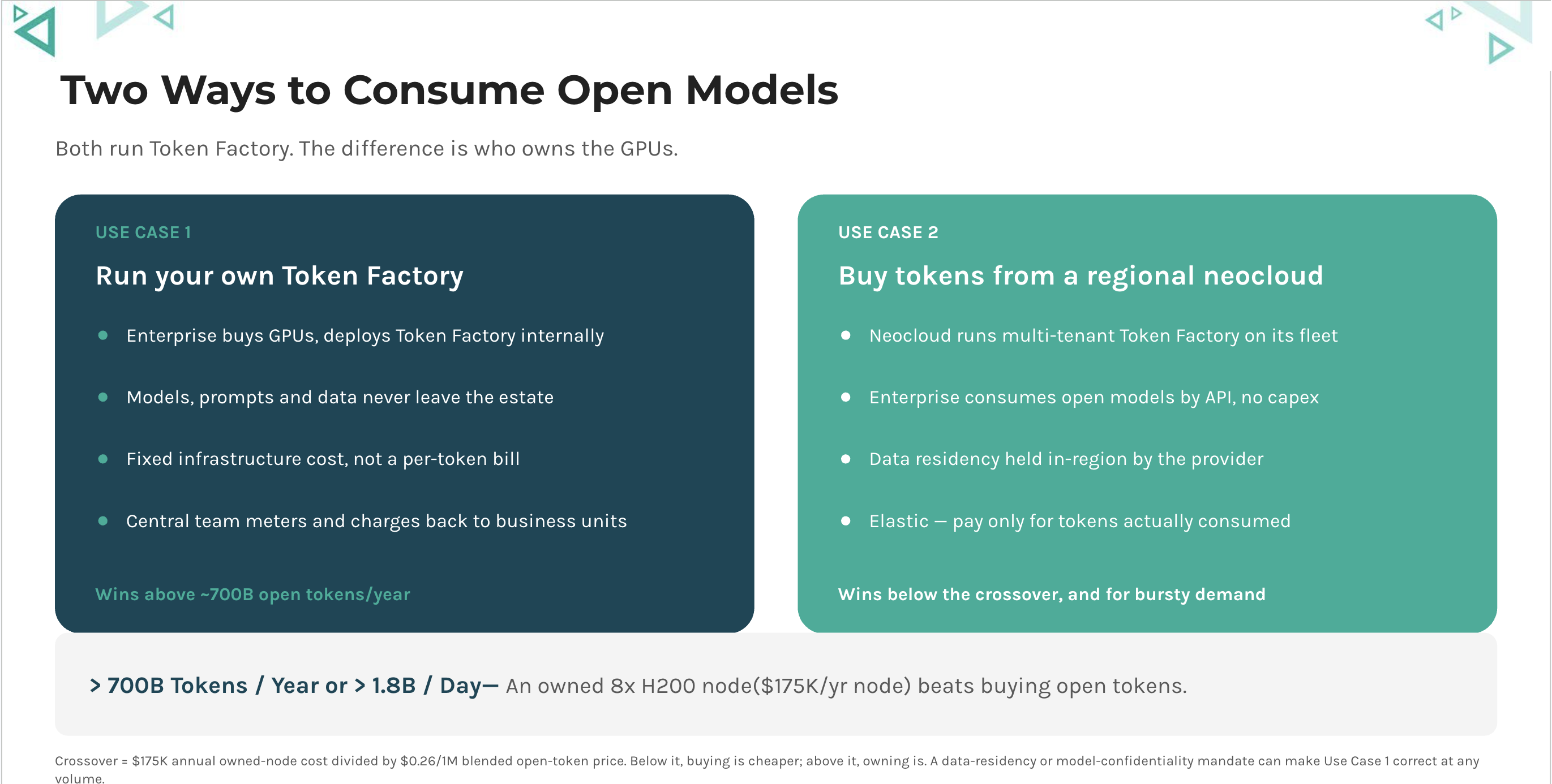
Once an organization decides to use open models, it faces another choice: own the infrastructure or buy the service. Both approaches can run on the same Token Factory platform, but they serve different operating needs.
1. Run Token Factory on Enterprise Infrastructure
In this model, the enterprise purchases or allocates GPUs and deploys Token Factory inside its own environment. Models, prompts, and data remain within the enterprise estate. A central platform team can publish approved models, apply policies, meter usage, and charge costs back to business units.
Ownership is attractive when demand is large and predictable, or when data residency and model confidentiality are decisive. We estimate that an owned eight-GPU H200 node can become more economical than purchased open-model tokens at roughly 0.7 trillion tokens per year. That threshold is illustrative, but it provides a useful way to think about the decision: stable utilization favors ownership.
2. Buy Tokens from a Regional Neocloud
The alternative is to consume open models through an API operated by a regional or sovereign cloud provider. The enterprise avoids capital expenditure, pays only for what it consumes, and gains elasticity for bursty or uncertain demand. A regional provider can also satisfy residency requirements while keeping the customer experience as simple as calling a familiar API.
This option tends to work well below the ownership crossover point, during early adoption, or when workload volume changes significantly over time. It also gives enterprises a way to test new models before committing infrastructure to them.
The Opportunity for GPU Providers
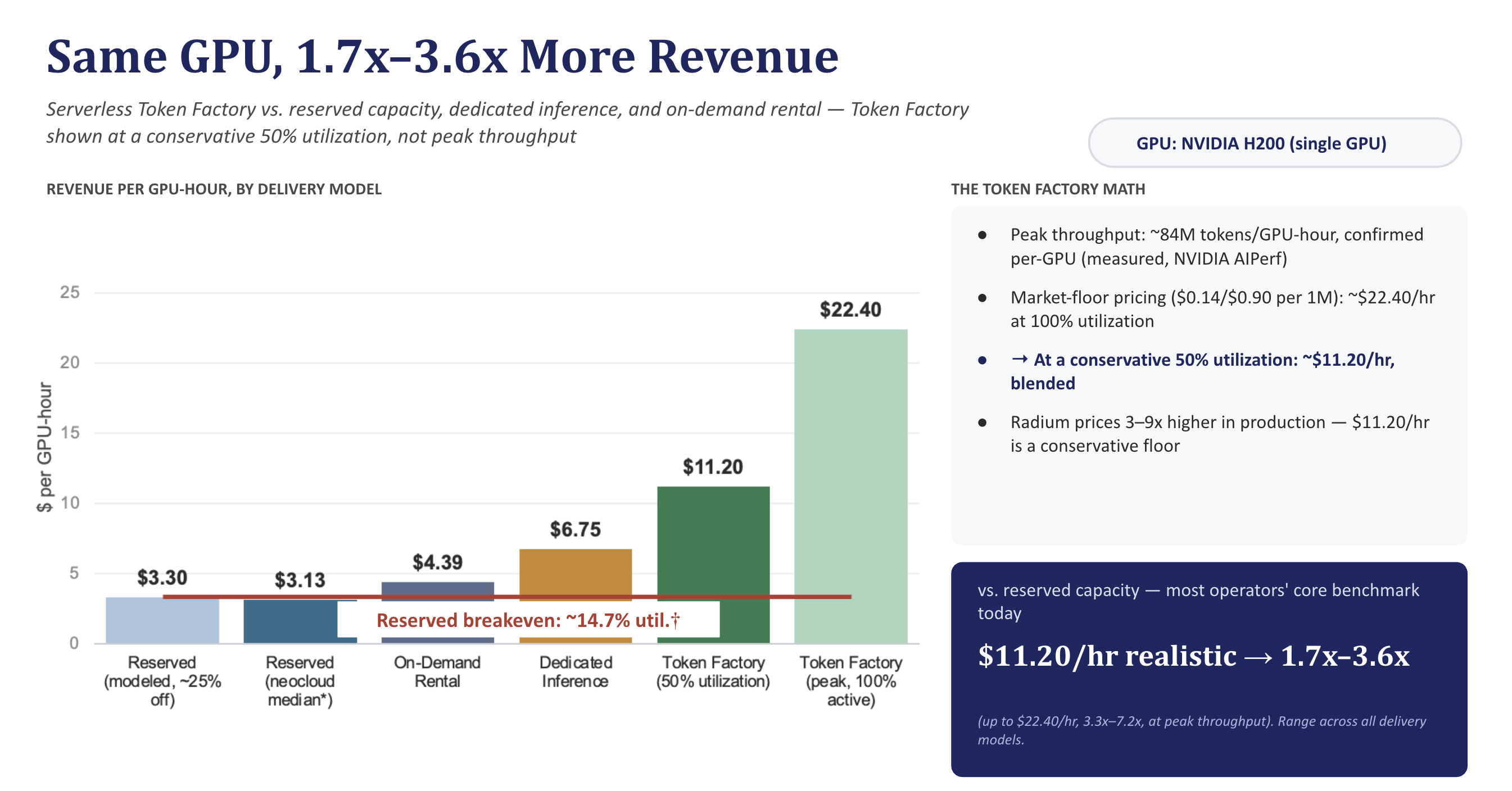
The same shift that helps enterprises control spending can improve the economics of GPU infrastructure. Many providers sell access to GPUs by the hour through reserved, dedicated, or on-demand offerings. Token Factory introduces a different commercial model: sell the useful output of the GPU rather than the raw capacity.
If you sell tokens instead of GPU hours, an NVIDIA H200 for example generates an estimated $11.20 per GPU-hour at a conservative 50% utilization level, with a peak of $22.40 per hour. At the conservative level, that represents approximately 1.7 to 3.6 times the revenue of the compared delivery models.
Actual results will depend on throughput, model mix, pricing, demand, and operating efficiency, but the strategic point is clear. Token-based services give providers another way to monetize infrastructure and participate directly in growing AI consumption.
For regional neoclouds, this is particularly compelling. A provider can operate a multi-tenant Token Factory across its fleet, publish a catalog of models, enforce quotas and rate limits, meter each tenant’s usage, and connect those metrics to a billing system. One deployment can support many enterprise customers, turning available GPU capacity into a repeatable AI service.
What Token Factory Adds
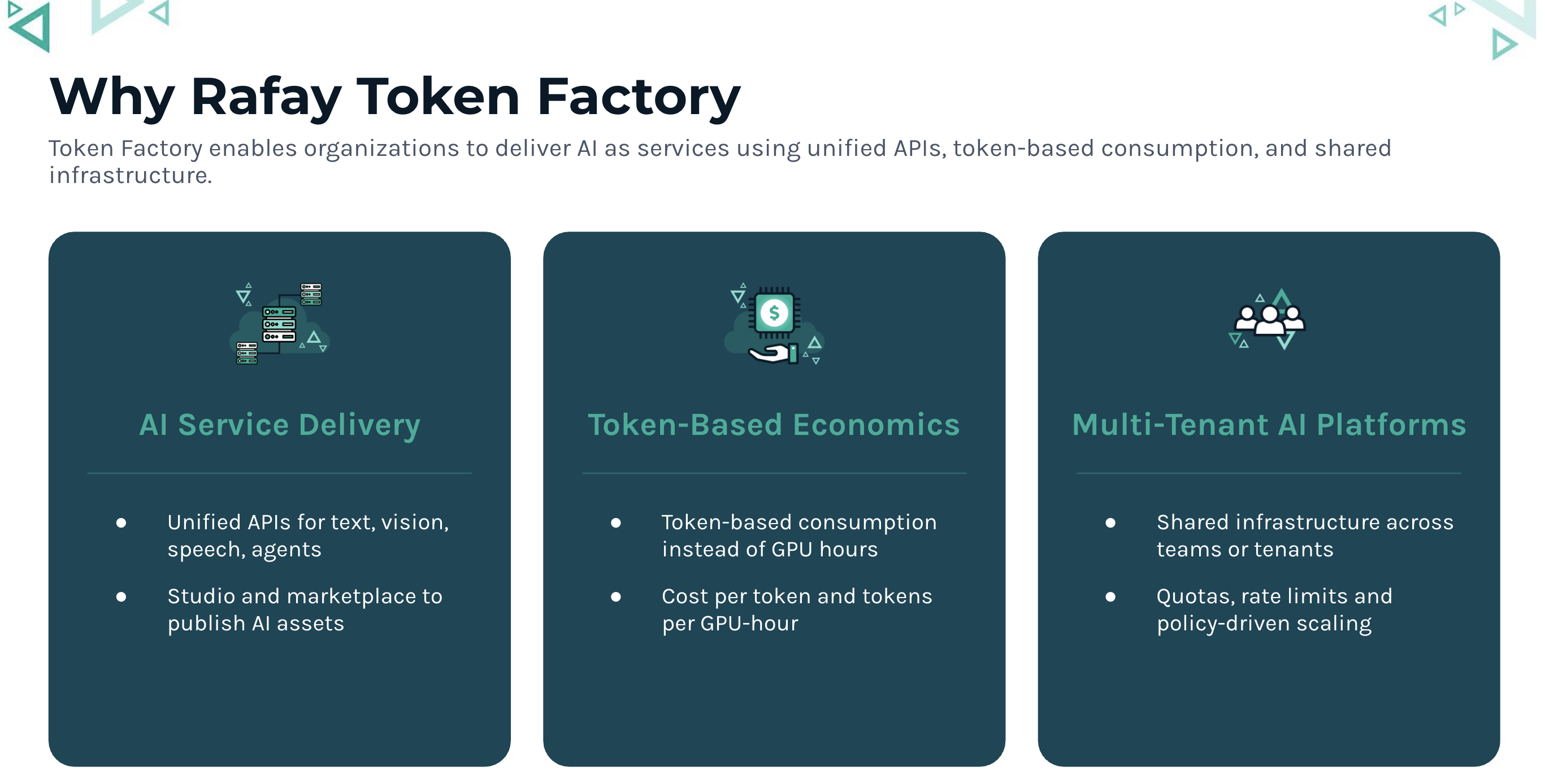
Running a model is only one part of delivering AI as a dependable service. Enterprises and providers also need consistent APIs, governed access, tenant isolation, usage controls, observability, and commercial metering. Token Factory brings those pieces together in three layers.
First, it provides AI service delivery through unified APIs for text, vision, speech, and agents, along with tools for publishing models and AI assets. Second, it introduces token-based economics, allowing operators to measure cost per token and tokens produced per GPU-hour. Third, it supports shared, multi-tenant infrastructure with quotas, rate limits, and policy-driven scaling.
For application teams, the experience can remain familiar: a single OpenAI-compatible inference endpoint provides access to multiple models. Behind that endpoint, the operator can deploy and replace models, route traffic, capture token-usage metrics, and send those metrics to a billing or chargeback platform. This separation makes the model portfolio easier to evolve without forcing every application to change its integration.
Two Routes to Market
The Rafay Platform supports two complementary business motions. The first is an Enterprise Token Factory for organizations with large frontier-model bills, high and predictable demand, or strict data-residency requirements. This is a direct cost-control and governance story: the enterprise turns AI infrastructure into a managed internal service.
The second is a Neocloud Token Factory for regional providers with GPU capacity to monetize. This is a revenue story: the provider moves beyond hourly GPU rental and sells metered inference to many downstream customers. The same core platform and enablement support both routes, but the value proposition changes with the buyer.
Why Rafay Token Factory
The gap most organizations run into is not the ability to run models. It is the ability to deliver AI as a scalable service. Most environments today can serve a model behind an endpoint, but they were never designed to publish that capability to many teams, meter what it costs, and hold it to a policy. Token Factory changes that operating model.
It does so along three axes. AI service delivery gives teams unified APIs for text, vision, speech, and agents, plus the tooling to publish models and other AI assets as governed products. Token-based economics lets customers consume in tokens rather than GPU hours, while operators track cost per token and tokens produced per GPU-hour, connecting infrastructure performance directly to business value. The multi-tenant platform allows infrastructure to be shared across teams or customers while preserving quotas, rate limits, and policy-driven scaling.
Together, these capabilities turn a collection of GPUs and models into a governed AI service, one that can be operated internally for the business or sold commercially to customers, with visibility into consumption and materially better resource utilization along the way.
Conclusion: Use the Right Model - and the Right Economic Model
The open model opportunity is not simply about replacing one model vendor with another. It is about creating a more deliberate operating model for enterprise AI. As applications become more agentic, token consumption will continue to grow. Organizations that route every task to a frontier model may find that declining unit prices offer little protection from rising total costs.
A hybrid portfolio provides another path. Keep frontier models where their capabilities justify the premium. Move suitable, high-volume workloads to open models. Decide whether to own infrastructure or purchase tokens based on utilization, control, and residency needs. Most importantly, measure the economics at the level of the business outcome.
For enterprises, that approach can unlock meaningful savings without slowing AI adoption. For infrastructure providers, it can turn GPU capacity into a differentiated, token-based service. Rafay Token Factory connects those two sides of the opportunity by providing the APIs, governance, multi-tenancy, metering, and operational controls needed to deliver AI as a service.
The organizations that benefit most will not necessarily be those with the largest model or the biggest GPU fleet. They will be the ones that become best at matching each workload to the right model, the right infrastructure, and the right economic model.
Compute Is the New Revenue: What I Heard at the AI Infra Summit
At the AI Infrastructure Summit, leaders from NVIDIA and Rafay discussed the financial shift in AI buildouts. Explore the four tiers of AI infrastructure monetization and discover why scaling up the value chain efficiently is critical for operators.
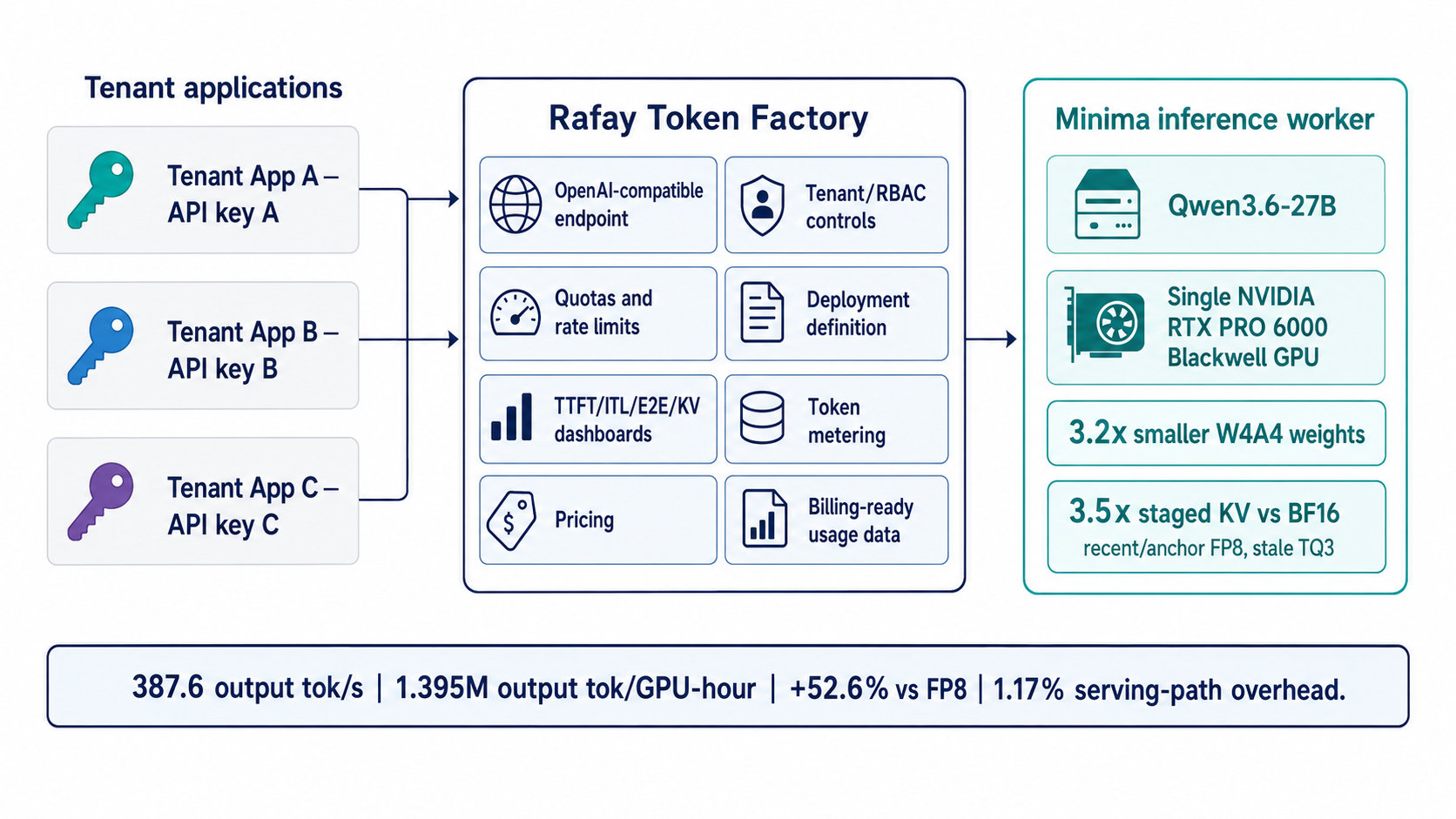
52.6% More Tokens, 1.53× Less GPU Time: Production Inference with Minima and Rafay
A single NVIDIA Blackwell GPU, an optimized Qwen3.6-27B worker from Minima, and Rafay Token Factory around it. The result was a governed, multi-tenant, token-metered service that delivered 52.6% more output than a strong FP8 baseline, with usage records reconciled at 99.97% for billing