Rafay has joined Lenovo AI Innovators, Lenovo’s ecosystem of AI software providers, enterprise AI platforms and industry solutions. Together, Rafay and Lenovo will bring the Rafay Platform to organizations deploying Lenovo AI infrastructure, and the two companies have started joint sales alignment across the Americas, EMEA and APAC. Read the full announcement.
The timing lines up with a message Lenovo brought to our AI Infrastructure Leadership Summit in Barcelona last month. Noam Rosen, who leads Enterprise AI for Lenovo in Europe and the Middle East, opened his talk by arguing that the industry is measuring the wrong thing.
From tokens consumed to outcomes delivered
“The next question is not how many tokens we are consuming, but what business outcome we are creating, at what cost, control and trust level.” Noam Rosen, Director of Enterprise AI for Europe & META, Lenovo
Noam called this the shift from “tokenmaxing” to “outcomemaxing.” A simple chat exchange uses roughly 900 tokens. An agent working toward a goal reads, retrieves, reasons, calls tools, checks its work and repeats, and a single task can run from tens of thousands of tokens to millions.
“Cheaper inference does not reduce demand. It expands the market significantly.” Noam Rosen, Lenovo
For anyone operating GPU infrastructure, that has a practical consequence. Demand is growing faster than hardware efficiency, and every GPU hour now has to be tied to a workload, a tenant and a cost. The differentiator is now the ability to allocate, govern and charge for that capacity.
Hybrid AI is the operating reality
Lenovo’s view is that most enterprises will not run AI in one place. Some workloads will call frontier commercial models. Many will move to open-weight models running on private infrastructure. Some will run on PCs and edge devices. Private AI itself lands in three places: on-premises, in hosted private AI environments, and on capacity rented from neoclouds.
“Hybrid AI is not just an architecture choice. It’s an operating reality for most enterprises today.” Noam Rosen, Lenovo
Lenovo supplies infrastructure to all three of those environments, from a single system to a full AI factory. What sits on top of that infrastructure decides whether it becomes a usable service.
Why the control plane matters
Noam named that layer directly:
“The winning layer in this hybrid world is the AI control plane: a control plane that would enable you to submit a task to the place it needs to run.” Noam Rosen, Lenovo
That is the problem Rafay works on. Neoclouds, sovereign AI clouds, telcos and enterprises all face the same gap between installing GPUs and delivering a service their developers or customers can use. Closing it takes capabilities most teams would otherwise build themselves:
- Multi-tenancy and isolation so many teams or customers can share the same infrastructure safely
- Quotas and governance that keep GPU allocation tied to policy and budget
- Self-service portals for developers and end customers
- Usage metering and billing down to the GPU hour or the token
- GPU and Kubernetes lifecycle management across bare metal, virtual machines and clusters
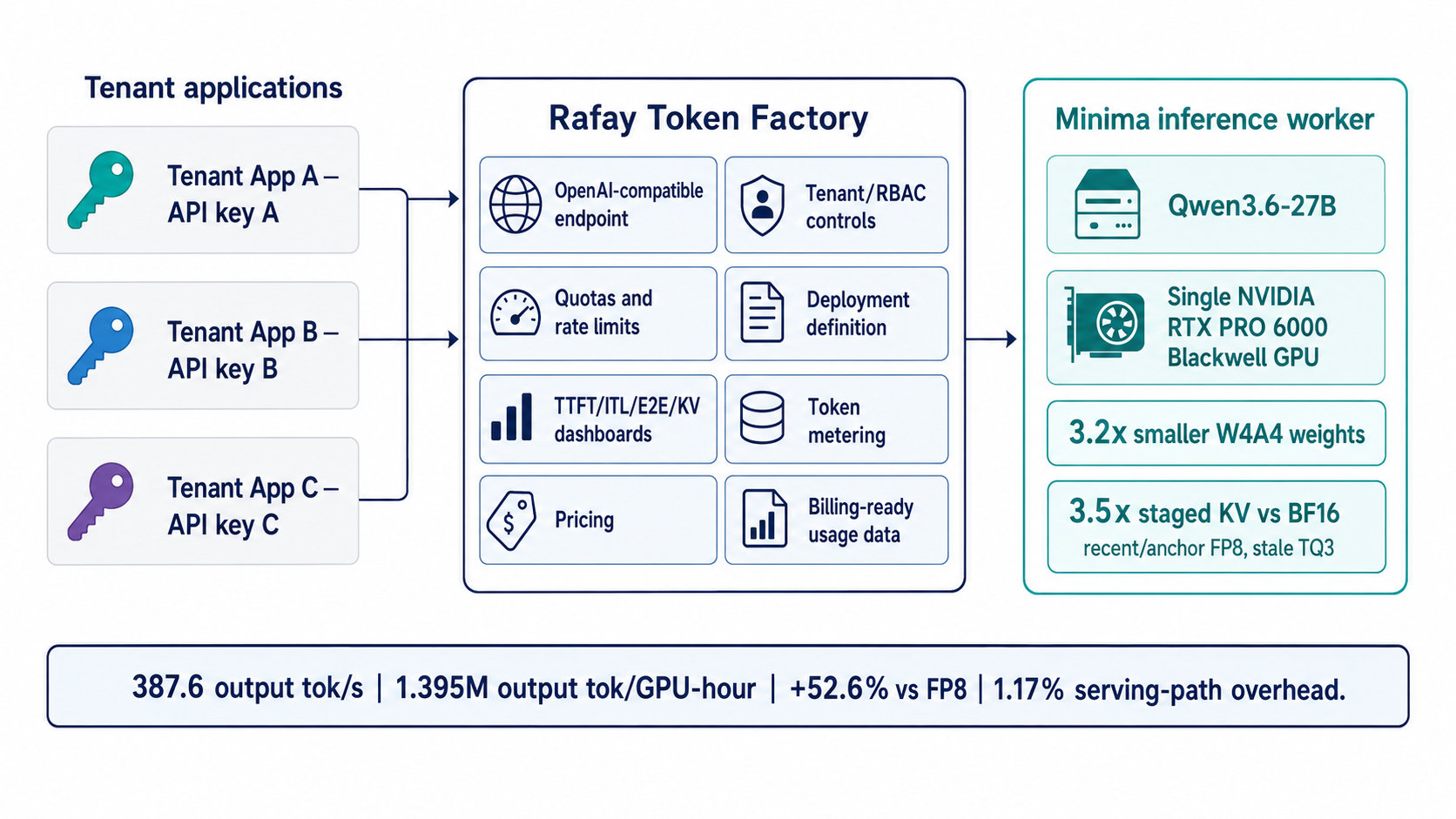
- Rafay Token Factory, which publishes models as token-metered inference APIs
Metering matters most for the outcome-driven model Noam described. In Rafay’s published testing on live Token Factory endpoints, token-metered serving earned roughly 2x to 4.8x the annual revenue per GPU of hourly rental at competitive open-model prices.
Sovereignty means control
Sovereignty came up throughout the summit, and Noam offered a useful definition.
“For me, sovereignty is really about agency: the capacity to decide and act for yourself, and with this, shape your outcomes.” Noam Rosen, Lenovo
Countries want control over energy, compute and data. Companies want control over their IP and platform dependencies. Both need infrastructure they can operate on their own terms. The Rafay Platform already powers TELUS AI Studio, Canada’s first sovereign, developer-ready AI platform, and the same model applies to sovereign and private AI deployments on Lenovo infrastructure.
What the partnership means for customers
Through Lenovo AI Innovators, Rafay and Lenovo will:
- Co-develop validated solutions and reference architectures on Lenovo platforms
- Test performance and interoperability in Lenovo AI test and validation labs
- Run joint sales motions, marketing campaigns and customer events across the Americas, EMEA and APAC
[If confirmed: The first joint validated design, covering X, is expected in QX 2026.] Lenovo reaches customers through channel partners in more than 180 markets, which gives Rafay a direct path to organizations already standardizing on Lenovo AI infrastructure.
Noam closed his Barcelona talk with the goal both companies share:
“The answer is not one model, not one cloud, not one architecture. The answer is hybrid AI, and we will help you and our customers build that platform: something that will be local, sovereign, secure, and yours.” Noam Rosen, Lenovo
Rafay provides the control plane for that platform. To see how the Rafay Platform runs on Lenovo AI infrastructure, talk to our team or reach out to your Lenovo account team.