From workload scheduling and inference to GPU fleet health, the Rafay Platform integrates with NVIDIA DSX™ OS across the layers operators run every day.
AI factories are becoming an industry with a shared blueprint. NVIDIA DSX brings together reference designs, APIs, software libraries, and technologies to design, simulate, build, and operate them, and DSX OS is its software core: open-source, modular components for running multi-tenant AI infrastructure. For the first time, neoclouds, sovereign AI clouds, and enterprises building their own capacity are working from the same reference stack.
A blueprint defines the parts. Operators still have to sell the outcome. Between the NVIDIA reference stack and a customer paying for GPU hours, models, or tokens sits a layer the blueprint leaves open. That layer turns components into products, tenants into accounts, and capacity into revenue. The Rafay Platform is built to be that layer.
Why integration depth matters
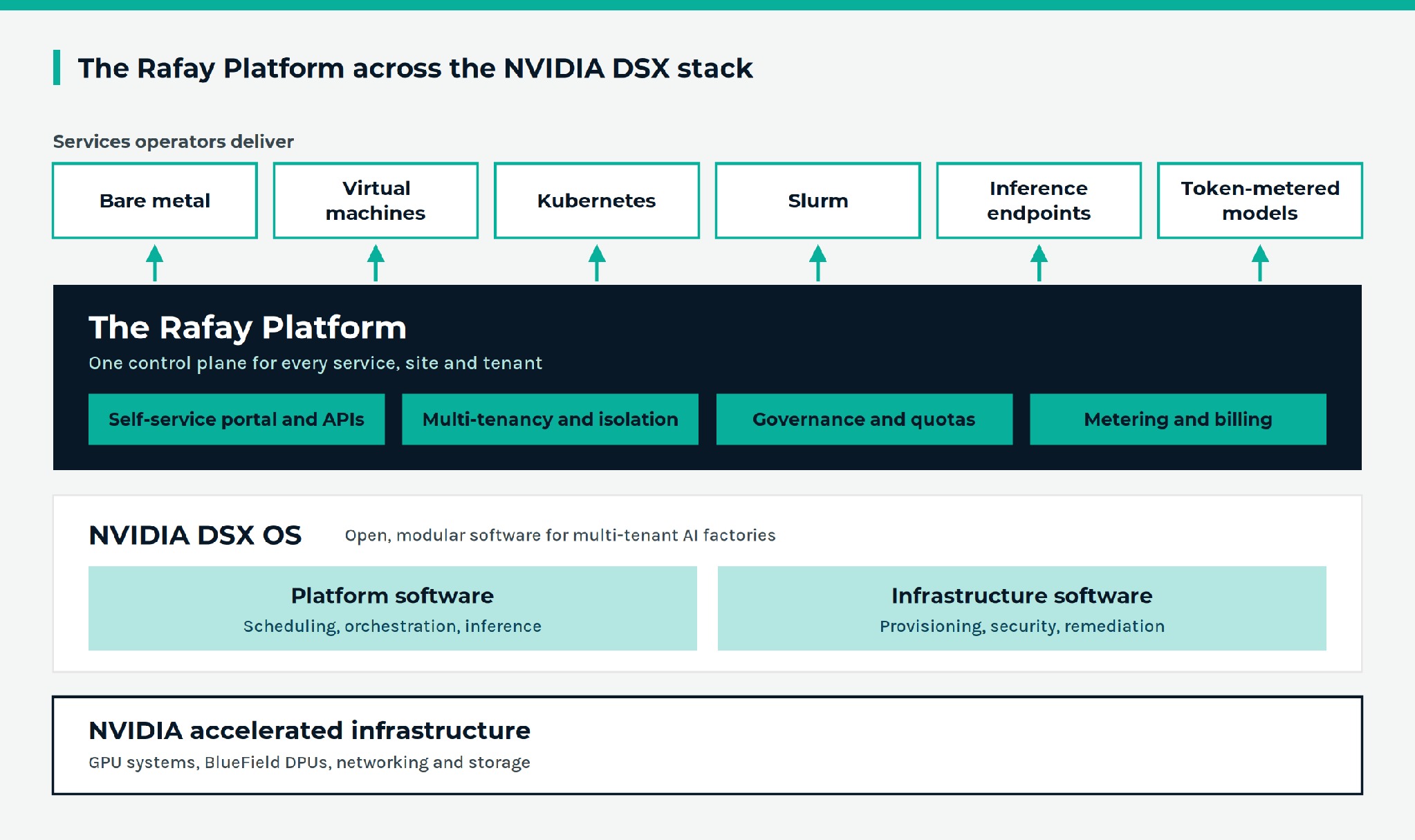
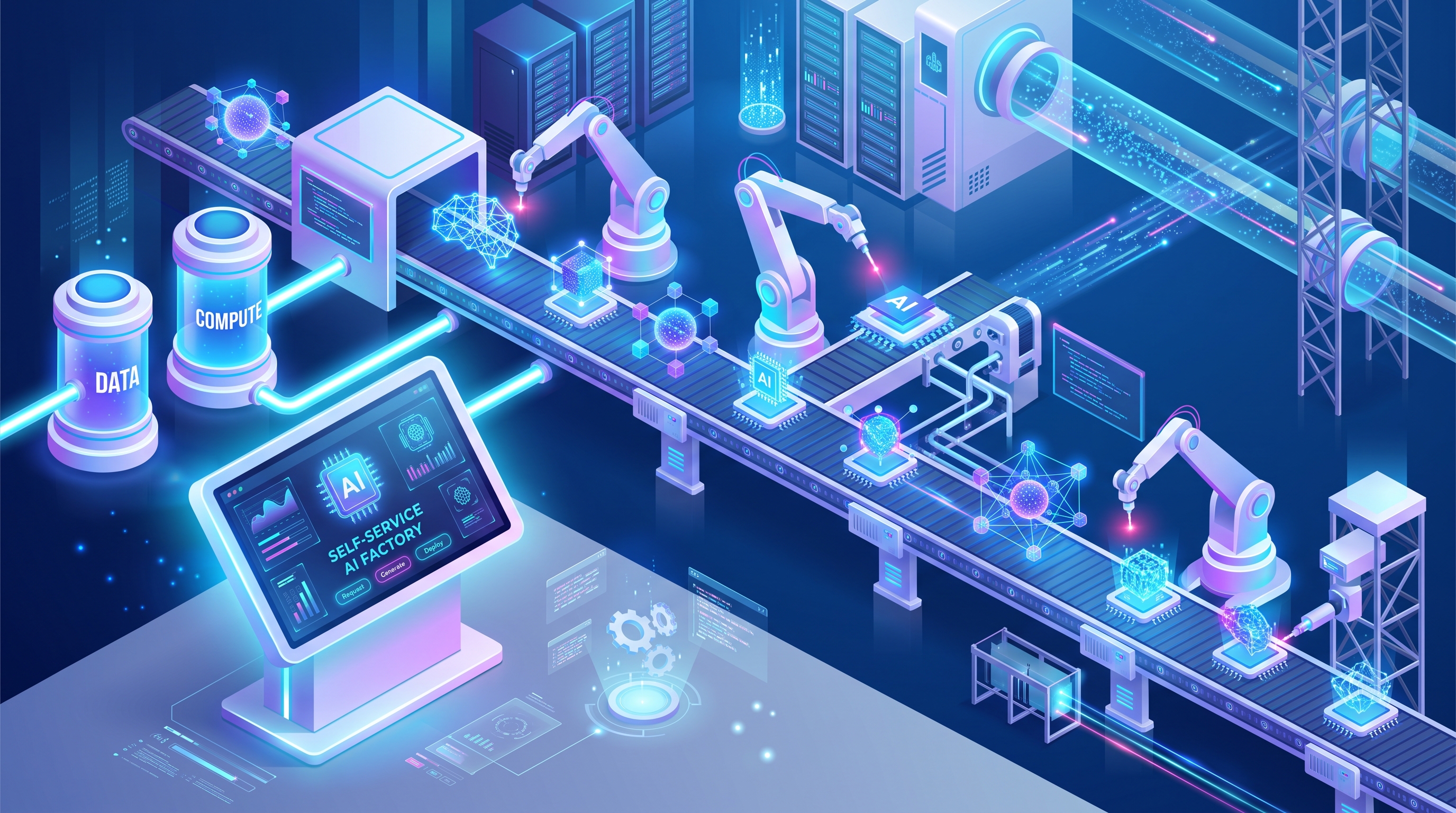
The Rafay Platform turns an NVIDIA AI factory into a set of services that customers consume on their own terms. Bare metal, virtual machines, Kubernetes, Slurm, inference endpoints, and token-metered models are delivered under the operator's own brand, through self-service portals and published APIs. Every service runs on one control plane, with multi-tenancy, quotas, governance, and metering built in from day one.
The Rafay Platform sits between NVIDIA DSX OS and the services an operator delivers, adding self-service, multi-tenancy, governance and metering to every layer.
In practice, the operator decides what to offer and the platform handles how it is delivered, isolated, governed, and billed.
Where Rafay integrates across DSX OS
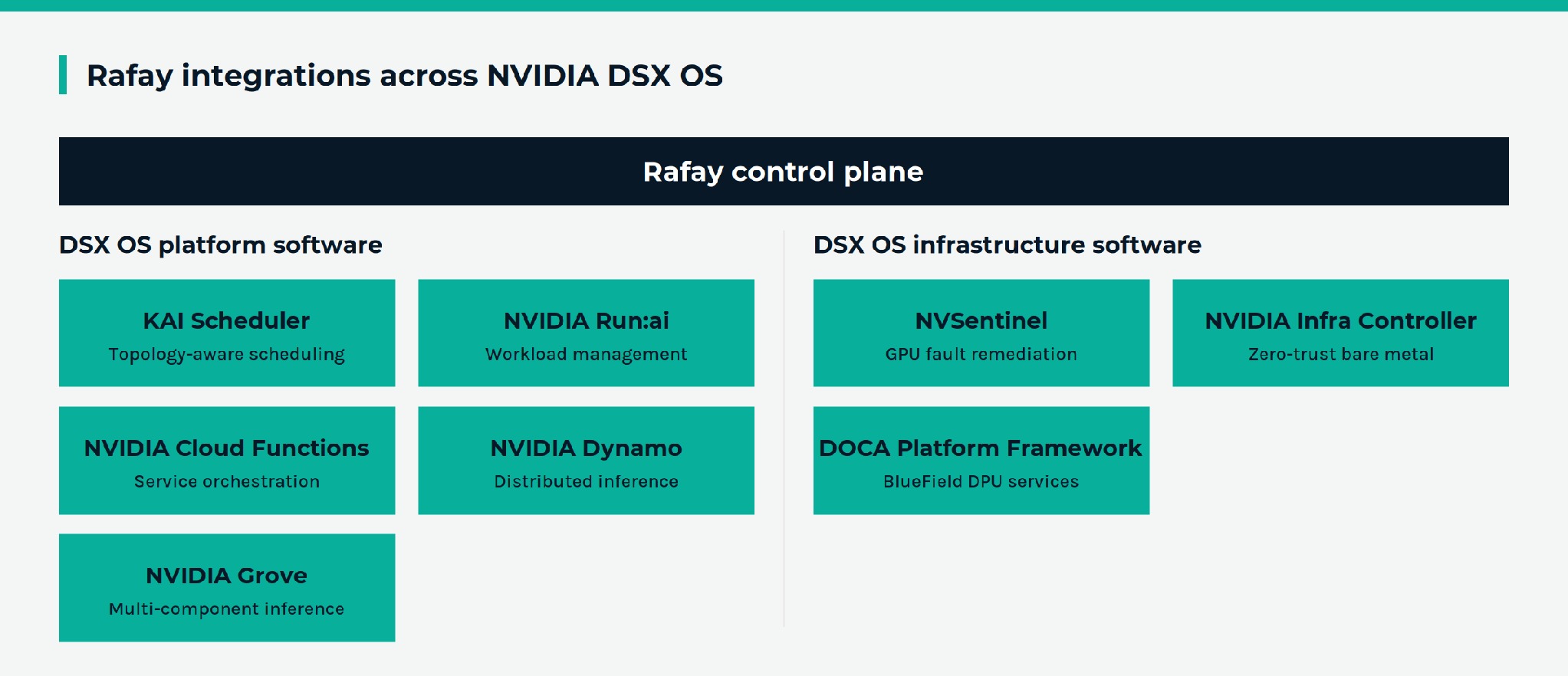
The Rafay Platform spans DSX OS from the workload layer down to the metal. It integrates with NVIDIA Run:ai, KAI Scheduler, Dynamo, Grove, and NVIDIA Cloud Functions, covering every Platform Software category: scheduling, workload management, service orchestration, and optimized inference. NVSentinel keeps GPU fleets healthy with automated fault detection and remediation.
The Rafay Platform also integrates with the NVIDIA Infra Controller (NICo) and the NVIDIA DOCA™ Platform Framework. The NVIDIA BlueField™ DPU becomes the isolation boundary, hosts are attested and securely wiped between tenants, and tenant networking runs without per-tenant switch configuration. Zero-trust bare metal becomes a SKU the operator can offer.
Rafay integrations across DSX OS platform and infrastructure software.
Every one of these integrations arrives already wired into billing, identity, and tenancy, so operators get NVIDIA's reference behavior without writing the glue code. Rafay co-engineers with NVIDIA and aligns its releases to the DSX OS roadmap, so new capability reaches operators without re-integrating their platform.
Metering and billing, built in
Operators can deliver token-metered access to models hosted as NVIDIA NIM™ microservices, alongside NVIDIA NeMo™ libraries, AI Blueprints, and a full range of compute services. Per-tenant metering and chargeback run across every service, so the platform that provisions capacity is also the platform that bills for it. Operators price and package each service as they choose, from GPU hours to tokens.
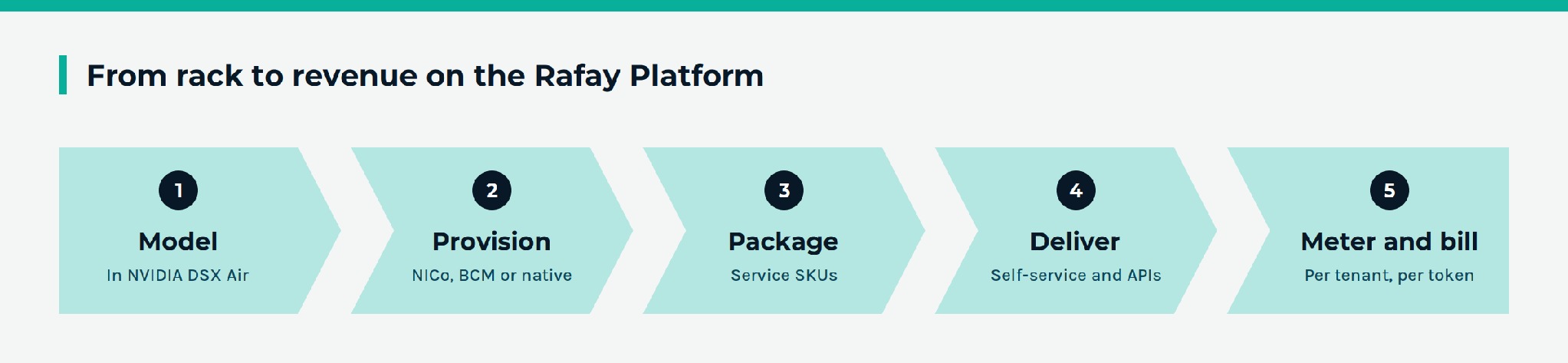
From rack to revenue: model the design, provision the hardware, package it as SKUs, deliver it through self-service, and meter every tenant.
Integrated with every NVIDIA provisioning path
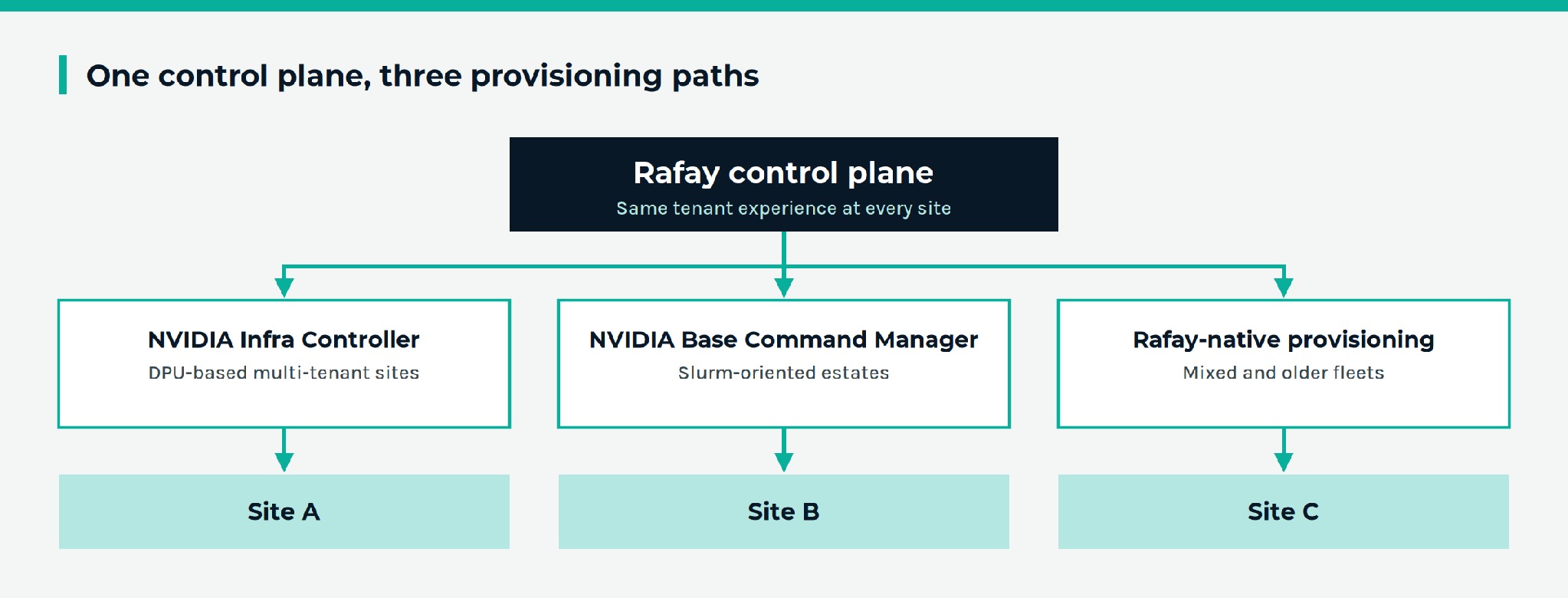
AI factories rarely run on a single hardware generation or provisioning model. The Rafay Platform supports NICo for DPU-based multi-tenant sites, NVIDIA Base Command™ Manager for Slurm-oriented estates, and Rafay-native provisioning for mixed fleets. Operators choose the right path per site, and tenants see the same experience everywhere. The platform does not require a single Kubernetes distribution or vendor stack underneath.
One control plane, three provisioning paths. Operators pick the path that fits each site without changing how they operate.
What deep integration means for each operator
Deep integration pays off differently depending on who runs the AI factory.
Neoclouds
Neoclouds compete on how quickly they turn new NVIDIA capacity into services customers will pay for, and on what they can offer beyond raw GPU hours. Because the Rafay Platform integrates with NVIDIA's own scheduling and inference components, a neocloud can offer managed Kubernetes, GPU-backed inference endpoints, and token-metered models from the first day a site comes online, without building and maintaining that integration work in-house.
The integration also keeps pace with NVIDIA. As NVIDIA DSX OS adds components and hardware generations, Rafay aligns its releases to the DSX OS roadmap, so the service catalog grows without re-platforming. Zero-trust bare metal is part of that catalog, giving neoclouds a secure bare-metal offering for their most demanding customers.
Sovereign AI clouds
Sovereign AI clouds run national infrastructure for government agencies, regulated industries, and local model builders. They need NVIDIA-aligned capability, and they need control over where workloads run, who can reach them, and how every action is recorded. Rafay's integrations run on the operator's own sites, and governance, quotas, and audit logging apply to every integrated service through one control plane. Because NVIDIA DSX OS components are open source, the operator keeps control of the stack it runs.
Isolation matters most here. NVSentinel keeps shared GPU fleets healthy, and the NICo and DOCA integration makes the BlueField DPU the boundary between tenants, with hosts attested and securely wiped before reuse. A sovereign operator serving several ministries or regulated customers on shared infrastructure gets isolation it can demonstrate to auditors.
Enterprises
Enterprises building private AI infrastructure face a different challenge: many internal teams competing for a limited pool of GPUs. Rafay's integration with NVIDIA Run:ai and KAI Scheduler brings topology-aware scheduling and workload management to that shared pool, and self-service access lets data science and application teams get GPU environments without waiting on tickets.
Rafay's metering becomes internal chargeback, so platform and finance teams can see which teams use which GPUs and hold them to quotas. Integration with NVIDIA Dynamo, Grove, and NVIDIA NIM lets enterprises move from experimentation to production inference on the same governed platform, across on-premises sites and public cloud Kubernetes.
One platform across the NVIDIA DSX stack
NVIDIA has defined what an AI factory is made of. The Rafay Platform turns that definition into a running business: self-service, multi-tenant, governed, and metered across every service it delivers. For operators building on NVIDIA, it means less time integrating infrastructure and more time delivering what it can do.
Talk to Rafay about running your AI factory on the Rafay Platform
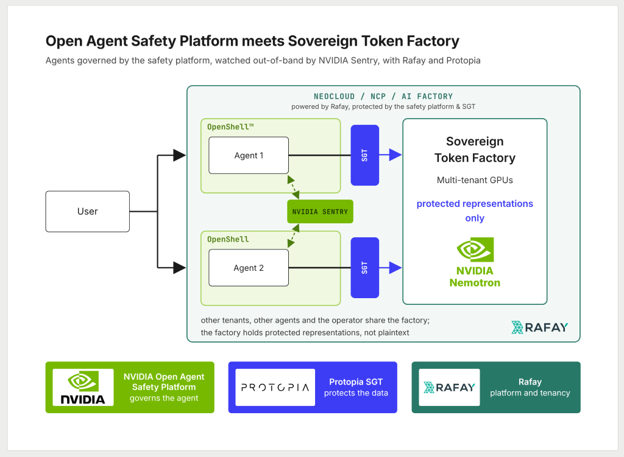
Governed Agents, Protected Tokens: Open Agent Safety Platform Meets the Sovereign Token Factory
Hosted AI agents raise two security questions: what the agent can do, and what the platform sees of its data. NVIDIA OpenShell, Protopia AI, and Rafay together let NeoClouds and sovereign AI providers sell governed Agent-as-a-Service and protected Tokens-as-a-Service on shared GPUs.
Rafay Joins Lenovo AI Innovators: Bringing the AI Control Plane to Hybrid AI
Rafay has joined Lenovo AI Innovators. Here's why the AI control plane matters for hybrid AI, with context from Lenovo's Noam Rosen at our Barcelona summit.
Rafay Delivers Governed, Self-Service Open-Source NVIDIA Run:ai for NVIDIA DSX AI Factories
Rafay is a launch partner for the open-source release of NVIDIA Run:ai, delivering it as a governed, self-service SKU that operators can publish in their service catalogs.