AI Infrastructure Is Entering Day 3


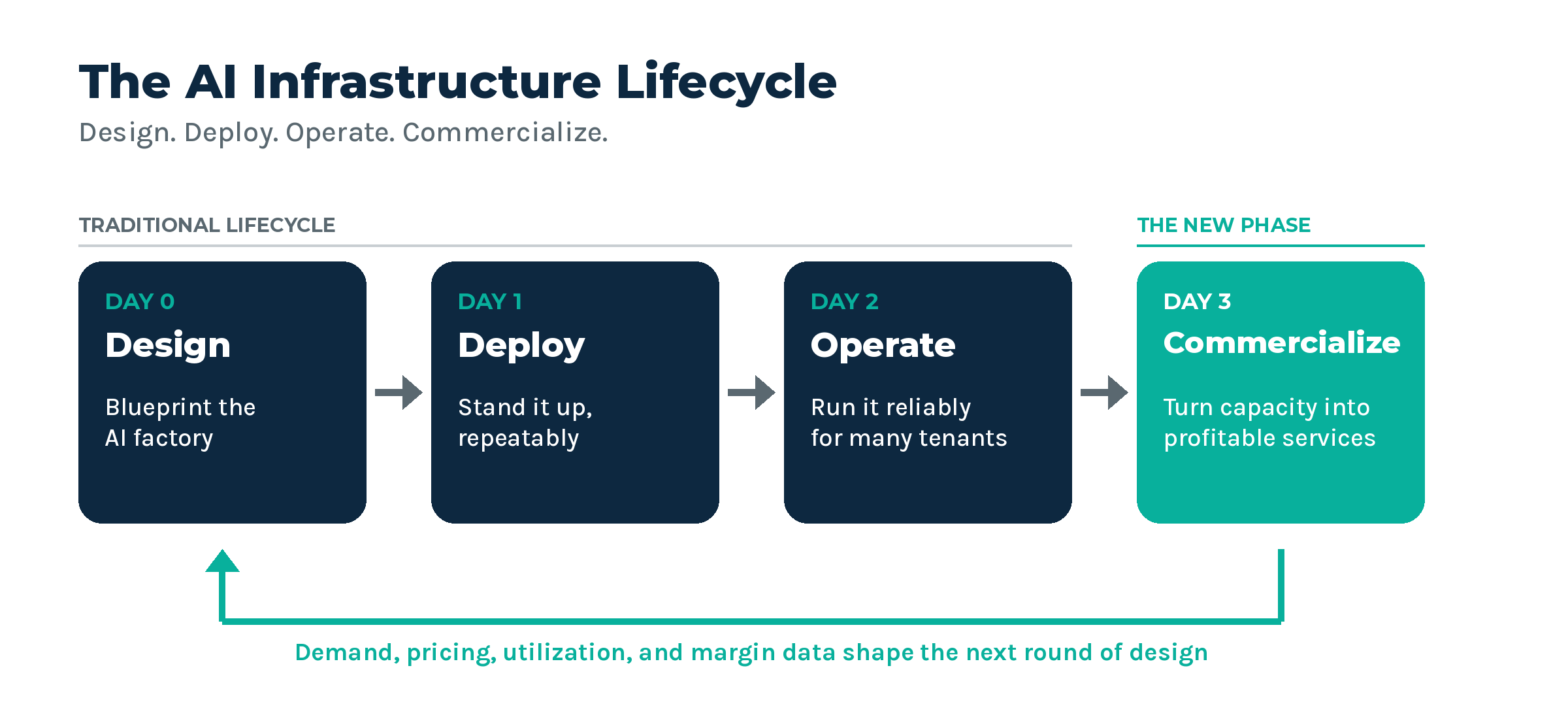
For years, infrastructure teams have relied on a familiar three-part lifecycle:
- Day 0: Design
- Day 1: Deploy
- Day 2: Operate
This model has served the industry well. It offers a simple way to think about how infrastructure moves from planning to production and into ongoing management.
AI infrastructure is forcing the industry to add a fourth phase. Day 3 is the point at which infrastructure becomes a product: GPU capacity is packaged into services, usage becomes measurable, customers get predictable experiences, and compute starts producing revenue.
For AI infrastructure providers, neoclouds, telcos, and sovereign AI operators, this is not a minor extension of the lifecycle. It is the difference between owning expensive infrastructure and running a sustainable AI business.
I call this the AI Infrastructure Lifecycle: Design. Deploy. Operate. Commercialize.
The old lifecycle ends at operations
Traditional infrastructure conversations focus on whether an environment can be designed correctly, deployed successfully, and operated reliably. That is still necessary. In the AI infrastructure market, it is no longer sufficient.
The economics are different. AI infrastructure demands enormous investment in GPUs, networking, power, cooling, storage, and facilities, and operators must tie that investment to real customer demand and measurable returns. The central question is no longer "Can we run the infrastructure?" It is "Can we turn the infrastructure into a reliable, repeatable, profitable service?"
At the AI Infrastructure Leadership Summit in Barcelona, that question came up again and again. Operators weren't only discussing how to build bigger GPU clusters. They were talking about utilization, margins, service models, token economics, inference, customer experience, and the operational complexity of serving many tenants at scale.
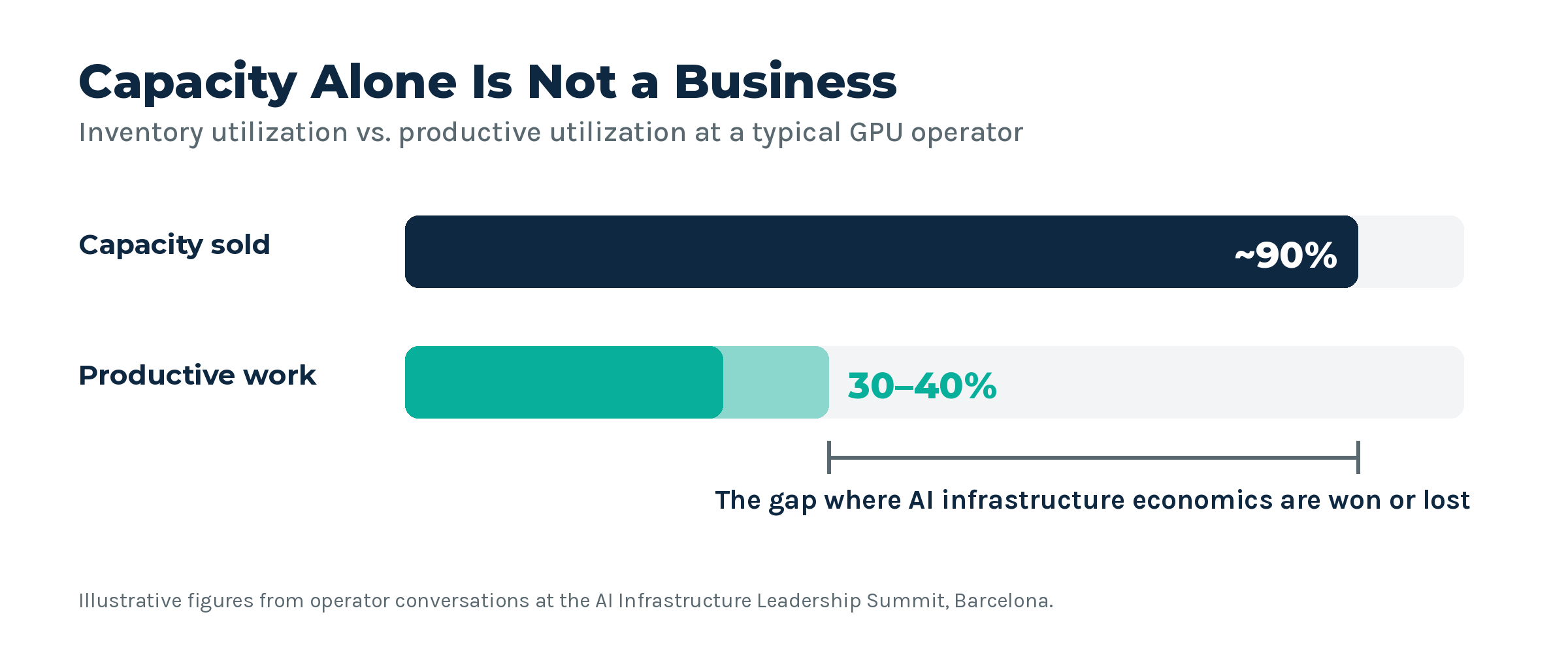
One insight stood out: capacity alone is not a business.
An operator can sell most of its GPU inventory and still struggle to earn acceptable returns if too much of that capacity is idle, poorly utilized, hard to manage, or expensive to run. Several operators described a wide gap between inventory utilization and productive utilization: as much as 90% of GPU capacity sold, but only 30–40% of the fleet doing productive work. That gap is where the economics of an AI infrastructure business are won or lost. Every idle hour is margin that never comes back, which is why bare metal alone isn't a business model.
Day 0: Design
Day 0 begins before the first server arrives. For AI infrastructure, design goes well beyond choosing servers and GPUs. It covers the architecture of the entire AI factory.
The network deserves special attention. At AI-factory scale, network architecture isn't an implementation detail to sort out after the hardware arrives. It determines whether the hardware can function as a coherent system. Connectivity, fiber routes, switching, DPU configuration, and network segmentation all need to be settled before deployment begins.
Day 0 should also account for the services the infrastructure will eventually deliver. An environment designed only to host raw GPUs can be hard to evolve into a platform for training, inference, virtual machines, Kubernetes, Slurm, or token-based services.
Simulate the AI factory before you build it
Digital twins are making Day 0 far less of a leap of faith. NVIDIA now offers two complementary tools for this:
The challenge is making these twins usable by more than a few specialists. Rafay packages the Omniverse DSX Blueprint as a one-click, self-service digital twin, with governed GPU access, multi-tenancy, and automated sessions, so design, facilities, and operations teams can each launch their own environment on demand. With DSX Air, operators can go a step further and exercise the service layer itself, including tenant isolation, self-service provisioning, and governance controls, before a single GPU is racked. That pulls Day 3 thinking into Day 0.
The output of Day 0 is more than a technical diagram. It is an executable blueprint that connects physical infrastructure, software architecture, operational requirements, and future commercial services. The GPU PaaS Reference Architecture that Rafay published with NVIDIA is one example of what that blueprint looks like in practice.
Day 0 failure mode: The hardware arrives, but the environment isn't ready to deliver usable capacity.
Day 1: Deploy
Day 1 is the transition from architecture to working infrastructure. Operators rack and integrate hardware, connect and configure the network fabric, install firmware and operating systems, provision GPUs, and bring the environment online. Typical work includes:
- Rack integration and fiber cabling
- Bare-metal provisioning, firmware, and drivers
- DPU and switch configuration
- GPU software deployment
- Kubernetes, VM, or Slurm enablement
- Storage integration
- Identity and security configuration
- Cluster validation and testing
But Day 1 isn't just about installing equipment. A rack full of GPUs is not yet an AI service. It becomes useful only when customers or internal teams can access compute, deploy workloads, connect to networks, store data, and get predictable performance.
What often separates successful operators from struggling ones is repeatability. If every deployment requires custom engineering and manual intervention, the business can't scale efficiently. The goal of Day 1 is a deployment pattern that can be repeated across sites, regions, and customers.
This is where automation pays off. Rafay works with NVIDIA tooling at each step: NVIDIA NCX Infra Controller (NICo) for bare-metal bring-up, NVIDIA AICR-generated cluster configurations that Rafay operates at scale, and the NVIDIA Cluster Readiness Engine to certify tenant GPU Kubernetes clusters before they're handed over. Telcos have used the same approach to turn existing GPU capacity into a revenue-generating AI factory in as little as 12 weeks.
Day 1 failure mode: The snowflake environment. Every cluster is unique, every deployment is a project, and every expansion depends on a handful of experts who understand how the original system was assembled.
Day 2: Operate
Day 2 is where infrastructure becomes a service that must be managed continuously. That includes:
- Observability and health monitoring
- GPU and network performance
- Capacity and utilization management
- Multi-tenancy and workload isolation
- Security and access control
- Firmware and software updates
- Incident response, fault detection, and remediation
- SLA management
- Hardware lifecycle management
AI makes Day 2 far more complex because the failure surface is much larger. Operators must monitor not only servers and applications, but also GPUs, switches, cables, transceivers, DPUs, storage, fabrics, schedulers, and tenant workloads.
At scale, something is always degraded or close to failing. A cable is throwing errors. A GPU is overheating. A switch is dropping packets. A workload is underperforming because of a network bottleneck. The question isn't whether failures will happen. It's whether the operator can detect, isolate, explain, and fix them quickly. Tools such as NVIDIA NVSentinel running on the Rafay Platform automate GPU health monitoring so problems are caught before tenants notice.
Day 2 maturity means being able to answer questions like these:
This is where observability connects to economics. Monitoring isn't only about keeping systems online. It's about understanding utilization, performance, customer impact, and margin. Capabilities such as self-service fractional GPUs help close the gap between capacity sold and productive work by letting smaller workloads share a GPU instead of stranding it.
Day 2 failure mode: Plenty of deployed capacity that is expensive to operate, hard to troubleshoot, and unreliable for customers.
Day 3: Commercialize
Day 3 is the missing phase in the traditional lifecycle. It's where infrastructure becomes a portfolio of services that customers can understand, consume, and pay for.
Customers don't want to buy a complicated collection of GPUs, switches, DPUs, drivers, and cluster-management tools. They want a service: a GPU instance, a training environment, a notebook, a Kubernetes cluster, a Slurm environment, an inference endpoint or model-serving API, a token-based consumption plan, or reserved capacity with a defined SLA.
Delivering those services takes a commercial layer on top of the platform:
Day 3 is where abstraction becomes commercial value. The platform must hide complexity behind simple interfaces while keeping the control, governance, isolation, and measurement required underneath.
This is the layer Rafay focuses on. Operators can publish governed, self-service catalog items, such as NVIDIA Run:ai, NVIDIA RAG Blueprints, or fine-tuning as a service, and connect consumption to revenue through usage metering and billing. For inference, Rafay Token Factory lets operators sell token-metered model endpoints instead of GPU hours. Rafay's analysis of production data, in Economics of the Rafay Token Factory, shows that shift can raise annual revenue per GPU by 2x to 4.8x.
What Day 3 looks like depends on the operator:
The label changes, but the requirement doesn't: infrastructure must become consumable, measurable, and economically accountable.
Day 3 failure mode: Renting raw capacity without understanding the business behind it.
Day 3 depends on the first three days
Commercialization can't be bolted on at the end with a billing system. It depends on decisions made throughout the lifecycle:
- If the infrastructure wasn't designed for multi-tenancy, isolating customers will be difficult.
- If operations can't provide reliable usage and health data, metering and SLA management will suffer.
- If the platform lacks abstraction, customers will be exposed to infrastructure complexity instead of receiving a simple service.
That's why the lifecycle works better as a loop than a straight line. Demand, pricing, utilization, and margin data from Day 3 should feed the next round of Day 0 design. The services customers actually buy should shape future capacity plans, and the workloads that generate the best returns should influence the mix of GPUs, networking, storage, and software.
The business informs the architecture, and the architecture determines the business.
From metal to token to revenue
The AI infrastructure market is moving up the stack. The first phase was about acquiring hardware. The next was about bringing it online. Today's challenge is operating it reliably across many customers, workloads, locations, and service types. The next competitive frontier is turning that infrastructure into a portfolio of profitable AI services.
Put simply: power becomes compute, compute becomes services, services become tokens, and tokens become revenue. As enterprises shift high-volume workloads to open models, that token layer is quickly becoming the main way AI capacity is bought and sold.
Here is where the Rafay Platform fits across the lifecycle:

The winners won't necessarily be the companies that install the most GPUs. They'll be the ones that can design, deploy, operate, and commercialize those GPUs as a repeatable AI business.
Day 3 is where AI infrastructure stops being only an engineering achievement and becomes a business model. That's why the AI Infrastructure Lifecycle shouldn't end with operations. It should end with commercialization.
Design. Deploy. Operate. Commercialize.
Want to go deeper? Read From GPUs to Revenue: A Practical Guide to AI Factory Builds.